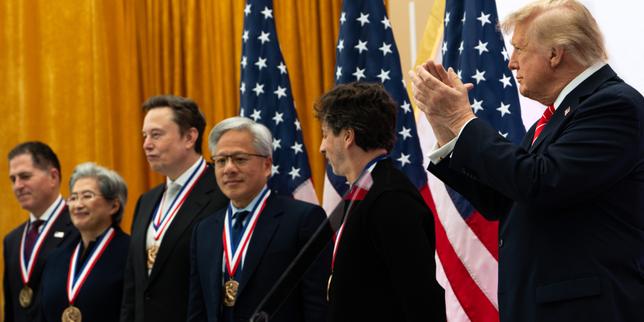
You can love him or hate him, but you can't ignore what just happened in Washington. Donald Trump handing Elon Musk the National Medal of Science isn't just another photo op. It’s a massive signal about where power actually lies at the intersection of government and private engineering.
During the White House ceremony at the "A New Golden Age" summit, Trump didn't just hand over the country's highest scientific honor. He called Musk a modern-day Thomas Edison and praised SpaceX and Tesla for pushing engineering to scales most people thought were impossible. Let's break down why this specific award matters, who else got hardware, and why this moment represents a total shift in how America views tech titans.
Beyond the Politics: The Engineering Reality
People love to reduce everything to political theater. They see a billionaire getting a medal and assume it's pure cronyism. But if you look past the headlines, the actual justification for the National Medal of Science comes down to hard metrics.
SpaceX didn't accidentally figure out how to land orbital-class boosters vertically. They didn't stumble into building a global satellite internet network called Starlink that fundamentally changes how remote areas and warzones communicate. Musk received the medal specifically for engineering achievements of extraordinary ambition and scale.
When you look at the numbers, the scope becomes clear. We're talking about reusable rockets that have driven down the cost of payload delivery to orbit by orders of magnitude, forcing legacy aerospace and global competitors to scramble for catch-up. Whether you agree with Musk's public persona or his management style, the engineering output of SpaceX and Tesla over the past two decades is unprecedented in private enterprise.
Who Else Got the Nod
Musk wasn't the only heavy hitter in the room. The administration handed out top science and technology honors to a select group of tech leaders who are actively shaping the physical and digital infrastructure of the world.
The ceremony also recognized figures like Google co-founder Sergey Brin, Nvidia CEO Jensen Huang, and AMD CEO Lisa Su. Interestingly, five of the six tech leaders honored during the summit were born outside the United States. Musk himself grew up in South Africa before moving to Canada and eventually the U.S.
This group represents the engine room of modern compute and aerospace. Jensen Huang's chips are powering the entire global artificial intelligence boom, while Lisa Su's hardware keeps data centers humming. Grouping Musk with these semiconductor and software pioneers frames the award not just as a political gesture, but as an acknowledgment of industrial might.
The Bigger Picture on State and Tech Relations
We are living through a fundamental shift in how nations view technology leaders. Governments used to keep Silicon Valley at arm's length, relying on defense contractors like Lockheed Martin or Boeing for heavy innovation. Today, the cutting edge has shifted to commercial entities that move twice as fast and take ten times the risk.
Musk’s relationship with the White House has had its public ups and downs over the years. But this award cements a reality: the federal government relies heavily on private commercial space and communications infrastructure to maintain global leadership. When the Pentagon needs reliable heavy-lift launch capabilities or secure low-earth orbit communications, they turn to SpaceX.
Critics will argue that handing medals to billionaires creates an unhealthy cozy relationship between big tech and the state. Supporters will argue it's about time the country publicly honored the people actually building the physical future. Both arguments contain elements of truth. But the undeniable takeaway is that traditional boundaries between statecraft and tech monopolies are dissolving fast.
Keep an eye on how these public-private partnerships evolve over the next few years. As space commercialization accelerates and AI integration deepens, the line between government policy and private corporate ambition will blur even further.


