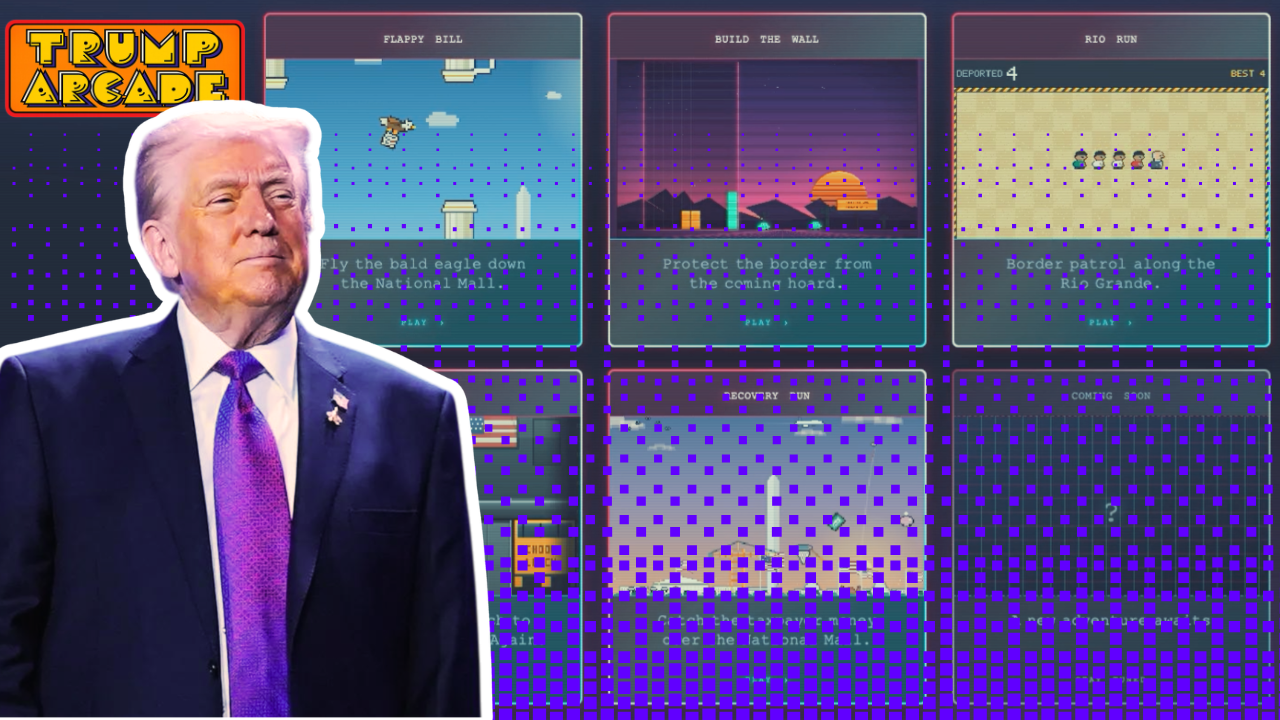
Governments have traditionally used dry press releases, policy papers, and formal televised addresses to pitch their agendas to the public. Donald Trump's administration just threw that playbook out the window. The White House launched an official online arcade featuring retro-style video games that let users build a border wall and manage deportations.
If you thought political stunts reached their peak on social media feeds, think again. The administration transformed hardline immigration policy into interactive entertainment, proving that digital messaging in Washington now prioritizes viral engagement over traditional discourse. For a different perspective, check out: this related article.
Inside the White House Arcade Website
The newly deployed website introduces five distinct mini-games modeled after vintage arcade classics. Each title targets a specific pillar of the administration's platform, packaging complex political objectives into quick digital loops.
The most controversial addition is Rio Run, a direct spin on the classic arcade game Snake. Players control a digital avatar representing US border enforcement—modeled after border czar Tom Homan—along the Rio Grande. The objective is to capture and deport individuals attempting to cross the border. Once caught, the characters change into orange jumpsuits and follow the player's trail. Related coverage on the subject has been shared by The New York Times.
Another immigration-focused title, Build the Wall, borrows its mechanics from Tetris. Users stack falling blocks to construct a physical barrier on the southern border while fending off what instructions describe as a "coming horde".
Beyond immigration enforcement, the arcade features three other policy-driven games:
- Flappy Bill: Players guide a bald eagle carrying legislation over the National Mall.
- Supply Line: A game tied to the "Make America Healthy Again" initiative where users sort school lunch items.
- Trump Savings Tycoon: Users collect cash and gold to fill investment accounts designed for newborns.
The administration promoted the launch on X with a teaser video stylized after retro video game maker Sega, accompanied by the rallying cry, "CAN'T STOP WINNING. Build the wall. Deport. Fill a Trump Account".
Why the White House Adopted a Gaming Strategy
Administration officials aren't hiding the intent behind the code. White House digital strategists describe the arcade as "policy you can interact with".
Traditional communication channels often fail to capture younger demographics or casual news consumers who scroll past long-form articles. By gamifying core political platforms, the White House bypasses traditional media filters entirely. Kaelan Dorr, head of digital strategy, spearheaded the project to make executive priorities digestible and shareable across social media.
A White House official defended the initiative bluntly, telling reporters that the arcade creates a sharp contrast between a "culture of fun and winning" and the opposition's political vision. It weaponizes pop culture nostalgia to embed policy talking points directly into viral culture.
The Immediate Backlash and Political Fallout
Unsurprisingly, the rollout ignited fierce opposition. Human rights organizations and border advocates condemned the platform, arguing that turning mass deportations and border enforcement into a game trivializes real-world human suffering.
Critics from borderland communities pointed out the stark disconnect between the digital arcade and the realities of immigration enforcement. Leaders from advocacy groups like the Frontera Federation noted that turning detention and expulsion into a high-score challenge dehumanizes migrants and minimizes the complexities of border security.
At the same time, political opponents questioned the timing and optics of the launch. Amid pressing national and international concerns—including rising inflation, energy costs, and foreign conflicts—lawmakers questioned why federal resources and digital strategy teams were allocated toward retro video games. Critics on social media pointed to high fuel prices and economic pressures, arguing that gamifying immigration policy serves as a deliberate distraction from domestic hardships.
The Shift in Modern Political Campaigning
This launch signals a permanent evolution in how political figures engage with the electorate. You no longer need to read a white paper or watch a cable news interview to understand a candidate's platform. You can play it on your phone during a lunch break.
Whether this digital stunt drives long-term political momentum or simply serves as another flashpoint in an already polarized media landscape remains to be seen. What's clear is that the boundary between entertainment, video games, and state-level political communication has effectively vanished.