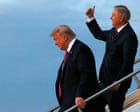
We've all been taught the basic rule of polite society: don't speak ill of the dead. When a long-serving politician passes away, their peers usually dust off the standard, sanitised playbook. They draft a solemn statement, sprinkle in some generic words about "public service" or "decency," and call it a day.
But Donald Trump doesn't do standard playbooks.
Following the sudden death of South Carolina Senator Lindsey Graham at age 71, Trump did what he always does. He turned a moment of national mourning into an impromptu therapy session about his own standing, his own golf game, and his own ultimate dominance.
If you want to understand how power, loyalty, and a hyper-sensitive ego function in the modern Republican party, you don't need to read political science papers. You just need to look at Trump's bizarre, backhanded public eulogies for the man who spent the last decade acting as his chief defender.
The Backhanded Eulogy as a Power Move
When a major political figure dies, the immediate response is usually a blanket of praise. Trump's initial post on Truth Social hit those notes, calling Graham "one of the greatest people and Senators I have ever known" and a "true American Patriot". But the discipline didn't last long.
During a subsequent Fox News interview, Trump’s tribute quickly devolved into a series of petty grievances and weirdly belittling put-downs.
First, he painted Graham as a needy nuisance who couldn't stop calling him.
"He would call me all the time," Trump told Fox News. "He would just, I'd say: 'Stop calling me, Lindsey'."
Then came the critique of Graham's work ethic, wrapped in a passive-aggressive swipe about whether politicians actually do any real work at all.
"He was a total workaholic politician," Trump added. "Now, some people don't call that work. Some people call that a lot of talking. But everybody loved him."
Finally, Trump couldn't even let the dead man have his golf game. Instead of remembering their frequent rounds together as a sign of friendship, Trump felt compelled to point out that Graham simply wasn't very good at the sport.
"It wasn't that he was a great striker of the ball," Trump mused. "He wasn't exactly a perfect – he wasn't Jack Nicklaus, he was not Tiger."
It’s easy to dismiss this as just "Trump being Trump." But there's a deeper, more calculated psychological mechanism at play here. For Trump, acknowledging someone else’s value without simultaneously lowering their status feels like a personal defeat. Even in death, Graham had to be kept in his place: a talkative, slightly annoying subordinate who wasn't very good at golf and desperately needed Trump's attention.
The Scorecard That Never Closes
To understand why Trump felt the need to chip away at Graham’s legacy, you have to look at the history. Trump’s memory is famously long and transactional. He doesn't forget a slight, and he certainly doesn't forget when someone tries to stand up to him.
Back in 2015, during the Republican presidential primaries, Graham was one of Trump's most vocal critics. He called Trump a "jackass," a "race-baiting, xenophobic, religious bigot," and "unfit for office". Trump responded by publicly reading Graham’s private cell phone number on national television, effectively destroying the senator's privacy and forcing him to get a new number.
Yet, once Trump won the presidency, Graham did a complete pivot. He became a golfing buddy, a fierce defender of Trump’s judicial nominees, and a reliable cheerleader.
But that complete submission wasn't enough to buy absolute forgiveness. Trump still brought up Graham’s brief, emotional rebellion on January 6, 2021, when Graham stood on the Senate floor and declared, "Count me out. Enough is enough".
In his Fox News tribute, Trump took the opportunity to gloat about how quickly Graham folded after that speech.
"He had one bad moment, that was the Jan 6 thing," Trump explained. "Then he called me about 40 minutes later and he said: 'Did I really say that? I can't believe it,' and he took it back. So I give him a 99 instead of a 100."
Think about the sheer pettiness of grading a dead ally's loyalty on a 100-point scale during their eulogy. It tells you everything you need to know about the power dynamics within the modern conservative movement. Loyalty is never a mutual pact; it’s a one-way street where even a single moment of independence leaves a permanent mark on your permanent record.
Why the GOP Accepts the Terms of Surrender
The real tragedy of Lindsey Graham's political legacy isn't just that he bent the knee; it's that he knew exactly what he was doing. Graham was a political survivor who understood that to stay relevant in South Carolina and the broader Republican party, he had to align himself with the man at the top.
Graham once famously told a reporter that he stayed close to Trump because he wanted to be "relevant" and have influence over foreign policy. He traded his personal dignity for a seat on the private jet and a say in judicial appointments.
But Trump’s barbed eulogy proves that this trade is ultimately a fool’s bargain. No matter how many times you defend the indefensible, no matter how many times you praise the leader as "not far behind God," the moment you are gone, you will be reduced to a punchline.
The lesson for current and aspiring Republican politicians is stark. If you tie your political identity entirely to Trump’s orbit, you surrender control of your own narrative—both in life and in death.
If you are looking at how to navigate the current political climate, the takeaway is clear: stop expecting traditional institutional respect from a system that has entirely abandoned it. To survive in modern politics, build a brand based on concrete policy achievements and local connection rather than relying on the fickle blessings of a single national figurehead. If you build your house on someone else's volatile estate, don't be surprised when they decide to remodel it the second you leave the room.
To see the original broadcast and listen to the tone of the remarks, watch Trump's live reaction to the passing of Senator Lindsey Graham. This clip captures the immediate, unfiltered nature of his comments shortly after the news broke.