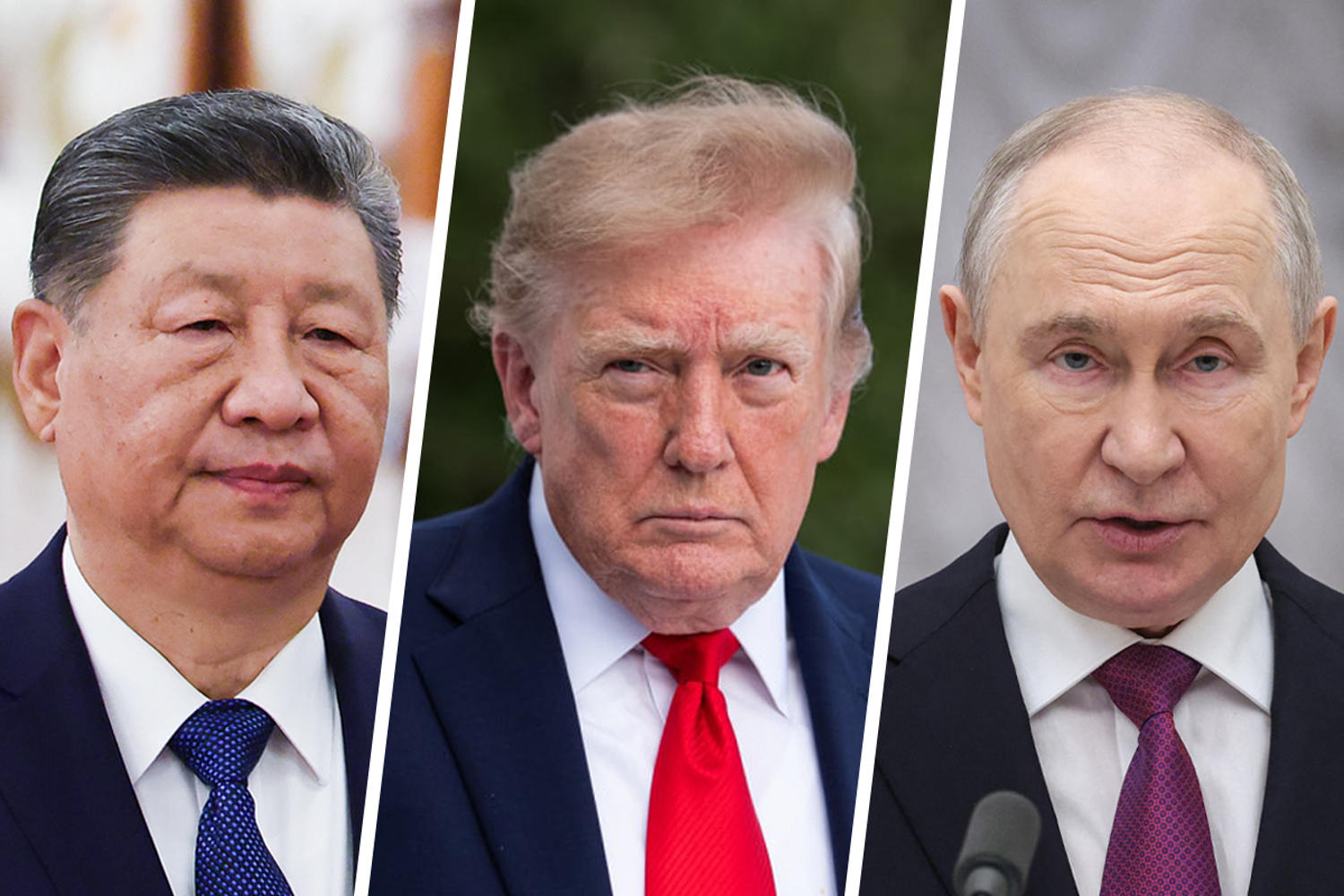
Every major foreign policy desk is hyperventilating over reports that Donald Trump, Xi Jinping, and Vladimir Putin plan to meet on the sidelines of the Asia-Pacific Economic Cooperation (APEC) summit. The mainstream consensus calls it an "unprecedented diplomatic breakthrough." They are wrong. It is a choreographed distraction designed to mask structural weakness behind a wall of camera flashes.
Legacy media treats summits like Hollywood premieres. Put three strongmen in a room, let them shake hands, and declare peace in our time. Having spent fifteen years analyzing geopolitical risk and watching multinational corporations lose hundreds of millions of dollars betting on diplomatic handshakes, I can tell you the exact playbook here. When leaders with irreconcilable domestic crises run out of economic ammunition, they stage a summit.
The Myth of Great Power Chemistry
The lazy consensus assumes personal rapport between leaders overrides hard national interests. You will hear commentators claim that a single closed-door session can reset trade wars, halt territorial aggression, and stabilize global supply chains. This is diplomatic illiteracy.
Great power politics does not run on vibes. It runs on structural incentives, domestic survival, and raw leverage.
Consider the actual positions of the three men walking into that room:
- Washington wants tariff relief for domestic consumers without looking soft on Beijing, alongside a rapid exit from European security entanglements that does not look like surrender to Moscow.
- Beijing faces severe demographic contraction, a deflating property sector, and crippling youth unemployment. Xi needs Western capital and market access, yet he cannot concede an inch on Taiwan or industrial subsidies without triggering an internal Party backlash.
- Moscow runs a wartime economy completely dependent on Chinese dual-use components and energy purchases. Putin needs sanctions relief to prevent long-term economic stagnation, yet his political survival requires maintaining territorial gains in Eastern Europe.
Putting these three men at the same table does not resolve these contradictions. It weaponizes them.
What "Sidelines" Actually Means in Diplomacy
People hear "on the sidelines of APEC" and picture a secret, high-stakes war room where history gets rewritten. In reality, sideline meetings (known in diplomatic parlance as pull-asides or bilaterals) are tightly scripted, severely time-constrained photo opportunities.
By the time three heads of state sit down in front of flags, every syllable of the resulting communiqué has already been fought over by mid-level bureaucrats for six months. If the bureaucrats could not agree on semiconductor export controls or maritime boundaries in Geneva or Vienna, three leaders will not magically solve them over a 45-minute espresso break between plenary sessions.
Dismantling the "New Yalta" Fantasy
Pundits love historical analogies because they save them from doing actual analysis. Right now, the favorite buzzword is "a new Yalta." Commentators warn—or hope—that Trump, Xi, and Putin are about to carve the globe into neat, twentieth-century spheres of influence.
Let us look at why that comparison collapses under basic scrutiny.
At the 1945 Yalta Conference, Roosevelt, Churchill, and Stalin commanded empires with total industrial mobilization and clear geographic frontlines. Today, economic interdependence makes clean geographic carving impossible. You cannot draw a line down the Pacific Ocean when American tech companies rely on Taiwanese foundries, which rely on Dutch lithography machines, which rely on Chinese rare earth minerals.
Imagine a scenario where the three leaders announce a grand bargain on trade and security at APEC. Within seventy-two hours, congressional hawks in Washington would introduce blocking legislation, European allies would revolt over unilateral security concessions, and Chinese state-owned enterprises would quietly ignore intellectual property clauses. A handshake at APEC binds nobody.
The Asymmetry of Leverage
The mainstream narrative treats this trilateral meeting as a gathering of three equal titans. That is mathematically false. Look at the actual economic weight sitting at that table:
- The United States controls the global reserve currency, the deepest capital markets, and the premier military alliance network.
- China commands the world's largest manufacturing base and dominates critical mineral processing, though it remains structurally vulnerable to external energy and food imports.
- Russia possesses massive nuclear stockpiles and raw commodities, yet its nominal GDP is smaller than that of Italy or Texas.
Putin is not sitting at that table as an economic peer. He is there because Xi uses Moscow as a strategic distraction to keep Washington tied down in Europe, and Trump views Moscow as a wedge to pull away from Beijing. Treating this as a three-way negotiation between equals misses the fundamental power dynamic. It is a two-player game with a heavily armed third party serving as the bargaining chip.
Answering the Wrong Questions
If you look at what people are searching for regarding this summit, the public is being fed entirely the wrong framing. Let us dismantle the core assumptions driving the news cycle.
Will this meeting prevent a global economic downturn?
No. Summits do not fix balance sheets. Global trade fragmentation is driven by long-term industrial policy—specifically, the shift from hyper-globalization to regionalized supply chains. Whether Trump and Xi smile for the cameras does not change the fact that Western corporations are actively de-risking their manufacturing footprints out of coastal China and into Vietnam, India, and Mexico. Capital expenditure decisions operate on ten-year horizons, not forty-eight-hour news cycles.
Does a trilateral summit mean the end of the Russia-China partnership?
This is the classic "Reverse Nixon" fallacy. Foreign policy amateurs constantly fantasize about Washington peeling Moscow away from Beijing, mirroring Henry Kissinger's 1972 opening to China against the Soviet Union.
That strategy worked in 1972 because Mao Zedong and Leonid Brezhnev were actively fighting a shooting border war along the Ussuri River and genuinely feared a Soviet nuclear first strike. Today, Xi and Putin share a 2,600-mile peaceful border, complementary economies (Chinese consumer goods and tech for Russian oil, gas, and grain), and an existential hostility toward American financial sanctions. Putin knows American presidents change every four years; Xi is there for life. Moscow will never trade a permanent, reliable authoritarian neighbor for temporary promises from Washington.
Why choose APEC as the venue?
Because APEC is an economic forum, not a security alliance. Founded in 1989 to promote free trade across the Pacific Rim, APEC operates on non-binding commitments and consensus. Choosing APEC gives all three leaders maximum plausible deniability. If the meeting produces zero concrete policy—which is the highest-probability outcome—they can claim they were simply attending a routine regional trade summit. It lowers the political cost of failure to zero.
The Real Danger Nobody Is Covering
When political analysts like John Mearsheimer or Stephen Walt examine great power competition, they emphasize the danger of miscalculation. The true risk of a high-profile, low-substance summit between Trump, Xi, and Putin is not that they will secretly sell out smaller nations. The real danger is strategic misperception.
Here is how this plays out in the real world:
- The Illusion of De-escalation: Financial markets love headlines. A photo of all three men smiling triggers an immediate, algorithmic rally in equities and a drop in volatility indexes. Corporate boards pause their supply chain diversification plans, assuming the geopolitical storm has passed.
- The Vacuum of Enforcement: Because sideline meetings lack formal treaty mechanisms, each side walks away interpreting the conversation to suit its domestic audience. Washington claims it extracted tough concessions. Beijing claims it forced America to respect its core interests. Moscow claims it broke Western diplomatic isolation.
- The Inevitable Backlash: Six months later, when nobody follows through on the imaginary agreements, the sense of betrayal is worse than before. Tariffs snap back higher. Naval patrols in the South China Sea grow more aggressive. Sanctions tighten.
I have watched this exact cycle repeat across three administrations. Businesses that treat summitry as a signal to lower their risk posture consistently get wiped out when reality reasserts itself.
The Downside of Cynicism
To be completely transparent, dismissing summitry entirely carries its own blind spot. Even hollow diplomatic theater serves one genuine, utilitarian purpose: crisis communication.
When militaries operate within miles of each other in the Taiwan Strait, the Black Sea, and the Baltic, personal familiarity at the top creates an emergency off-ramp. If an American reconnaissance plane collides with a Chinese fighter jet, or a Russian missile strays into NATO territory, having established direct leader-to-leader contact can prevent an accidental skirmish from escalating into a nuclear exchange. Talking is always better than shooting.
However, confusing an emergency phone line with a grand strategic realignment is a fatal mistake.
How to Actually Read This Summit
Stop watching the podiums. Stop listening to the press secretaries. If you want to know whether the Trump, Xi, and Putin meeting at APEC actually changes the world, ignore the speeches and track four hard metrics over the ninety days following the summit:
- Treasury Flows and Tariff Schedules: Do actual statutory tariff rates drop, or do they simply get delayed while "working groups" study the issue? Working groups are where diplomacy goes to die.
- Semiconductor Export Licenses: Watch the U.S. Department of Commerce Bureau of Industry and Security. If restrictions on advanced chips and lithography equipment remain untouched, the U.S.-China tech cold war is still fully intact regardless of how warm the handshake looked.
- Dual-Use Trade Across the Amur River: Track customs data on machine tools, microelectronics, and heavy trucks moving from China into Russia. If those numbers keep climbing, Beijing has not conceded a single thing on Ukraine.
- Defense Posture in the First Island Chain: Look at ship deployments and weapons deliveries to Taiwan, the Philippines, and Japan. Hardware movements tell the truth; joint statements lie.
Diplomacy is not a reality television show where a dramatic season finale solves every plotline. Power is measured in factories, naval tonnage, energy reserves, and capital flows. Until those underlying realities shift, three men shaking hands in a convention center is just expensive lighting for a photo op.