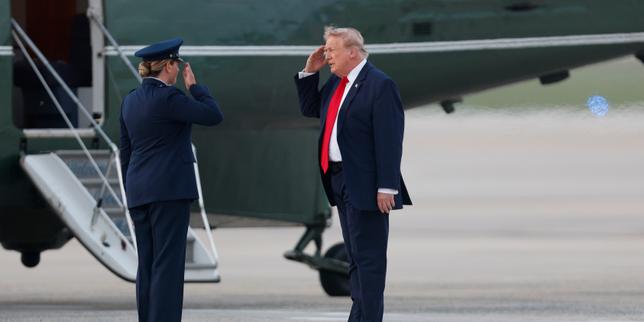
Donald Trump just raised the stakes in the Middle East once again. After recent enemy strikes killed three American service members across Jordan and Iraq, the U.S. president took to Truth Social with a direct, uncompromising threat to Tehran. He warned that every single time Iran kills an American soldier, the regime will pay for that killing many times over.
He didn't stop at social media posturing either. Trump explicitly stated that this direct mandate has already gone straight down the chain of command to Defense Secretary Pete Hegseth, Chairman of the Joint Chiefs of Staff Gen. Daniel Caine, and military commanders on the ground.
If you've been following the back-and-forth rhetoric over the past few months, you might think this is just standard operational posturing. It isn't. This specific directive marks a sharp turn toward direct retaliatory calculus in a war that has already spiraled far beyond its initial borders.
The Casualties That Triggered Washington's New Retaliation Doctrine
To understand why Washington is taking this stance right now, you have to look at the specific events on the ground from late July 2026.
For months, skirmishes and air raids traded blows across regional hubs, but direct military casualties remained relatively constrained. That dynamic shattered over a brutal weekend. The Pentagon identified two service members killed during a heavy Iranian ballistic missile and drone strike on a coalition military base in Jordan. They were 1st Lt. Tyler James Feehan, 25, of Ewa Beach, Hawaii, and Pvt. Isabella Gonzales, 19, of Carrollton, Texas. Both had been deployed in support of the ongoing U.S. mission against ISIS.
Meanwhile, a third service member died in northern Iraq while conducting a controlled detonation of a downed Iranian drone.
These deaths brought the total count of American troops killed since the wider hostilities began up to 17. While four other soldiers wounded in the Jordan attack were treated and discharged from local medical centers, the symbolic weight of direct Iranian fire hitting American personnel proved to be a line in the sand for the White House.
Trump announced he would attend the dignified transfer of the fallen service members at Dover Air Force Base in Delaware, underscoring the political and human gravity of these losses. But behind the ceremonial honors lies a concrete shift in military engagement.
Inside the Strategic Shift from Precision Deterrence to Overwhelming Punishment
So what does "paying many times over" actually look like on the battlefield?
Up to this point, American operations relied primarily on precision targeting designed to degrade offensive capabilities without completely obliterating infrastructure. The U.S. military's Central Command had already executed nine consecutive nights of relentless airstrikes against Iranian military installations. These strikes hit command centers, coastal surveillance radars, maritime assets, air defense batteries, and critical communications networks.
Reports from Iranian state news agency IRNA showed American strikes pounding targets across multiple provinces. Bases around Tabriz in the northwest, a key site home to underground missile facilities run by the Islamic Revolutionary Guard Corps (IRGC), took heavy hits. Strikes also rocked coastal regions including Bandar Imam Khomeini, Sirik, Jask, Konarak, and Chahbahar.
Yet despite nine nights of continuous bombardment, Tehran didn't back down. Instead, it answered with retaliatory strikes hitting bases and allied territories in Bahrain and Kuwait, home base for the U.S. Navy's 5th Fleet.
By explicitly ordering military leaders like Hegseth and Caine to inflict disproportionate costs for future American casualties, Trump is altering the rules of engagement. Deterrence isn't about matching force anymore. It's about overwhelming counter-strikes meant to make the price of direct confrontation completely unbearable for Iranian leadership.
The Breakdown of Diplomacy and the Mirage of a Ceasefire
Many observers thought the regional war was on the verge of cooling down just a few weeks prior. Back in June, Pakistan brokered a tentative memorandum of understanding between Washington and Tehran aimed at pausing hostilties and exploring a long-term diplomatic roadmap. Trump had even publicly praised Tehran following the release of a detained American national, signaling a potential window for negotiations.
Secretary of State Marco Rubio publicly maintained that a diplomatic deal was still achievable. However, the realities on the ground rapidly dismantled those diplomatic overtures.
The core issue comes down to conflicting strategic goals. Washington wanted a complete halt to Iranian ballistic missile expansion and an end to proxy warfare. Tehran wanted immediate sanctions relief and a total withdrawal of U.S. forces from neighboring territories. When neither side budged, the temporary understanding collapsed into open combat.
The mixed signals coming out of Washington didn't help either. Trump has historically favored keeping opponents off balance through unpredictable threats and rapid strategic shifts. But when mixed messaging meets active war zones, ambiguity usually leads to miscalculation rather than compromise.
The Danger of Regional Escalation Across Vital Shipping Lanes
This conflict isn't contained to military bases in Iraq and Jordan. It's actively threatening global trade channels that power the international economy.
Shortly after the fresh wave of strikes, the UK Maritime Trade Operations center confirmed attacks on commercial vessels near the UAE within the Strait of Hormuz. At the same time, Iran-backed Houthi forces in Yemen announced a maritime blockade aimed at regional shipping corridors.
When you disrupt the Strait of Hormuz, you're squeezing a narrow waterway through which roughly twenty percent of the world's petroleum flows. Oil markets reacted immediately, swaying wildly with every post on Truth Social and every defense communique coming out of CENTCOM.
If American forces pivot from target-degradation strikes to heavy infrastructure destruction as part of Trump's "many times over" directive, Iran's obvious counter-move is to choke maritime transit entirely. That creates a cascading economic crisis far beyond the borders of the Middle East.
Why Proportionality in War Is Becoming a Thing of the Past
For decades, military doctrine among Western nations emphasized proportional response. If an adversary hits a radar post, you strike a radar post. If they attack a supply convoy, you eliminate the launcher that fired the missile. The goal was always containment—preventing localized skirmishes from erupting into broad regional wars.
Trump's latest stance rejects that concept entirely.
By demanding multiple Iranian targets destroyed for every single U.S. casualty, the White House is adopting an asymmetric retaliation model. This approach relies on the idea that an adversary will only stop attacking if the cost of doing so is blatantly unsustainable.
Critics argue that asymmetric responses backfire against stubborn, ideological regimes. Instead of forcing submission, disproportionate retaliation often locks both sides into an escalating retribution loop. If Washington strikes five key IRGC bases in response to one killed service member, Tehran feels compelled to respond with twice as many ballistic missiles to maintain internal legitimacy and regional credibility.
Once you enter that cycle, breaking out of it without total military capitulation or outright war becomes nearly impossible.
What Real Escalation Looks Like in the Coming Weeks
If you want to know where this confrontation goes next, keep your eyes on three specific operational indicators over the coming days.
First, look at the target selection coming out of CENTCOM. Up to now, U.S. airstrikes focused heavily on active military assets—missile sites, radar stations, and command posts. If strikes expand to energy infrastructure, electrical grids, or government command centers, you'll know Trump's directive for heavy retribution is being executed in full.
Second, monitor Iran's proxy network activity. Iran rarely fights purely through its regular armed forces. Watch for increased coordinator actions from armed groups in Syria, Iraq, and Yemen. If militia groups start launching coordinated, multi-vector drone and missile swarms against isolated U.S. outposts, casualty risks will skyrocket.
Third, keep a close watch on maritime security around the Persian Gulf. Any attempt by Iran or its allies to lay sea mines or seize commercial tankers in the Strait of Hormuz will trigger immediate naval engagements with the U.S. 5th Fleet.
The rhetoric has already shifted from diplomatic posturing to direct threats of heavy punishment. Now, the military execution of those threats will determine whether this conflict stays a series of heavy tactical exchanges or boils over into a full-scale war across the Middle East.
Track CENTCOM daily operational briefs and monitor official updates from the Department of Defense to see how these newly issued rules of engagement play out on the ground.