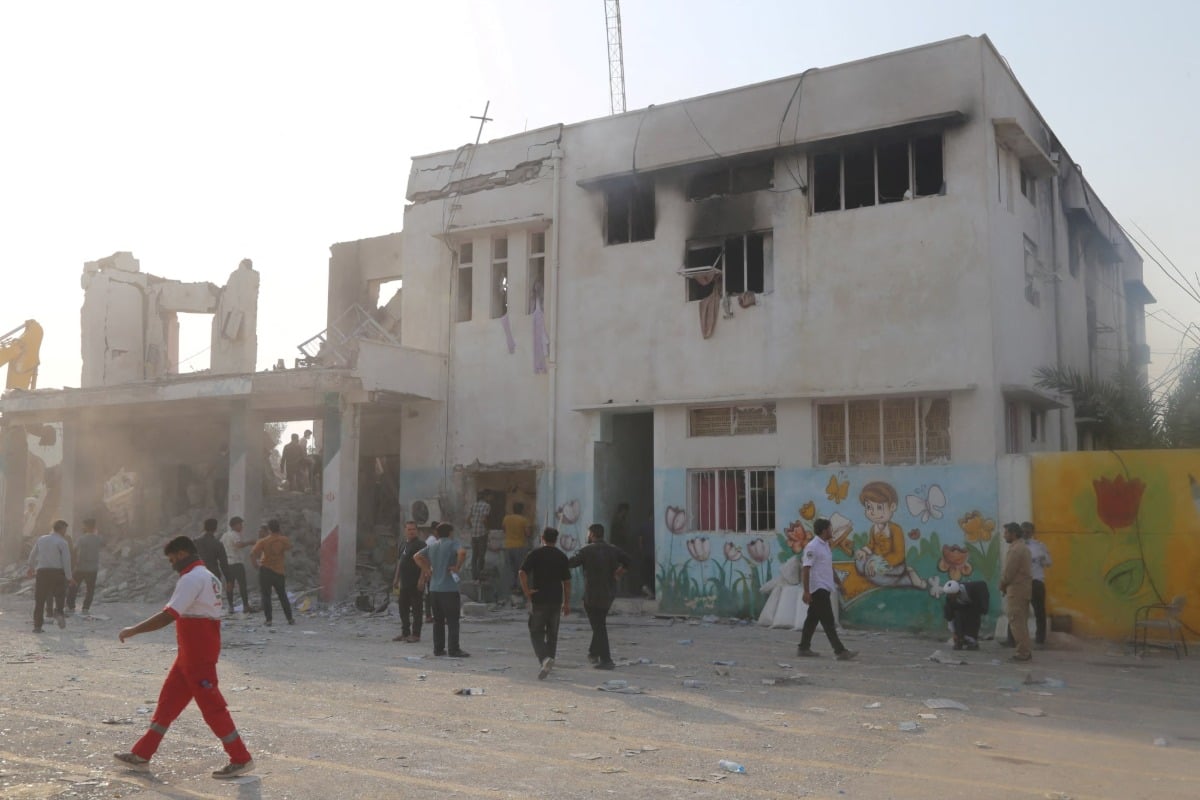
The dust of a collapsed concrete wall has a distinct, metallic taste. It clings to the back of the throat long after the smoke clears, a gritty mixture of pulverized mortar, burnt plastic, and the vaporized remnants of childhood.
In the quiet corridors of the Pentagon, three thousand miles away, there is no dust. There is only the hum of central air conditioning, the soft squeak of leather shoes on polished linoleum, and the dry, sterile scent of high-grade printer paper.
Yet, these two completely different worlds are currently locked in a tense, silent standoff.
At the center of this collision is a single, heavily classified file. It contains the military’s internal assessment of a devastating school bombing linked to Iranian influence—an event that left a community shattered and a pile of rubble where algebra and history lessons used to happen. For months, this report has remained buried in the deepest vaults of American defense intelligence.
Now, a bipartisan group of 25 United States senators is trying to tear open the lock.
The Anatomy of an Echo
To understand the political firestorm currently brewing in Washington, we must first look at what happens when a bomb meets a schoolyard. Let us construct a representative scenario based on the typical anatomy of these tragic regional flashpoints.
Consider a hypothetical student named Rafik. He is twelve. He worries about his upcoming spelling test and whether his older brother will let him play with the football after school. When the strike occurs, there is no dramatic whistle like in the movies. There is only a sudden, violent displacement of air. The sky turns the color of dirty wool.
When Rafik wakes up, his desk is gone. The blackboard is in splinters. His teacher, a man who spent thirty years teaching children how to find the lowest common denominator, is silent beneath a slab of gray stone.
In the immediate aftermath of such strikes, the blame game begins instantly. Local officials point fingers. Angered citizens march in the streets. The international community issues carefully worded statements expressing deep concern.
Behind closed doors, however, a much more sophisticated hunt takes place.
High above the clouds, American satellite arrays and signals intelligence assets have already swept the area. They have captured the thermal signatures of the launch. They have intercepted the encrypted radio chatter of the militia fighters who coordinated the attack. They have traced the supply lines back to their origin point.
The Pentagon knows exactly who made the weapon. They know who ordered the strike. They know who paid for the fuel.
But they are not telling.
The Paper Wall
The 25 senators pushing for the release of these findings are not acting out of sudden curiosity. They are responding to a growing, systemic frustration with how the American security apparatus handles information.
When a foreign power—specifically Iran, through its web of regional proxies—is suspected of targeting civilian infrastructure, the geopolitical calculations become incredibly complex. The Department of Defense operates on a philosophy of strategic ambiguity. Information is a currency. Sometimes, holding onto a secret is deemed more valuable than revealing the truth, even when that truth could bring closure to a grieving population.
The senators argue that this secrecy has crossed the line from tactical caution into counterproductive evasion.
In their joint demand, the lawmakers are asking for more than just a summary. They want the raw truth. They want to know the extent of the Pentagon’s knowledge regarding the planning of the attack, the specific munitions used, and the degree of direct command and control exercised by Iranian state actors.
The defense establishment’s typical defense is predictable: protecting sources and methods.
It is a shield that has been used for decades. If the Pentagon reveals how much it knows about a specific drone launch or missile trajectory, it inadvertently teaches the adversary how to hide their next launch. It exposes the double agents, the listening posts, and the cyber-penetrations that took years to establish.
Yet, this argument is wearing thin.
The lawmakers, representing a broad spectrum of the political landscape, suggest that the public interest in holding state-sponsored terror accountable far outweighs the utility of keeping this specific report in the dark. Without official, unclassified attribution, there can be no international sanctions. Without sanctions, there is no deterrence.
Without deterrence, another school becomes a target.
The Language of Redaction
If you have ever held a declassified government document, you know the feeling of looking at a page that has been systematically slaughtered.
Thick, black ink bars run across the paragraphs like iron grates. You might see a sentence start with a promising lead: "Intelligence assets in the western sector confirmed that..." followed by three inches of solid black marker.
It is a bizarre form of modern art. It tells a story through what it refuses to say.
For the families of those lost in the school bombing, these redacted pages are an insult. To them, the black lines are not shields for national security. They are a cover-up of convenience. They allow diplomats to continue delicate back-channel negotiations without having to confront the uncomfortable reality of dead children.
Consider the leverage this gives to the perpetrators. When a state actor can orchestrate an attack through a proxy and suffer zero public exposure from the world's premier superpower, they are effectively granted a license to repeat the act. The proxy takes the blame. The patron state remains clean, sitting comfortably at the diplomatic table, negotiating trade deals and nuclear parameters as if their hands were spotless.
The 25 senators are trying to wash those hands in the public square.
The Cost of Looking Away
This is not a dry debate about intelligence protocols. It is a fundamental question of what we value more: the smooth operation of foreign policy or the moral clarity of truth.
When the Pentagon refuses to release its findings, it creates a vacuum. In that vacuum, conspiracy theories grow. Propaganda flourishes. The state media of adversarial nations quickly steps in to rewrite the history of the event, claiming the school was a weapons depot, or that the strike never happened at all, or that it was carried out by the victims themselves.
The truth does not simply emerge on its own. It must be defended.
By keeping the report locked away, the United States risks appearing complicit in the silence. It sends a message to the survivors that their suffering is merely a variable in a larger, more important equation—an equation solved by suits in Washington and generals in Arlington.
The senators’ letter is an attempt to disrupt that equation. It is a demand to bring the human cost back into the ledger of national security.
The sun sets over the ruins of the schoolyard, casting long, jagged shadows across the broken concrete. A plastic chair, melted on one side, sits alone in the middle of what used to be a playground.
In Washington, the desks are clean. The folders are filed away. The black ink is dry.
Whether those 25 signatures will be enough to break the seal on the vault remains to be seen. But until those pages are opened, the dust of that classroom will continue to hang in the air, silent, unsettled, and waiting for an answer.