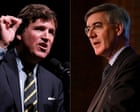
When an orthodox British Conservative and an American right-wing media provocateur sit down to talk geopolitics, sparks usually fly. But few expected the conversation to skid straight into twentieth-century revisionism.
Former UK minister Jacob Rees-Mogg found himself openly rebuking Tucker Carlson after the American podcaster questioned why Britain bothered fighting Nazi Germany. The exchange exposed a deep ideological chasm opening up between traditional Western right-wing conservatism and the populist isolationism dominating modern media. If you liked this post, you might want to read: this related article.
The Clash Over Britain's Finest Hour
The friction started when the discussion turned toward foreign policy, defense spending, and the historical necessity of confronting aggressive expansionism. Carlson pressed Rees-Mogg on whether entering the Second World War was genuinely worth the catastrophic loss of life and the eventual dismantling of the British Empire.
Carlson even went as far as questioning the accepted narrative of Nazi aggression in Poland, suggesting that history has been overly simplified. For another perspective on this story, see the recent update from TIME.
Rees-Mogg countered with straightforward historical realism, pointing out the obvious alternative to fighting back.
"Otherwise we'd be speaking German," Rees-Mogg said.
Carlson's response shocked many listeners by dismissing the gravity of that outcome entirely.
"Who cares?" Carlson replied, adding that having a major European language spoken widely in Britain might not be the worst thing.
That flippant dismissal prompted Rees-Mogg to draw a sharp line, accusing the host of getting dangerously close to defending Adolf Hitler. While Carlson quickly denied being a secret Nazi, joking about the label, the damage to the premise of the interview was already done.
Why This Argument Matters Right Now
You might wonder why a debate about 1939 matters in today's political climate. The answer lies in how history is being weaponized to shape current attitudes toward modern conflicts, particularly Russia's invasion of Ukraine.
Carlson has consistently pushed an isolationist narrative, arguing that Western intervention abroad only triggers unnecessary economic pain and global instability. By downplaying the existential threat of Nazi Germany, critics argue he is laying the groundwork for a broader apathy toward modern dictatorships. If standing up to Hitler was allegedly a mistake that cost Britain its superpower status, the underlying logic implies that standing up to modern autocrats is equally pointless.
Rees-Mogg, representing a more traditional Atlanticist and hawkish conservatism, rejected that premise. He argued that national defense, economic deterrence, and alliances matter. Even politicians who disagree on domestic economic policy often find themselves uniting behind basic historical facts about fascist aggression. Yet, the fact that mainstream commentators are now willing to platform these kinds of revisionist talking points shows how much the media landscape has shifted.
The Real Cost of Historical Revisionism
Revisionism sounds intellectual on a podcast, but it erodes the shared reality required to sustain a democracy. When basic consensus about the Second World War starts fraying for the sake of shock value or contrarian engagement, political discourse breaks down entirely.
You don't have to love Rees-Mogg's domestic politics to see why his pushback was necessary here. Ignoring the horrors of the Nazi regime or treating the defense of Europe as a trivial policy misstep isn't just bad history; it's a dangerous distortion of what peace actually costs.
History isn't a malleable script you can rewrite to fit an evening isolationist broadcast. When commentators start treating the defeat of fascism as an open question, we've drifted far past normal political disagreement and straight into dangerous territory.
Simon Marks reacts to Tucker Carlson vs Jacob Rees-Mogg
This video provides an analytical breakdown of the contentious exchange between Jacob Rees-Mogg and Tucker Carlson regarding World War Two history and foreign policy.