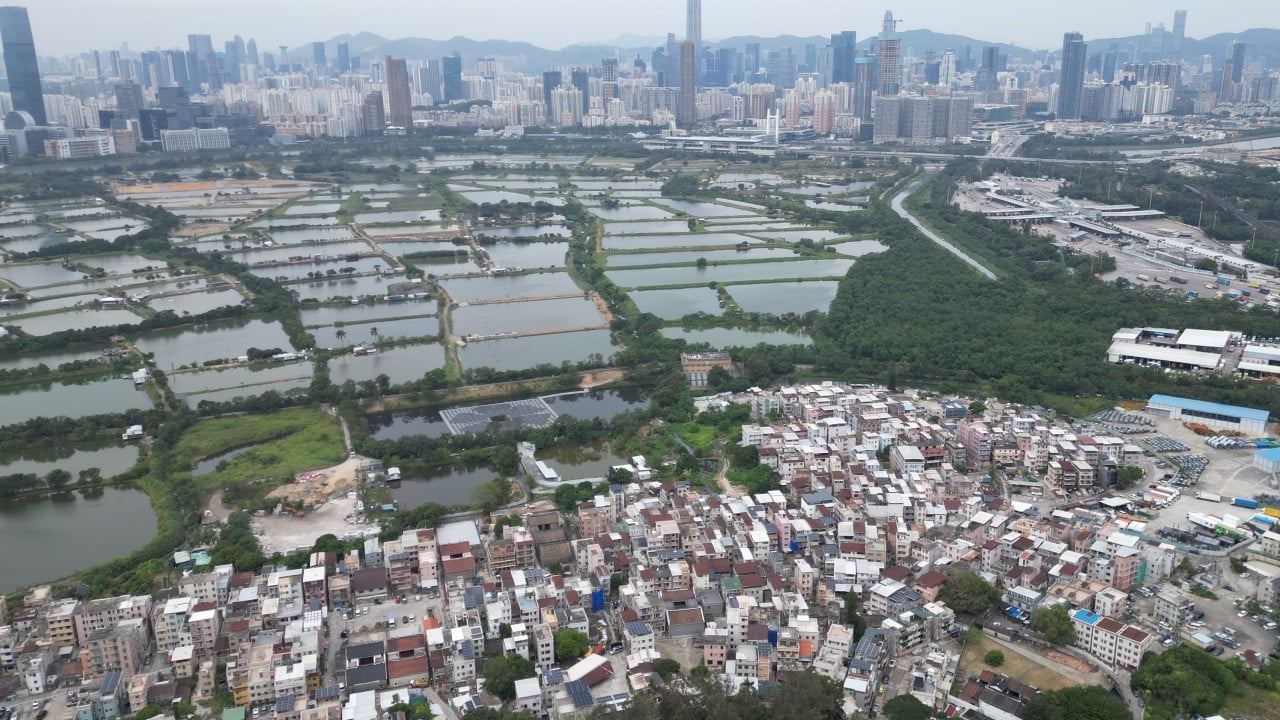
The wind off Deep Bay smells like salt, mud, and wet cement.
Stand at the northern edge of Hong Kong, right where the Shenzhen River cuts a muddy scar between two worlds, and look south. For decades, this was a buffer zone of fishponds, reed beds, and sleepy border villages—a place where migratory birds outnumbered people ten thousand to one. Look north across the water, and the skyline of Shenzhen rises like a wall of glass and neon, humming with the restless energy of hardware startups, electric vehicle giants, and algorithms that shape how half the planet shops and talks.
Look down at your boots, though, and you are standing in the Lok Ma Chau Loop.
Right now, it is mostly dirt, cranes, and ambition. Yet this quiet stretch of reclaimed marshland—alongside the sprawling San Tin Technopole—is the centerpiece of a massive financial gamble. The Hong Kong government wants to pour another HK$27 billion (roughly US$3.46 billion) into the Hetao Shenzhen-Hong Kong Science and Technology Innovation Co-operation Zone.
That number is so large it numbs the brain. Twenty-seven billion dollars.
If you stack twenty-seven billion one-dollar Hong Kong coins on top of each other, the tower wouldn’t just pierce the clouds over Victoria Peak; it would stretch out past the International Space Station, halfway to the moon. When money reaches that scale, politicians stop talking about actual human beings and start talking about "infrastructure phases," "gross floor area," and "cross-border talent flows."
And that is precisely why, inside the Legislative Council chamber in Admiralty, lawmakers are starting to sweat.
The Anatomy of a Blank Check
To understand why elected representatives are balking at a tech hub—usually the easiest ribbon-cutting ceremony in politics—you have to look at the ledger sitting on their desks.
Hong Kong is no longer swimming in the endless, effortless budget surpluses of the 2010s. The city has been staring down consecutive fiscal deficits hovering around the HK$100 billion mark. Land sales, the traditional engine that paid for everything from subways to hospitals, have sputtered in a sluggish property market. Every dollar spent on pouring concrete in the New Territories is a dollar not spent on public healthcare, elderly care, or keeping the lights on for small businesses struggling with high interest rates.
So when officials walked into the Legislative Council asking for HK$27 billion to push forward the Hong Kong Park of the Hetao zone—specifically for site formation, infrastructure, and the initial batch of buildings—lawmakers did not roll out the red carpet. They pulled out their calculators.
"Where is the return on investment?" they asked. "Who is actually moving in? And how much more will this cost before a single breakthrough leaves a lab?"
These are not cynical questions. They are survival questions.
Consider a hypothetical founder named David. Let’s invent him for a moment, though versions of him sit in co-working spaces from Kwun Tong to Cyberport every single night. David runs a fifteen-person biotech startup developing rapid diagnostic strips. He has brilliant researchers from the Chinese University of Hong Kong, solid intellectual property protections under Hong Kong’s common law system, and a desperate need for two things: cheap wet-lab space and fast access to clinical trials across the border.
Right now, David is paying absurd rent in an industrial building in Fo Tan, retrofitting ventilation systems out of his own pocket because standard offices weren't built for chemical reagents. When he hears about the Hetao tech hub—a place promising custom-built laboratories right on the border, with special green channels for data, biological samples, and researchers to move back and forth between Hong Kong and Shenzhen—his heart leaps.
Then he asks the practical question: When can I move in, and what will the rent be?
If the answer is "five years from now, at rates only multinational pharmaceutical giants can afford," David won't be there. His startup will have either died in Fo Tan or packed its bags and moved twenty minutes north to Shenzhen, where local district governments hand out subsidized lab space and cash grants like flyers outside a subway station.
Lawmakers know about David. They have seen this movie before.
Ghosts of Cyberport Past
You cannot talk about big-ticket tech projects in Hong Kong without summoning the ghost of 1999.
Back then, at the height of the dot-com frenzy, the government announced Cyberport—a gleaming, futuristic hub on the western side of Hong Kong Island meant to turn the city into the Silicon Valley of Asia. There was no open tender. The contract went to a major property developer, and within a few years, critics noticed something uncomfortable about the "tech hub": an awful lot of it looked like luxury waterfront apartments.
Cyberport eventually found its footing as an incubator for fintech and digital entertainment, housing hundreds of startups today. Yet the scar tissue remains in the public consciousness. In Hong Kong, the line between "technology infrastructure" and "real estate development dressed up in a lab coat" has always been dangerously thin.
When lawmakers scrutinize the HK$27 billion price tag for the Hetao zone, they are haunted by that history. They look at the cost of site formation—draining wetlands, stabilizing soft alluvial soil, building roads, sewage systems, and power grids from scratch in a remote corner of the Northern Metropolis—and they see the classic Hong Kong trap: spending astronomical sums on heavy civil engineering before proving the economic engine inside will actually roar.
Building on mud is expensive. Building on political and economic uncertainty is even riskier.
Let's look at the numbers without the gloss. The total area of the Hong Kong Park in Hetao is roughly 87 hectares—about four and a half times the size of Victoria Park. Developing it isn't a one-and-done expense. The HK$27 billion currently on the table is just the latest tranche, following billions already committed to early infrastructure and decontamination works on the former river loop. Once you add the remaining phases of the Hong Kong Park and the adjacent San Tin Technopole, the total public bill for the Northern Metropolis tech corridor easily marches toward hundreds of billions of dollars.
Think of it like building a five-star restaurant in the middle of a desert before you’ve hired a chef, printed a menu, or checked if anyone is driving down that highway. The marble countertops might look magnificent, and the kitchen equipment might be top-of-the-line, but if the dining room sits empty, the depreciation alone will bankrupt you.
The Invisible Friction at the Border
Why not just let private developers build the whole thing? That was one of the sharpest questions raised during the legislative debates. If this border zone is truly going to be the crown jewel of the Greater Bay Area’s innovation economy, why isn't private capital fighting for the privilege of funding it?
The answer lies in the invisible friction of the border itself.
On paper, the Hetao Co-operation Zone is brilliant. It consists of two parts: the 87-hectare Hong Kong Park south of the Shenzhen River, and the 300-hectare Shenzhen Park immediately north of it. Together, they form a "one zone, two parks" model. The grand theory is that Hong Kong brings international capital, world-class basic research from its five top-100 universities, and Western legal standards, while Shenzhen brings manufacturing muscle, rapid prototyping, and a massive domestic market.
In practice, stitching two different legal, tax, and regulatory systems together is like trying to splice a fiber-optic cable onto a copper pipe.
Take data. Artificial intelligence companies—the very firms Hong Kong desperately wants to attract—live and die by data. Mainland China enforces strict cross-border data security laws; moving sensitive datasets out of the mainland requires rigorous regulatory clearance. Hong Kong operates under an open, international internet regime. If an AI lab sets up in the Hong Kong Park of Hetao, can it freely train its models on mainland medical or financial data?
Take biological samples. Suppose our hypothetical founder, David, wants to bring blood samples or cell lines from a hospital in Guangzhou across the river to his lab in Hetao for testing. Traditionally, customs clearance for biological materials is a bureaucratic nightmare of quarantine permits and cold-chain delays.
Take taxes and visas. If a senior engineer lives in Shenzhen, commutes across a dedicated footbridge into the Hong Kong Park each morning, and earns a Hong Kong salary, which tax authority takes a bite? How easily can a foreign researcher from Boston or Munich get a multi-entry pass to walk across that bridge to visit a supplier in Shenzhen without spending weeks at a visa office?
Officials promise "special policy breakthroughs" to solve every single one of these bottlenecks. They talk about dedicated border crossings, streamlined customs for research materials, and tax subsidies.
Yet private investors hate "promises." Private investors price risk. Until those cross-border rules are written into black-letter law and tested in the real world, private developers will sit on their hands, waiting for the government to absorb the upfront risk with taxpayer money. That is why the public purse is being asked to carry the HK$27 billion burden first.
The Cost of Standing Still
At this point, it would be easy to side entirely with the skeptics, slam the ledger shut, and declare the whole project an overpriced vanity play.
That would also be a catastrophic mistake.
To see why, step away from the spreadsheets and walk through an ordinary Tuesday in Central, Hong Kong’s financial district. Look at the suits streaming out of the glass towers at lunchtime. For forty years, Hong Kong made an extraordinary living as the middleman—the financier, the lawyer, the logistics broker connecting China to the global economy. That model minted billionaires and funded a world-class city.
It is also running out of steam.
Geopolitics has fractured global supply chains. Initial public offerings on the Hong Kong stock exchange have gone through brutal dry spells. Regional rivals like Singapore are aggressively poaching family offices, regional headquarters, and tech talent with ruthless efficiency. If Hong Kong relies purely on finance and real estate for the next thirty years, it will slowly hollow out into a gorgeous, expensive museum of its former glory.
Every city needs a second act. For Hong Kong, science and technology isn't a luxury hobby; it is an existential hedge.
Look closely at what Hong Kong actually has that almost nowhere else in Asia can match. Within a twenty-mile radius, the city packs five universities ranked among the top 100 globally. Its professors publish groundbreaking papers in oncology, robotics, clean energy, and materials science. For decades, the tragedy of Hong Kong’s economy was that its brilliant professors would invent something remarkable in a university lab, publish a paper, and then watch someone in California or Shenzhen commercialize it and capture 99 percent of the value.
Why? Because Hong Kong had no room to scale. There was nowhere to put pilot manufacturing plants, no space for mid-sized R&D campuses, and no clear pipeline connecting the university lab bench to the factory floor.
The Hetao zone is the physical attempt to fix that broken pipeline.
When you walk through the plans for the first batch of buildings in the Hong Kong Park—wet laboratories, talent apartments, an industry-academia-research building—you are looking at the missing middle of Hong Kong’s economy. If a professor at Hong Kong University develops a new solid-state battery membrane, they shouldn't have to fly across the Pacific to find a facility capable of testing it at scale. They should be able to take a forty-minute train ride north to Hetao, walk into a purpose-built lab, and collaborate directly with battery engineers stepping across the bridge from Shenzhen.
Accountability in the Mud
So here is the paradox sitting on the desks of Hong Kong’s lawmakers: spending HK$27 billion right now feels reckless, yet failing to build an innovation engine feels suicidal.
How do you square that circle? You don't do it by blindly signing checks, and you don't do it by paralyzing the project in endless committee hearings. You do it by changing how the money is governed.
During the heated Legislative Council sessions, the most constructive voices weren't calling to cancel Hetao. They were demanding guardrails. They pushed officials to answer hard operational questions:
- Anchor tenants before concrete: Instead of building empty shells and hoping tenants show up, secure binding commitments from heavyweight pharmaceutical firms, AI labs, and advanced manufacturing leaders while the foundations are being poured.
- Public-private co-investment: Stop treating the government as the sole wallet. Structure joint ventures where private enterprises take on construction and operational costs in exchange for long-term leasing rights or equity stakes, forcing market discipline onto every square foot.
- Clear performance metrics: Define what success looks like in five years—not in terms of square meters of floor space completed, which any construction firm can hit, but in patents commercialized, private R&D dollars matched, and high-value jobs created for local graduates.
- Phased release of funds: Keep the government on a short leash. Approve funding in tightly audited stages so that if global economic conditions shift or early buildings sit under-occupied, taxpayers aren't locked into a runaway train.
These demands transform a blind gamble into a calculated investment. They force bureaucrats to think less like town planners and more like venture capitalists—obsessed with burn rates, product-market fit, and measurable outcomes.
The Bridge Over the River
Late in the afternoon, the sun drops low over the Shenzhen River, turning the brown water into a ribbon of hammered gold.
On the northern bank, the lights of Shenzhen’s Futian district begin to flicker on—millions of small windows glowing inside towers built in a single generation. On the southern bank, inside the perimeter fence of the Lok Ma Chau Loop, the first steel skeletons of the Hong Kong Park are beginning to rise above the reeds.
In a few years, a footbridge will span this narrow strip of water. People will walk across it carrying laptops, prototypes, and contracts. Some will be young Hong Kong engineers who didn't have to leave their hometown to find a career in deep tech. Some will be mainland scientists drawn by international research grants and global collaborations.
Whether that bridge becomes a bustling artery of invention or an expensive monument to bureaucratic hubris won't be decided by the architects who drew the blueprints. It will be decided in the gritty, unglamorous details—in customs regulations, lab rental subsidies, venture capital co-investment funds, and the relentless scrutiny of lawmakers refusing to let twenty-seven billion dollars vanish into the mud without a fight.
The cranes are already swinging against the evening sky. The concrete is being poured. Now comes the hard part: building something inside those walls worth crossing a river for.