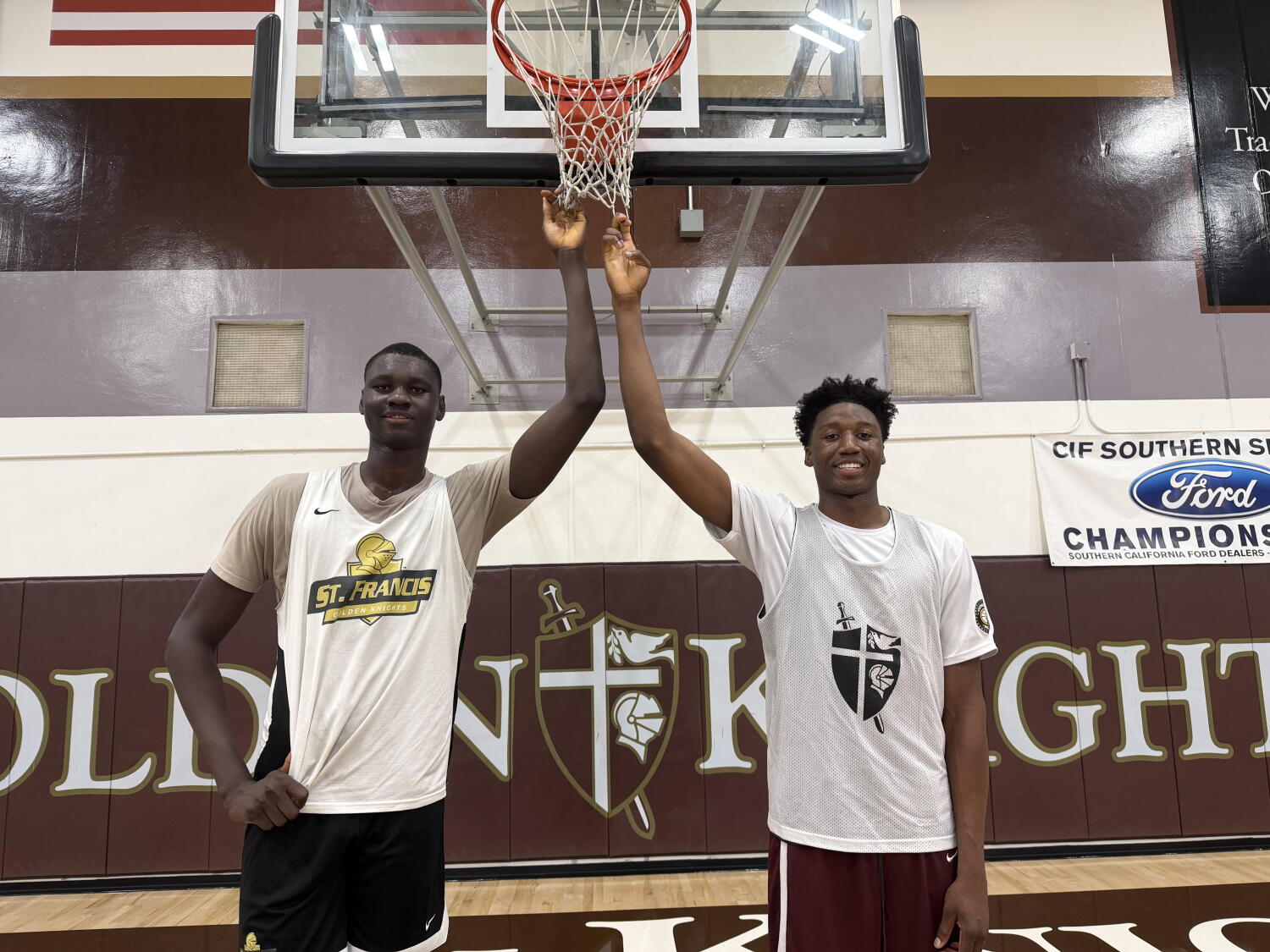
Deploying two legitimate seven-footers or near-seven-foot frontcourt players on a high school basketball court alters the fundamental geometry of the game, yet the raw possession of size rarely guarantees postseason dominance. When a program like St. Francis High fields a "twin towers" lineup, observers immediately fixate on verticality—blocked shots, offensive rebounds, and paint touches. This superficial reading misses the operational reality of prep basketball. Two oversized frontcourt anchors introduce severe spatial bottlenecks, transition vulnerabilities, and stamina deficits that can cripple an offense faster than they fortify a defense. To understand whether a dual-post configuration functions as a structural advantage or an exploitable liability, one must deconstruct the mechanics of floor spacing, defensive recovery, and high school pace-and-space economics.
The Geometry of the High School Court
The standard high school basketball court measures 84 feet in length by 50 feet in width, 10 feet shorter than the NBA and NCAA regulation floor. The high school three-point arc sits at 19 feet, 9 inches from the center of the basket, creating significantly less perimeter surface area than the college (22 feet, 1.75 inches) or professional (23 feet, 9 inches) game.
When you place ten adolescents on an 84-by-50-foot rectangle, spatial congestion is already high. Introducing two high-usage, low-post players simultaneously shrinks the playable area further. In analytical terms, the Effective Spacing Radius—the distance defenders must travel to help on a drive and recover to a shooter—collapses.
- Paint Congestion: If both bigs occupy the dunker spot and the strong-side low block, a single help defender can zone up both players simultaneously. Driving lanes for perimeter guards vanish because the primary rim protectors on the opposing team never have to leave the restricted area.
- Entry Pass Angle Degradation: Without a threat to pull opposing bigs out to the 19-foot arc, entry passes into the post must travel through narrower corridors. High school guards, who generally lack the elite passing velocity and height of college facilitators, suffer spike increases in live-ball turnovers when attempting to feed crowded posts.
- Offensive Rebounding Diminishing Returns: While two seven-footers theoretically dominate the offensive glass, they often occupy the same rebound zones. Without disciplined weak-side crashing assignments, two bigs frequently collide or cancel out each other's box-out leverage, allowing smaller, quicker guards to sneak in for long rebounds generated by three-point misses.
Defensive Rim Deterrence Versus Perimeter Exposure
The primary justification for the twin towers alignment at St. Francis High or any prep program is defensive rim deterrence. At the high school level, where shooting percentages from beyond the arc fluctuate wildly from gym to gym, forcing opponents into contested mid-range pull-ups is a mathematically sound strategy.
However, defensive efficiency in modern basketball is dictated by the weakest link in rotation, not the strongest anchor at the rim. The presence of two traditional bigs creates a structural trade-off between Vertical Rim Protection and Horizontal Perimeter Containment.
- The Drop Coverage Trap: Against a competent high school pick-and-roll ball handler, two bigs force the defense into rigid drop coverage. If the primary post defender drops to protect the paint, the secondary big must either hug the weak-side block—leaving the corner three-point shooter wide open—or zone the midline, exposing the short roll.
- Switchability Deficits: High school offenses increasingly utilize five-out sets and ghost screens to force bigs onto the perimeter. When an opposing coach puts both towers into a double-drag screen action, the defense faces an immediate crisis. Neither big possesses the lateral hip fluidity to stay in front of a 6-foot-1 combo guard in space, resulting in either blow-by layups or high foul rates.
- Foul Trouble Cascading: High school games consist of four eight-minute quarters (32 minutes total), and players foul out on their fifth personal foul. Because high school officiating crews tend to call contact tighter in the paint than college officials, a twin towers lineup carries massive foul-trouble variance. If both bigs pick up two fouls in the first quarter, the coaching staff is forced to abandon its primary identity and revert to a small-ball rotation that has received minimal practice reps.
The High-Low Passing Mechanism as the Viability Threshold
Historically, dual-post lineups succeed only when at least one of the frontcourt players possesses high-level processing speed and passing accuracy from the high post (the free-throw line extended and elbow areas). Without a functional high-low passing mechanism, two bigs simply stand in each other's way.
To make a twin towers alignment mathematically viable, the offense must operate through a Split-Tiered Frontcourt Alignment:
- The High-Post Hub: One big operates exclusively at the 15-to-17-foot elbow. This player must be a credible threat to shoot the mid-range jumper; if the opposing power forward sags into the paint, the hub takes an uncontested rhythm shot. If the defender steps up to contest, the hub immediately looks for the backdoor cut or the seal down low.
- The Low-Post Seal: The second big establishes deep position on the opposite block, pinning the opposing center under the basket. As the ball enters the high-post hub, the weak-side defender must choose between helping on the lob pass over the top or staying attached to the weak-side corner shooter.
- Perimeter Relocation: The three perimeter players cannot remain stationary. They must execute continuous baseline drifts and slot cuts to punish defenders who turn their heads to watch the interior passing angles.
If St. Francis High possesses one big who can reliably hit a 15-foot jumper and throw a crisp diagonal pass against double teams, the twin towers label transforms from a novelty into a lethal offensive engine. If both players require touches within six feet of the rim to be effective, the offense will stall against any disciplined 2-3 or 3-2 matchup zone.
Transition Pace and Stamina Economics
High school basketball is a game of runs driven by turnover-to-transition conversion. Teams that lack elite half-court execution compensate by pressing, trapping, and sprinting the floor to generate easy layups before the defense sets.
Fielding two massive frontcourt players imposes an immediate tax on transition defense. Big men require more caloric energy to accelerate and decelerate over 84 feet. Over the course of a 32-minute game, the cumulative fatigue of sprinting from baseline to baseline degrades defensive positioning by the fourth quarter.
- The Rim-Run Discrepancy: Offensively, trailing bigs can punish smaller teams by rim-running into deep seals before the opposing guards can set their bodies. However, if the initial transition push fails, the bigs are stuck at the bottom of the floor when the shot goes up.
- The Transition Leak: Opposing coaches counter twin towers by instructing their wings to leak out the moment a shot hits the rim. Because two bigs naturally gravitate toward the ball to secure the defensive rebound, they frequently vacate the middle of the floor, giving opposing guards an unobstructed runway for uncontested transition buckets.
Tactical Blueprint for Coaching Execution
A coaching staff managing a twin towers roster cannot rely on standard high school playbooks. They must implement strict operational rules to mitigate the inherent spatial and tempo drawbacks of the lineup.
- Enforce a Strict Staggered Rotation: Never play both towers together for all 32 minutes. Start both to establish physical dominance and dictate the initial whistle, then sub one out at the four-minute mark of the first quarter. This ensures that at least one seven-footer is on the floor at all times, keeps both players fresh for the fourth quarter, and protects against simultaneous foul trouble.
- Install a Matchup Zone Defense: Playing straight man-to-man defense with two slow-footed bigs invites perimeter exploitation. A disciplined 2-3 or 1-3-1 matchup zone keeps both bigs anchored near the paint, masks lateral foot-speed deficiencies, and turns every missed shot into a high-probability defensive rebound.
- Mandate Inside-Out Touch Rules: Establish an offensive rule that the ball must touch the paint—either via a post entry or a dribble penetration—before any three-point shot is attempted. When two bigs command double teams, the resulting kick-out passes generate wide-open, rhythm threes for the perimeter unit.
- Drill Outlet Velocity: A defensive rebound by a seven-footer loses half its value if the player holds the ball above his head for three seconds waiting for a guard to come get it. The bigs must be drilled to pivot immediately toward the sideline and snap crisp chest passes to sprinting wings, turning defensive stops into immediate numbers advantages.
The Strategic Play for St. Francis High
Do not build the offense around feeding the post on every possession. Use the twin towers primarily as a defensive deterrent and a high-post passing hub that forces opponents into reactive double teams. Keep one big stationed at the free-throw line to maintain driving lanes, stagger their minutes so the paint is never unguarded, and convert their defensive rebounding dominance into early-clock perimeter three-pointers before opposing defenses can pack the lane.