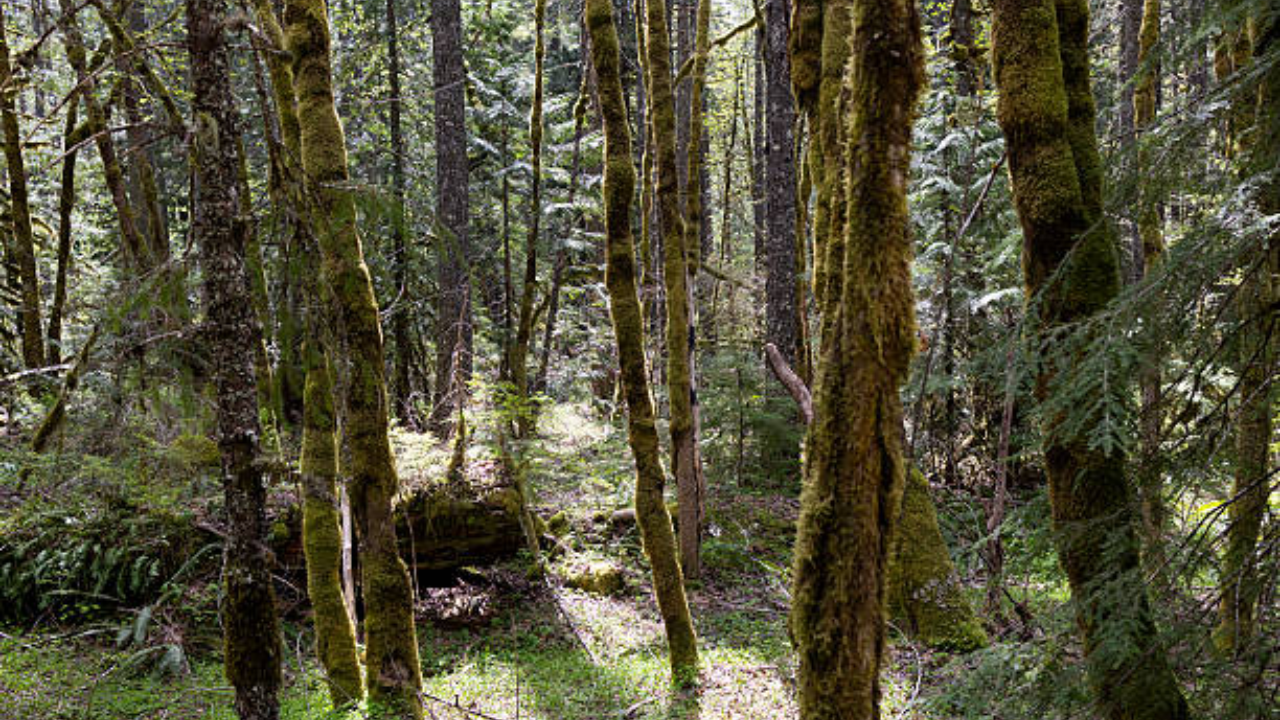
The air smells like wet iron and old moss, the specific scent of a forest that has forgotten the sound of a highway.
For forty years, a couple in New Jersey woke up to that smell. They did not own the land so much as they surrendered to it. Ninety acres of dense, breathing earth tucked away from the asphalt sprawl of the Garden State—a state that usually trades its green spaces for strip malls and logistics warehouses with the ruthless efficiency of a casino. But here, time slowed down. The maples dropped their leaves into the muck. The deer moved without fear. And standing quietly above it all, older than the nation’s constitution, older than the railways, older than every single house built within a fifty-mile radius, stood a white oak.
Two hundred and one years old.
To stand beneath its canopy is to feel violently small. Its bark is deeply furrowed, like the face of someone who has survived every winter the continent could throw at them. It was a sapling when James Madison was in the White House. It had weathered droughts that turned creeks into dust, ice storms that cracked limbs like bones, and the slow, suffocating creep of suburban development that ate away at the edges of the county until this property became a lonely, emerald island in a sea of gray.
Most people look at land like this and see an equation. Ninety acres. Do the math on commercial zoning. Calculate the multi-family housing units. Multiply by the median price per square foot. In a region where every square inch is aggressively monetized, holding onto forty years of unbuilt, unblemished wilderness is an act of quiet rebellion.
It is also an act of profound loneliness.
Protecting land privately means bearing the weight of its defense alone. Every time a developer’s surveyor appeared at the property line with a tripod and a clipboard, the couple had to hold the line. Every time property taxes crept upward, mirroring the explosive inflation of the surrounding commuter towns, they had to find a way to pay the toll without cashing in the only thing that mattered. They were stewards of a secret. They knew every dip in the topography, every vernal pool that filled with peeper frogs in the early spring, every hidden hollow where the coyotes raised their pups.
And then, they made a choice that sounds irrational in a capitalist culture.
They gave it away.
Not to a developer. Not to the highest bidder. They handed the keys over to the public, turning their private sanctuary into a permanent preserve.
Why would someone spend four decades guarding a treasure with their own sweat and money, only to legally strip themselves of ownership and hand it to strangers?
Because ownership is an illusion we mistake for control.
Consider what happens when a piece of land transitions from private custody to public trust. For forty years, the couple understood a fundamental truth that modern urban planning tries desperately to ignore: we do not inherit the earth from our ancestors, we borrow it from our children. But more than that, we borrow it from the silence. They realized that their stewardship was temporary. They were just a brief, flickering chapter in a very long book. By donating the land, they ensured that the story wouldn't end with them.
The legal mechanisms of land preservation are notoriously dry. Conservation easements, municipal filings, ecological surveys, deed restrictions—it reads like a language designed to drain the soul out of nature. But beneath the bureaucratic jargon lies a desperate act of love. It is a legal cage built to protect a living thing from the worst impulses of humanity. When the papers were finally signed, the ninety acres became untouchable. No bulldozers. No asphalt. No overnight shipping hubs. Just trees, water, soil, and time.
At the center of it all remains the ancient white oak.
Trees do not speak, yet they keep the most meticulous records we have. Every ring is a diary entry written in cellulose. If you were to core that two-hundred-and-one-year-old giant, you would find the history of New Jersey compressed into concentric circles. You would see the narrow rings of the severe drought years, the wide, fat rings of the wet decades, and perhaps the faint, chemical signatures of distant industrial revolutions carried on the wind.
The tree has witnessed the transformation of a continent. It watched the horse-drawn carriages give way to steam locomotives, and steam give way to the internal combustion engine. It watched the sky fill first with passenger pigeons—now extinct—and later with commercial jets. It stood silently while generations of humans rushed frantically past its borders, chasing promotions, mortgages, deadlines, and distractions.
While we built lives out of speed, the oak built its life out of patience.
There is a profound humility in looking at something that will outlive your grandchildren, your great-grandchildren, and likely your entire family line. We live in an era obsessed with legacy, yet our version of a legacy usually involves a screen, a brand, or a bank account balance—things that dissolve the moment the power goes out or the market shifts.
The New Jersey couple understood a different kind of legacy. A heavy, rooted legacy.
When you walk the newly minted public preserve today, the gravel paths guide you gently through the understory. You hear the crunch of dry leaves under the boots of hikers who live in cramped apartments twenty miles away. You see children pointing up at the canopy, their eyes wide with a sense of scale that TikTok videos can never replicate. They are breathing air filtered by leaves that started growing when Thomas Jefferson was still alive.
That is the hidden dividend of the donation. By letting go of their private Eden, the couple multiplied its value infinitely. What was once the exclusive privilege of two people watching the sunset over their private treeline is now a shared sanctuary for a stressed-out, hyper-connected public that desperately needs a place to remember what quiet sounds like.
We spend so much of our lives trying to secure things, to put fences around our little patches of existence, to lock the doors and keep the world out. We think security looks like a deed with our name on it, filed away in a fireproof box.
Yet the truest form of security is letting go at the exact right moment.
The couple’s forty-year vigil is over, but the forest’s vigil has only just been secured. The white oak still stands, shedding its acorns into the leaf litter, feeding the jays and the squirrels, anchoring the hillside against the autumn rain. It does not know that it has been deeded to the public. It does not care about conservation easements or municipal tax exemptions. It only knows how to do what it has done for two centuries: reach upward toward the light, push downward into the dark, and endure.
The path ahead for the land is quiet now. No one will ever pave over the roots of the ancient tree. No one will pour concrete over the vernal pools. The ghosts of the last forty years—the late-night checks on the property line, the quiet worries over property assessments, the fierce, protective love of two people guarding a piece of the earth—are baked into the soil.
Sometimes, the most radical thing you can do in a world obsessed with growth is to simply stand still, protect what is sacred, and then have the grace to give it away so everyone else can breathe.