One hundred and twenty seconds.
That is barely enough time to take a sip of lukewarm coffee, close three browser tabs, and find your notebook under a pile of unread press releases. In the James S. Brady Press Briefing Room—a cramped, windowless basement space built over a drained swimming pool—time usually moves with the predictable, rhythmic plod of institutional bureaucracy. Reporters know the script before the heavy blue doors swing open. They know the cadence of the podium, the careful hedging of deputy secretaries, and the exact angle of the television lights reflecting off the faux-wood paneling.
Then, on a routine afternoon in Washington, the internal speakers crackled with an unscheduled alert. Two minutes. No advance guidance. No leaked talking points to dissect on cable news panels beforehand. Just a countdown clock ticking down in a room full of people whose entire professional existence relies on knowing what happens next.
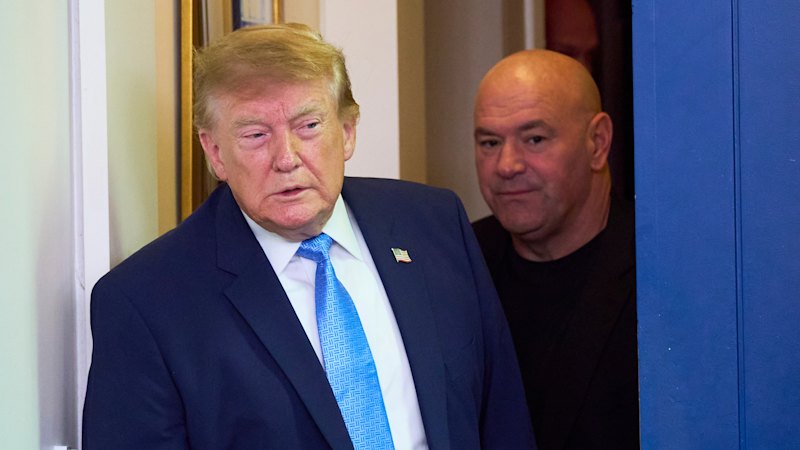
When the doors finally parted, it was not a seasoned diplomat, an economic advisor, or a legislative liaison who stepped behind the seal of the President of the United States.
It was Dana White.
To understand the quiet shockwave that rippled through those forty-nine leather seats—and subsequently across millions of phone screens—you have to look past the immediate spectacle of the Ultimate Fighting Championship CEO standing at the most famous podium in the world. On paper, the event itself is a simple news item. Dana White, longtime ally and friend to Donald Trump, appeared unannounced at the White House press briefing, delivering remarks and fielding questions in a setting normally reserved for statecraft and policy rollouts. Yet treating this moment as a mere scheduling quirk misses the seismic shift happening beneath our feet.
The Architecture of the Ambush
I have spent enough years watching press rooms and boardrooms to recognize the exact sound a room makes when its rules are rewritten without consent. It is not a gasp. It is a sudden, collective intake of breath followed by the frantic, almost rhythmic clicking of laptop keys—the sound of trained observers trying to force an unfamiliar shape into an old box.
Think about what the White House briefing room actually represents. For decades, it has functioned as a carefully choreographed theater of legitimacy. Every element—from the seating chart assigned by the White House Correspondents' Association to the binder of pre-approved responses resting on the lectern—is designed to signal stability, predictability, and institutional order. Journalists arrive armed with policy briefs; officials arrive armed with talking points. Both sides understand the unspoken treaty: we will argue over the facts, but we will agree on the stage.
By dropping Dana White into that room with a two-minute fuse, the administration did not just introduce a surprise guest. They detonated the treaty.
Consider a hypothetical veteran correspondent sitting in the second row—let us call her Sarah. Sarah has covered three administrations. She spent her morning memorizing unemployment revisions, trade tariff percentages, and the precise wording of a pending Senate appropriation bill. Her muscle memory is calibrated for the subtle evasions of career politicians. When a press secretary says, "We are reviewing all options," Sarah knows how to translate that diplomatic fog into a three-hundred-word dispatch for her editors.
Suddenly, standing ten feet away is a man whose entire career was built on dismantling polite evasions. White does not speak in Washington subjunctives. He speaks in the blunt, unfiltered vernacular of a fight promoter from Boston who turned a bankrupt, heavily regulated bloodsport into a multi-billion-dollar global empire under the banner of Endeavor and TKO Group Holdings.
Sarah's carefully prepared questions about regulatory frameworks suddenly feel like bringing a fountain pen to a cage match. The two-minute warning was not an oversight; it was the entire point. In mixed martial arts, you do not telegraph your strikes. If your opponent sees the punch coming, they slip it, counter, and control the center of the octagon. By denying the press corps time to prepare, the White House stripped away their primary defensive weapon: context and pre-framing.
Why a Fight Promoter Speaks the Language of Modern Politics
To see why Dana White fits so naturally—and so disruptively—into the machinery of modern executive power, we have to look at how political communication has evolved over the last twenty years.
For generations, American politics operated like broadcast television. There were three major networks, a handful of newspapers of record, and a shared national living room. If a president wanted to reach the public, he had to pass through the filter of the briefing room. Reporters acted as translators, taking dense policy and rendering it intelligible for the evening news.
That world is gone. Today, political attention operates like a pay-per-view fight card.
Let us use an analogy to make this concrete. Imagine traditional governance as a classical symphony. Every instrument has sheet music, a conductor keeps strict tempo, and the audience sits quietly until the final movement ends before applauding. The modern media ecosystem, by contrast, is a Saturday night UFC broadcast. There are no intermissions. The crowd is loud, the pacing is relentless, and the promotional buildup—the weigh-ins, the stare-downs, the viral clips—matters almost as much as the bout itself.
Dana White spent twenty-five years mastering that exact attention economy. When he took over the UFC in 2001 alongside the Fertitta brothers for two million dollars, mixed martial arts was banned in dozens of states and dismissed by mainstream sports commentators as "human cockfighting." White did not win legitimacy by apologizing or softening the product to please traditional gatekeepers. Instead, he went directly to the audience. He used reality television with The Ultimate Fighter, embraced early internet forums before legacy sports networks understood social media, and turned himself into the central character of his own brand.
When White walked into the White House briefing room, he brought that exact playbook with him.
Look at the mechanics of his relationship with Donald Trump. Their bond dates back to 2001, when Trump hosted UFC 30 and UFC 31 at the Trump Taj Mahal in Atlantic City at a time when almost no other major venue would touch the promotion. That loyalty became foundational. Over the ensuing decades, Trump appeared cageside to roaring ovations, and White spoke at Republican National Conventions, framing Trump not as a conventional politician, but as a fighter—a narrative archetype that resonates deeply with millions of voters who feel alienated by polished, focus-grouped rhetoric.
When White steps behind the White House podium, he is not acting as a policy expert. He is acting as a cultural translator. To his audience—predominantly young, male, skeptical of legacy institutions, and deeply embedded in podcast ecosystems like Joe Rogan's—White's presence in the West Wing signals something profound: One of us is inside the building.
The Invisible Stakes Behind the Spectacle
It is easy to get swept up in the theater of the moment—the viral clips, the baffled expressions of beat reporters, the immediate surge of partisan commentary online. Yet if we stop at the spectacle, we miss what is actually at stake for democratic accountability and public trust.
I will admit something openly here: watching moments like this makes me deeply uneasy, even as I recognize their undeniable brilliance as political theater. The uneasiness comes from watching two entirely different systems of truth collide in real time.
In a traditional press briefing, friction is productive. Reporters ask granular, sometimes tedious questions about budgets, legal authorities, and unintended consequences because those details determine how policies affect real people in Akron, Phoenix, and Atlanta. When an official stands at that podium, they are theoretically accountable to the public record. If they misstate a figure, the transcript preserves it.
When an outside celebrity, business mogul, or cultural icon takes that same lectern—especially on two minutes' notice—the rules of accountability blur. White is not a confirmed Cabinet secretary. He does not oversee a federal agency, manage taxpayer appropriations, or answer to congressional oversight committees. If he makes a sweeping claim or brushes aside a complex question with a trademark quip, there is no bureaucratic mechanism to hold him to account. He can walk out of the West Wing, board a private plane back to Las Vegas, and leave the press corps debating the optics while the underlying policy questions remain unanswered.
Consider what happens next in that briefing room once the precedent is set.
If the podium becomes an extension of a podcast studio or a promotional stage, the incentives change for everyone in the room. Reporters, knowing they are competing against viral soundbites engineered for X and TikTok, feel pressured to ask sharper, more performative questions just to remain relevant in the clip economy. Meanwhile, officials realize they no longer need to engage with difficult, substantive inquiries if they can simply change the channel by bringing in a high-wattage surrogate.
The History Echoing in the Basement
None of this happened in a vacuum. Every generation of American leadership has found ways to bypass the press corps when the press corps felt like an obstacle.
In the 1930s, Franklin D. Roosevelt used his Fireside Chats on radio to speak directly into American living rooms, going over the heads of hostile newspaper publishers. In 1961, John F. Kennedy opened press briefings to live television cameras for the first time, recognizing that his charisma on screen could overwhelm skeptical print columnists. In 1992, Bill Clinton put on sunglasses and played the saxophone on The Arsenio Hall Show, shocking traditional political observers who thought late-night variety television was beneath the dignity of the presidency.
Each of those moments felt like a rupture at the time. Each was criticized as a cheapening of civic discourse. And each, in retrospect, was simply a leader adapting to the dominant communication technology of their era.
What makes the Dana White moment distinct—and far more potent—is the inversion of where the legitimacy is flowing.
When Kennedy went on television or Clinton went on Arsenio Hall, the politician was borrowing the cultural currency of the medium to reach voters. When Dana White steps into the White House briefing room, the institution itself is borrowing the cultural currency of an outsider to validate its own relevance. It is an acknowledgment that in 2026, a UFC broadcast, a three-hour unscripted podcast, or a viral clip from a fight weigh-in commands more visceral trust among certain demographics than the official seal of the federal government.
That is a sobering realization, regardless of where you sit on the political spectrum. It tells us that institutional authority is no longer inherited; it has to be fought for, round by round, in an environment where attention is the only currency that clears.
The Human Element in the Front Row
Let us return to our hypothetical reporter, Sarah, sitting in that basement room as Dana White wraps up his remarks and steps away from the microphone.
The entire appearance has lasted only a matter of minutes. The heavy blue doors swing shut again. Within seconds, the room erupts into a low roar of competing voices—producers shouting into headsets, correspondents dictating ledes into their phones, cameras swiveling to capture stand-up reports for the evening broadcasts.
Sarah looks down at her notebook. On the left page are her neat, bulleted notes on municipal bond yields and international shipping lanes. On the right page, scribbled hastily in black ink, is a single quote from a fight promoter who just commanded the most powerful stage on earth without a script, without a title, and without a moment's hesitation.
She realizes something in that quiet second before she begins typing. Her job has not disappeared, nor has the importance of the facts on the left side of her notebook. The roads still need funding; the laws still need scrutiny; the truth still matters.
Yet the walls of the room have changed. The boundary between entertainment and governance, between the octagon and the Oval Office, is no longer a line drawn on a map. It is a door that can swing open with two minutes' notice, revealing a world where the loudest voice in the arena writes the rules of the fight.
The lights in the briefing room stay hot long after the podium empties, illuminating forty-nine leather chairs and a room full of people trying to figure out what round they are in.