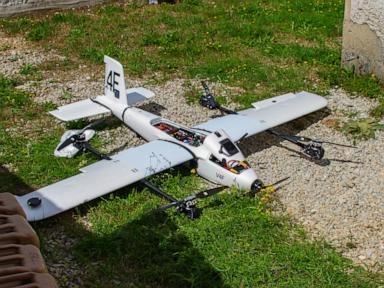
The traditional infantry doctrine of the United States military is built on a fundamental assumption. Total air supremacy and absolute electronic dominance belong to the Western coalition. For decades, American forces planned for conflicts where skies were either friendly or easily cleared by multi-role fighters and cruise missiles.
That architecture broke down in the muddy fields of eastern Europe. You might also find this connected article useful: The Smoke on the Horizon That No One Wants to Name.
Ukrainian combat veterans have quietly embedded with United States units during major training exercises to impart hard-learned survival lessons about modern drone warfare. These sessions are not polite tactical exchanges between allied forces. They are urgent reality checks. The core premise is straightforward. Commercial quadcopters modified with improvised munitions have transformed the tactical baseline of modern combat. American soldiers, accustomed to fighting insurgents with small arms and rudimentary roadside bombs, are now being forced to confront an environment where every square meter of open terrain is visible, transparent, and lethal.
The integration of Ukrainian operators into American training rotations highlights a profound institutional panic within the Pentagon. For years, defense acquisition programs focused on exquisite, multi-million-dollar platforms like the Reaper and the Global Hawk. These systems are optimized for counter-insurgency operations in permissive skies. They are useless when an adversary jams GPS signals, saturates the spectrum with radio frequency noise, and deploys cheap, first-person-view quadcopters piloted by operators sitting safely in a basement three kilometers away. As discussed in detailed reports by NBC News, the effects are significant.
The Anatomy of a Forced Adaptation
To understand why Ukrainian personnel are now teaching American troops, one must examine the speed of industrial adaptation on the front lines. Traditional military procurement cycles take years, sometimes decades. Requirements are written, committees debate, contractors lobby, and prototypes undergo exhaustive testing in sterile desert environments.
The war in Ukraine moves on a weekly cycle.
When Russian forces introduce a new frequency hopping algorithm for their electronic warfare suites, Ukrainian software developers rewrite flight firmware within forty-eight hours. When standard lithium-ion batteries fail in freezing winter trenches, workshops cobble together custom thermal casings using salvaged consumer electronics.
American units participating in joint exercises are finding that their expensive, heavily encrypted tactical radios are remarkably fragile under heavy electronic attack. Ukrainian instructors bring a different philosophy. They rely on redundant, off-the-shelf components, analog backups, and decentralized command structures that allow individual squads to improvise counter-measures on the fly.
During recent simulated engagements at major combat training centers, American platoons discovered a hard truth. Operating without strict electronic silence is equivalent to painting a target on your own chest. Commercial off-the-shelf receivers can detect the electromagnetic signature of a standard military radio from miles away. Within minutes of transmission, an artillery strike or a drone drop follows.
Ukrainian veterans teach American infantrymen how to move across a landscape stripped of cover not by hills and trees, but by thermal optics and digital eyes. Every vehicle exhaust plume, every smartphone signal, and every careless movement in the open is instantly processed by automated targeting systems. The American way of war, which historically relied on massed logistics and concentrated command nodes, must now adapt to a hyper-distributed environment where visibility equals destruction.
Institutional Inertia Meets Kinetic Reality
The friction between legacy defense contractors and the demands of modern drone warfare creates a dangerous bottleneck. Major prime contractors want to sell the Department of Defense heavy, complex systems that require specialized maintenance crews and multi-million-dollar support infrastructure.
Ukrainian units operate on a principle of disposable utility. If a reconnaissance drone costs four hundred dollars, it does not need to be repaired. It needs to complete its mission, locate the target, and guide a munitions drop before it gets shot down or loses signal.
This economic asymmetry is breaking military budgets. Firing a Patriot missile or a specialized surface-to-air interceptor at a modified agricultural drone is a financial trap designed to exhaust Western arsenals. American commanders are learning from their Ukrainian counterparts that counter-measure economics matter just as much as tactical efficacy. Shotguns loaded with birdshot, cheap electronic jammers mounted on rifle barrels, and acoustic sensors placed in tree lines are proving far more effective at protecting squad-level positions than multi-billion-dollar air defense umbrellas designed for ballistic missile defense.
Yet, institutional inertia runs deep. Senior leadership in Washington often views the war in Ukraine through the lens of a temporary anomaly rather than a permanent shift in the character of conflict. They want to integrate drone capabilities into existing battalion structures without fundamentally altering how those battalions fight, supply, and communicate.
The Ukrainians are pushing back against this bureaucratic comfort. They argue that adding a drone platoon to a traditional infantry battalion is insufficient if the entire chain of command still relies on rigid, centralized reporting structures that take hours to approve a fire mission. In a conflict where targets present themselves for less than thirty seconds, the decision-making loop must be compressed to the lowest possible tactical level.
The Problem of Electronic Saturation
Beyond the tactical utility of small quadcopters lies a more insidious challenge. The electromagnetic spectrum is no longer a neutral medium; it is a contested battlefield.
American forces have trained for decades under the assumption that they own the spectrum. Their electronic warfare capabilities were designed to suppress primitive air defense radars and intermittent communications from irregular militias. They were not built to operate in an environment where every tree line contains a passive sensor listening for command links, and every sector is flooded with high-power broadband jamming.
When Ukrainian instructors run electronic warfare drills with American units, the results are often humbling. Communications blackouts occur within minutes. GPS guidance systems fail completely. Units that have grown entirely dependent on digital Blue Force Tracking systems find themselves forced back to paper maps, magnetic compasses, and dead reckoning.
This reversion to analog fundamentals is causing friction among younger soldiers who have never operated without a glowing screen providing real-time positional data. The psychological shock of losing digital situational awareness is acute. Ukrainian veterans emphasize that mental resilience in a communications-denied environment is just as critical as the hardware being carried in the rucksack.
Furthermore, the proliferation of low-cost reconnaissance drones has eliminated the concept of the rear echelon. In previous conflicts, a forward operating base ten miles behind the front lines was a zone of relative safety where soldiers could sleep, eat, and maintain equipment away from direct fire. Today, fiber-optic-guided drones and long-range loitering munitions hunt logistics convoys and command posts deep behind what used to be considered safe lines.
Rebuilding the Force Architecture
The lessons absorbed from these joint training sessions are slowly bleeding into official doctrine, but the process is agonizingly slow. The United States Army is currently overhauling its division and brigade structures under the Transformation in Contact initiative, attempting to push reconnaissance and drone-jamming assets down to the company level.
However, hardware acquisition is only half the battle. Training pipelines take years to update. Drill sergeants at basic training installations are only now beginning to incorporate drone evasion and anti-air camouflage into standard infantry instruction. For decades, basic training taught soldiers to look up for high-flying aircraft and listen for incoming artillery. Now, recruits must learn to spot the faint, high-pitched buzz of a four-propeller drone hovering three hundred feet above the treeline, invisible against a gray sky.
The integration of Ukrainian personnel into these exercises represents an admission of a painful reality. The American military, despite its unmatched global reach and technological sophistication, was structurally unprepared for the democratization of precision air power.
When combat engineers and infantry squads from the 82nd Airborne or the 101st Division sit down with veterans who spent months holding trenches against relentless FPV strikes, the traditional hierarchy of military expertise inverts. The teacher becomes the student. The superpower learns from the battle-tested survivor how to wage war in an age where absolute dominance of the skies has vanished, replaced by a contested, crowded, and unforgiving low-altitude frontier.
The gaps exposed in these training blocks will not be closed by another multi-billion-dollar procurement bill or a new Pentagon committee. They require a total reconfiguration of how American soldiers think about visibility, mobility, and decentralized command in a world where anyone can buy the tools of precision destruction off a commercial shelf.