Water remembers where it used to go before we paved over it.
That is the first thing you realize when you stand beside an urban waterway in Incheon, South Korea. The concrete banks try to pretend they are permanent, boxing the tide into straight, predictable lines. But nature has a stubborn memory. On an ordinary morning, ordinary citizens walking their dogs or commuting across the bridges found something that shattered that illusion completely.
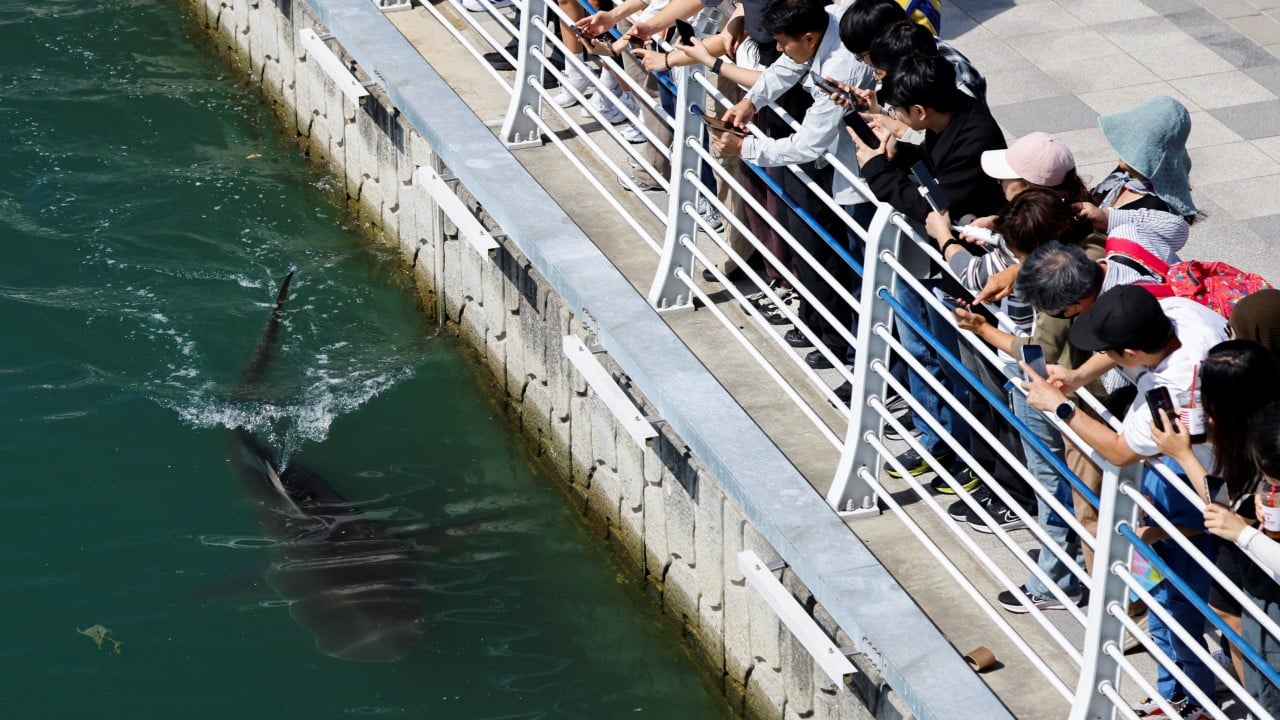
A shark. Not in the deep, blue expanse of the Pacific, but trapped in a narrow, shallow concrete canal, fighting a losing battle against a shrinking tide.
Picture the scene through the eyes of a local resident leaning over the metal railing. (Note: This is a dramatized perspective built on the verified emergency response accounts.) At first, it looks like a discarded piece of dark fabric or a floating log swaying with the ripples. Then comes the unmistakable slice of a dorsal fin breaking the surface. Panic ripples faster than the current. Phones emerge from pockets. Emergency services are dialed.
How did it get there? Marine biologists and local fisheries officials faced a baffling puzzle. Sharks do not casually commute inland. They follow prey, or temperature gradients, or currents pushed deep inland by freak tidal anomalies. In coastal areas where commercial fishing fleets operate and bustling ports interact with narrow estuaries, marine life and urban sprawl often collide in bizarre, unintended ways. This particular apex predator, likely disoriented and swept in by high tides, found itself navigating a concrete labyrinth meant for stormwater drainage, not marine wildlife.
Rescue is rarely clean when humans try to reverse an ecological collision.
The first attempt arrived with good intentions and standard gear. Rescuers tried to herd the animal, creating a makeshift barrier to guide it back toward the wider open waters of the sea. But the canal is a harsh environment for a creature built for momentum and open space. Sharp angles, slippery concrete, and the roaring echo of city noise overhead create sensory overload. The animal thrashed, panicked, and ultimately slipped away from the initial rescue net, remaining stranded as the sun climbed higher and the water level dropped.
Silence descended on the canal banks after that first failure.
Consider what happens next: the clock starts ticking. A marine animal out of its depth is fighting a double battle against human interference and biological reality. Without enough depth to cover its gills properly, stress builds. Lactic acid floods the muscles. The margin for error shrinks with every passing hour.
This is where expertise meets vulnerability. The authorities did not abandon the effort. A second rescue attempt was mobilized, bringing in specialized marine animal handlers equipped with heavy-duty stretchers, transport tanks, and precise timing coordinated with the local tide schedule. They had to wait for the water to shift, balancing the safety of the human crew against the survival of a frightened animal that could easily inflict severe injury out of sheer terror.
When the second team entered the water, the approach changed. It was slower, more methodical, and deeply respectful of the creature's raw power. They didn't fight the shark; they intercepted its panic with calm, coordinated positioning. Using a specialized canvas sling, the handlers secured the animal, lifting it out of the concrete trap and into a specialized transport vehicle bound for release far out in the open sea.
The canal grew quiet again. The crowds dispersed, scrolling through the photos they had captured, returning to their buses and office buildings.
Yet, the image lingers.
We build our cities to keep the wild world safely compartmentalized on the other side of a seawall or a glass screen. We draw neat lines between human spaces and nature. But every so often, a misplaced wave or a wandering current reminds us that those boundaries are entirely porous. The city is built on top of habitats that were there long before the concrete was poured, and occasionally, the two worlds collide in the most unexpected places.
The water keeps flowing. The concrete stays put. And somewhere out in the deep water, a lone survivor swims away from the shadow of the bridge, back into the dark, indifferent sea.