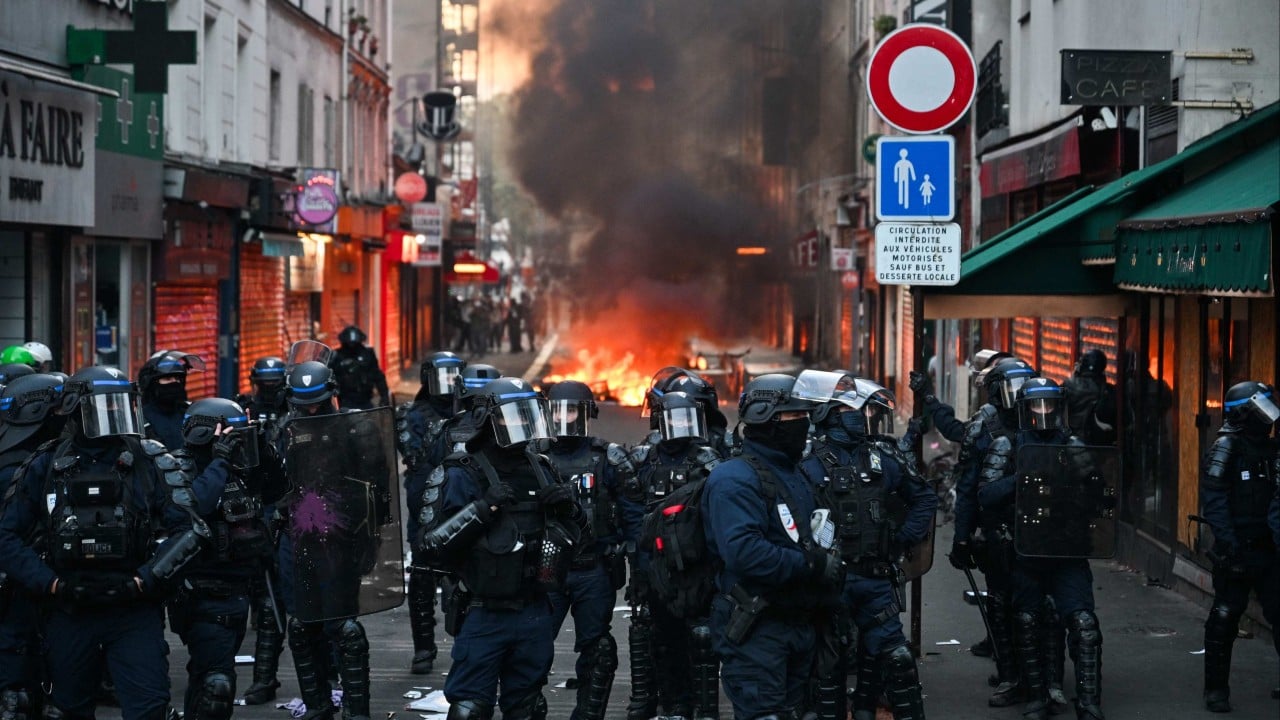
Standard news coverage of Parisian street unrest treats demonstrations, barricades, and shop looting as a single wave of chaos. That framing is analytically broken. When large demonstrations against living costs and public service strain—such as the October 2026 mobilizations across France—converge with dense urban commercial corridors, crowd behavior splits into distinct tactical modes that overwhelm static crowd-control doctrine.
The blueprint for understanding these escalations rests on four structural mechanics: Actor Divergence, Spatial Resource Allocation, Tactical Lag, and Institutional Escalation Costs. When police forces optimize for fixed-point defense of state institutions and march routes, mobile opportunistic actors exploit the resulting coverage gaps.
Separating Demonstrators From Violent Clashes and Looters
Conventional headlines conflate three populations that operate under different incentives, risk tolerances, and mobility profiles. Mixing them in a single narrative obscures why arrests can spike into the hundreds or thousands while commercial corridors still suffer prolonged damage.
Peaceful Mass Demonstrators
- Primary objective: Signal political grievance—such as rising living costs, fuel expenses, or school funding—through visible collective presence.
- Spatial profile: High volume, predictable routes, and slower movement speeds across boulevards and squares.
- Vulnerability: Exposed to containment perimeters, tear gas drift, and crowd-density medical risks when routes compress.
Confrontational and Black Bloc Actors
- Primary objective: Disrupt state authority, erect street obstacles using bikes or urban street furniture, and engage security units directly.
- Spatial profile: High-intensity focal points near junctions, symbolic buildings, or march flanks.
- Constraint: Require tight group cohesion or rapid dispersal lanes to avoid encirclement and arrest.
Opportunistic Looters
- Primary objective: Acquire high-resale or high-utility goods—footwear, electronics, eyewear, jewelry, or retail stock—under cover of diverted security attention.
- Spatial profile: Decentralized, fast-moving, and willing to hit secondary commercial streets away from the primary protest march.
- Constraint: Sensitive to immediate patrol presence and shopfront hardening, yet able to operate in small cells that scatter on foot or transit when sirens approach.
Cause and effect run unevenly across these groups. Peaceful marches supply the crowd density and media visibility that draw security resources to central axes. Confrontational clashes consume police reserves and create street debris. Once reserves are committed to holding lines or extinguishing fires, the marginal cost of smashing a storefront drops sharply for opportunistic actors.
The Cost Function of Urban Crowd Containment
Public-order policing operates under a binding resource constraint: personnel, armored vehicles, specialist riot units, and detention processing capacity are finite at any given hour. Every officer assigned to guard a government ministry, town hall, or primary march flank is unavailable to patrol adjacent shopping streets.
This trade-off explains a recurring operational puzzle during multi-day unrest. Even after hundreds of arrests are logged in a single weekend, looting can recur on subsequent evenings. Arresting suspects does not immediately restore patrol density; processing detainees, documenting offenses, and staffing custody facilities absorb administrative and operational bandwidth. When police leadership debates whether enforcement was distributed evenly across neighborhoods or concentrated on specific districts, the underlying bottleneck is almost always force-to-area ratio rather than a single commander's whim.
From an economic standpoint, looters face a low-probability, high-payoff micro-transaction when response times lag behind a 30-to-90-second window needed to shatter glass and clear shelves. Shopkeepers face the inverse cost structure: repairing plate glass, replacing inventory, paying higher insurance premiums, and absorbing lost weekend foot traffic. That asymmetry is why merchants sometimes pre-emptively pack stock into vans or shutter early once unrest persists past the first night.
Why Multi-Day Escalation Catches Security Off Guard
A common reporting trope suggests that authorities are simply "surprised" when violence continues into a second night. In practice, post-march nightfall shifts the operational environment in three predictable ways that punish static daytime postures:
- Dispersion after formal marches end: Once organized unions or protest organizers conclude a daytime route, peaceful participants head home, leaving behind a smaller but more fragmented street footprint across wider entertainment and retail zones.
- Information velocity vs. command cadence: Rumors, livestreamed flashpoints, and viral claims spread across social platforms faster than tactical units can be redeployed across dense street grids.
- Accumulated fatigue and infrastructure strain: Extended shifts degrade reaction speed, while damaged street furniture, burned vehicles or e-bikes, and blocked lanes slow vehicle pursuit.
Consider a practical example along a dense commercial corridor connecting a major transit hub to side streets with boutiques and pharmacies. If riot vans commit to clearing a burning barricade on a main square, small groups operating two blocks over can hit a storefront, grab portable items, and vanish into pedestrian alleys before a patrol car navigates the rerouted traffic. That is a tactical lag problem, not a failure to notice that unrest exists.
How Authorities Respond and Where Those Levers Break Down
When street disorder escalates nationwide or spills across borders during broader cost-of-living waves, governments typically pull four policy and operational levers. Each carries distinct trade-offs and failure modes.
Surge Deployments and Perimeter Hardening
- Mechanism: Increasing officer headcount on subsequent weekends and ring-fencing sensitive public buildings and commercial hubs.
- Limitation: High personnel cost and potential displacement of looting to unguarded secondary streets or neighboring municipalities.
Protest Bans and Administrative Restrictions
- Mechanism: Prohibiting specific gatherings or restricting movement in high-risk zones to preempt clashes.
- Limitation: Legal challenges, friction with peaceful demonstrators who follow rules, and limited deterrence against actors who already ignore public-order laws.
Fast-Tracked Prosecutions and Custody Scaling
- Mechanism: Accelerating court hearings and expanding detention capacity to raise the immediate legal penalty for rioting and theft.
- Limitation: Strain on legal defense systems, arrest identification challenges in chaotic crowds, and slow effect on underlying economic grievances.
Political Messaging and Grievance Framing
- Mechanism: Televised national addresses condemning lawlessness while signaling attention—or resistance—to underlying social demands.
- Limitation: Rhetoric alone rarely calms active street dynamics if residents and merchants perceive a gap between stated resolve and visible street protection, or if protesters view leadership as tone-deaf to living costs.
Tactical Playbook for Evaluating and Managing Unrest
Analysts, municipal planners, and commercial operators tracking civil unrest can apply a disciplined four-step diagnostic rather than relying on aggregate arrest totals or dramatic street labels:
- Map the three-way split early: Separate peaceful march attendance estimates from localized clashes and commercial looting incidents, noting timestamps and distances from the main route.
- Track force allocation against commercial density: Watch whether patrol presence is clustered around symbolic state sites while high-turnover retail streets remain lightly covered.
- Measure night-over-night persistence: Distinguish a single-day spike tied to a mass march from multi-night opportunistic spillover, which signals a shift from protest-adjacent disruption to autonomous street predation.
- Audit second-order economic friction: Look beyond broken glass to transit disruptions, early store closures, emergency service strain, and polarized political narratives that harden positions on all sides.
There is no silver bullet in public-order management because aggressive mass containment risks inflaming peaceful citizens and injuring bystanders, whereas light-touch containment invites property destruction and erodes public confidence. Any strategy that treats a political march and a smash-and-grab raid as the same problem will misallocate resources before the first siren sounds.
Strategic Play: Pair mobile, rapid-response patrol cells dedicated specifically to commercial corridors with clear, pre-announced perimeter protection around civic buildings—while coupling short-term order maintenance with transparent, verifiable relief on core household cost pressures so legitimate grievances do not keep replenishing the street crowd week after week.


