Reports originating from the Wall Street Journal confirm that the United States military has conducted targeted strikes on Qeshm Island, a sprawling, rocky landmass controlled by Iran inside the Strait of Hormuz. This kinetic action marks a sharp departure from the shadow boxing that has defined Washington and Tehran’s interactions for decades. By hitting assets on Qeshm, American planners moved directly against the physical infrastructure Iran uses to project power over the world's most sensitive maritime bottleneck.
Standard news coverage treats this as another routine flare-up in a long-running regional feud. That view misses the structural reality on the ground. Qeshm is not just an isolated outpost in the Persian Gulf; it is the forward operating base for the Islamic Revolutionary Guard Corps Navy (IRGCN) and a vital logistics node for drone, missile, and fast-attack boat operations. Striking it directly signals a shift in American deterrence doctrine from reactive defense to proactive disruption of Iranian anti-access capabilities.
The Geography of a Chokepoint
To understand why Qeshm matters, look at a map of the Strait of Hormuz. At its narrowest point, the waterway between Oman and Iran is roughly 21 nautical miles wide. Within that gap, the actual shipping lanes for deep-draft supertankers are only two miles wide in each direction, separated by a two-mile buffer zone.
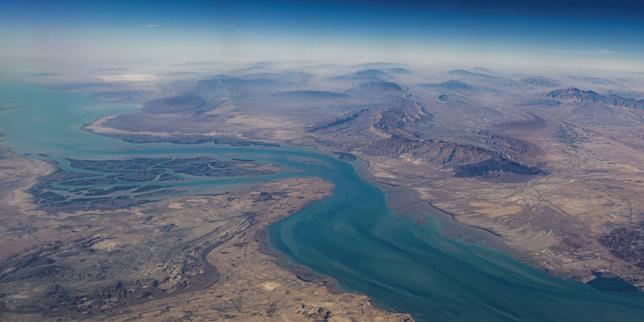
Qeshm Island stretches for roughly 85 miles parallel to the southern Iranian coast, sitting immediately adjacent to this navigational pinch point. It is the largest island in the Persian Gulf, dwarfing Bahrain. Because of its sheer size and rugged terrain, the island provides natural cover and strategic depth that mainland ports like Bandar Abbas cannot always match.
For years, military analysts have tracked the fortification of Qeshm. The island houses underground storage facilities, coastal defense cruise missile batteries, and deep-water berths designed for the IRGCN's asymmetric fleet. Unlike the conventional Iranian Navy, which operates larger, aging frigates suited for blue-water patrols, the IRGCN relies on swarms of small, heavily armed speedboats, midget submarines, and unmanned aerial vehicles. Qeshm is their primary launchpad.
When commercial vessels transit the Strait, they pass directly under the shadow of sensors and launch sites positioned along Qeshm's southern shoreline. Roughly one-fifth of the world's total petroleum consumption—around 20 to 21 million barrels per day—moves through this corridor, alongside massive volumes of liquefied natural gas (LNG) from Qatar. Any military action on Qeshm immediately threatens the physical security of global energy markets.
Breaking the Asymmetric Playbook
For decades, Iran has relied on plausible deniability and proxy warfare to keep Washington off balance. Whether through Houthi attacks in the Red Sea, militia rocket fire in Iraq, or limpet mine sabotage against tankers in the Gulf of Oman, Tehran has carefully calibrated its aggression to stay just below the threshold of conventional war. The operational goal was clear: impose continuous economic and political costs on the United States and its allies without inviting devastating retaliation on Iranian soil.
The strikes on Qeshm shatter that calculus.
By hitting targets on sovereign Iranian territory—even an island separated from the mainland—the Pentagon crossed a psychological and strategic red line that previous administrations hesitated to breach. Even during the height of the 2019 tanker wars, when Iranian air defenses downed a multi-million-dollar US Global Hawk drone over the Strait, Washington pulled back from kinetic strikes on Iranian soil at the final hour, opting instead for cyberattacks against missile control systems.
Executing physical strikes on Qeshm demonstrates that the old rules of engagement are dead. The target selection likely focused on specific high-value nodes rather than broad infrastructure. In operations of this nature, military planners prioritize three distinct categories of targets:
- Command, Control, and Intelligence Nodes: Radar installations and signals intelligence facilities used to track naval movements and guide anti-ship missiles.
- Unmanned Systems Infrastructure: Assembly workshops, fuel depots, and launch rails for one-way attack drones and surveillance UAVs.
- Naval Logistics and Munitions: Hardened bunkers housing anti-ship cruise missiles (such as the Noor or Qader variants) and naval mines capable of closing the shipping lanes within hours.
Neutralizing these assets degrades Iran's ability to coordinate complex, multi-axis attacks against international shipping. It forces the IRGCN to spend time and resources repairing command links and dispersing surviving hardware rather than planning offensive operations.
The Economic Shockwave and Maritime Risk
Markets hate uncertainty, and nothing generates panic on trading floors faster than smoke rising from the Strait of Hormuz. Even if the American strikes were surgically precise and avoided civilian port facilities or energy infrastructure, the mere precedent of direct combat inside the Gulf alters the risk profile for every shipping company on earth.
Consider the mechanics of maritime insurance. Whenever hostilities flare near critical waterways, London-based underwriters—specifically the Joint War Committee—reassess the war risk premiums charged to vessel owners. A sudden spike in these premiums adds hundreds of thousands of dollars to the cost of a single voyage. If the threat level escalates further, insurers may pull coverage altogether, effectively halting commercial traffic without a single mine being laid in the water.
Bypassing the Strait of Hormuz is practically impossible at scale. While Saudi Arabia and the United Arab Emirates have invested billions in overland pipelines—such as the East-West Pipeline to the Red Sea and the Habshan-Fujairah pipeline to the Gulf of Oman—their combined spare capacity can only absorb a fraction of the crude that normally travels by sea. Furthermore, there is no pipeline alternative for Qatari LNG. European and Asian energy grids, heavily reliant on Qatari gas shipments to balance supply, remain completely exposed to any disruption around Qeshm.
| Strategic Factor | Impact of Qeshm Strikes | Long-Term Implication |
|---|---|---|
| IRGCN Operations | Immediate degradation of radar and launch sites | Forced dispersal of assets to mainland sites |
| Oil & Gas Markets | Immediate spike in geopolitical risk premiums | Sustained volatility in Brent crude and LNG futures |
| Maritime Insurance | Higher war-risk surcharges for Gulf transits | Increased consumer costs for global shipping |
| Regional Diplomacy | Heightened alert status across Gulf Arab states | Pressure on GCC nations to stay neutral |
The Gray Area of Escalation Control
Military force is a blunt instrument, and veteran strategists know that tactical success rarely guarantees strategic victory. While the strikes on Qeshm undeniably damaged Iranian military hardware, they also introduce profound risks regarding escalation control.
Tehran now faces an acute domestic and regional credibility crisis. The Iranian leadership has spent years projecting an image of invulnerability, promising that any attack on Iranian territory would trigger a regional inferno. Absorbing strikes on Qeshm without a visible response risks undermining the regime's deterrence posture and demoralizing its proxy network across the Middle East.
Yet, a massive conventional retaliation carries existential risks for Tehran. Engaging the US Navy directly in the Persian Gulf would result in the rapid destruction of Iran's surface fleet and coastal air defenses. Consequently, Iranian planners are caught between the political necessity to respond and the military reality of American firepower.
History suggests Tehran will look for asymmetric off-ramps. Instead of a direct confrontation in the Strait of Hormuz, Iran might increase pressure in theaters where the United States is more vulnerable or politically constrained. This could mean authorizing intensified attacks by allied militias against US bases in Syria and Iraq, ramping up cyber operations against Western financial or infrastructure targets, or seizing commercial vessels with tenuous links to Western interests under legal pretexts.
There is also the nuclear dimension. Whenever Iran's conventional deterrence is degraded, hardliners in Tehran argue more forcefully for advancing the country's nuclear program as the ultimate guarantor of regime survival. By demonstrating that conventional island fortifications cannot stop American precision munitions, the strikes may inadvertently strengthen the hand of those within the Iranian establishment who advocate for crossing the nuclear threshold.
The Vulnerability of Gulf Neighbors
Caught directly in the crossfire are the Arab states of the Gulf Cooperation Council (GCC)—Saudi Arabia, the United Arab Emirates, Qatar, Kuwait, Bahrain, and Oman. Over the past several years, Riyadh and Abu Dhabi have worked aggressively to de-escalate tensions with Tehran, restoring diplomatic ties and prioritizing domestic economic transformation over regional ideological battles.
The strikes on Qeshm put these nations in an untenable position. Most host major American military installations, airbases, and naval headquarters. While Gulf leaders publicly call for restraint and diplomacy, they remain acutely aware that if Iran decides to retaliate regionally, their own desalination plants, oil refineries, and commercial ports sit just minutes away by ballistic missile or drone flight.
During previous crises, Gulf states have quietly restricted the US military from using bases on their soil to launch offensive strikes against Iran, forcing the Pentagon to rely on aircraft carriers, long-range bombers flying from the continental United States, or bases further afield. Whether regional partners provided logistical support or airspace access for the Qeshm operation remains shrouded in operational security, but the political fallout in Gulf capitals will be intense. If Tehran perceives that any Arab neighbor facilitated the attack, the fragile détente in the Persian Gulf could collapse overnight.
Assessing the New Reality in the Gulf
The narrative surrounding the Qeshm strikes will inevitably be shaped by political spin from both Washington and Tehran. American officials will frame the operation as a measured, necessary step to restore deterrence and protect freedom of navigation. Iranian state media will either downplay the extent of the damage to avoid looking weak or boast of successful air defense interceptions to rally domestic support.
Strip away the rhetoric, and the physical facts remain clear. The buffer zone that protected sovereign Iranian territory from direct American kinetic action has evaporated. Qeshm Island, long treated by the IRGCN as an untouchable fortress overlooking the world's most vital energy artery, has proven vulnerable to modern precision strike capabilities.
For shipping executives, energy traders, and defense planners, the operational baseline has permanently shifted. The Strait of Hormuz is no longer merely a zone of heightened tension where naval vessels trade radio warnings and fire flare guns. It is an active battlespace where the world's premier military superpower has demonstrated a willingness to strike Iranian soil directly, leaving the global economy to absorb the aftershocks of whatever move Tehran makes next.