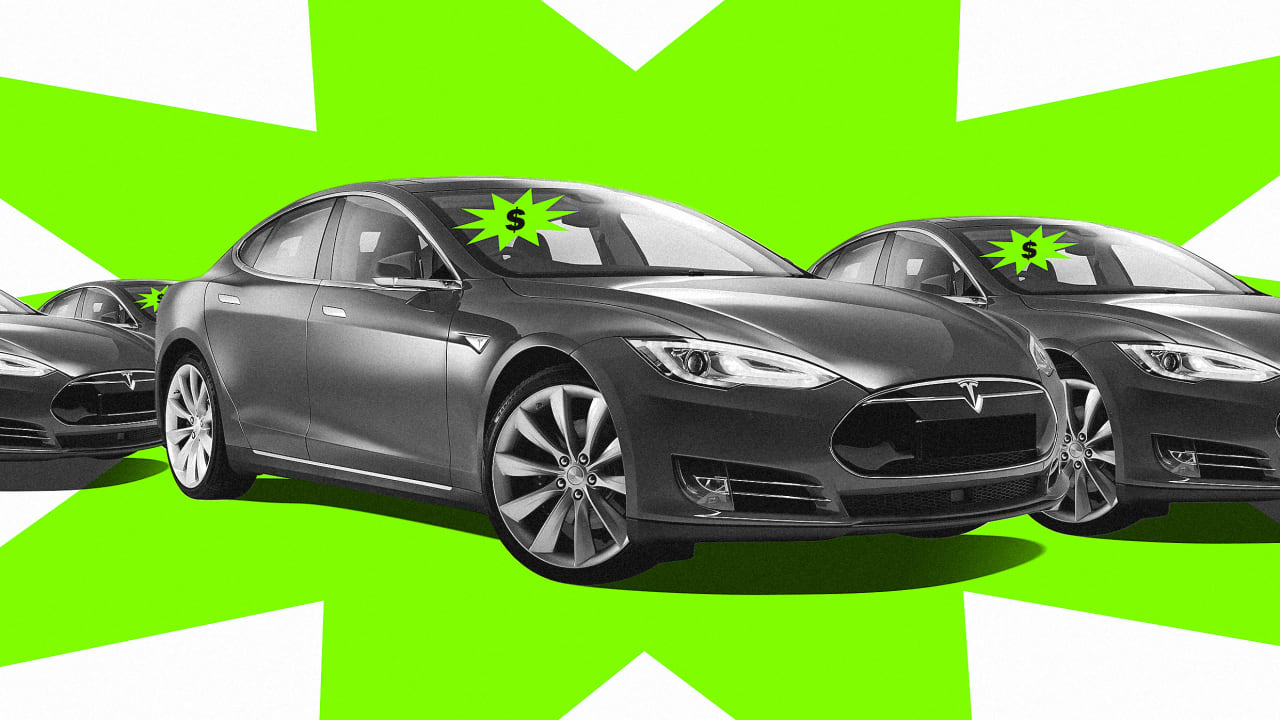
The headlines are predictable. Tensions in the Strait of Hormuz spike, Brent crude creeps toward $100, and suddenly every armchair analyst claims the used electric vehicle market is the ultimate hedge against geopolitical instability. They want you to believe that a conflict between the US and Iran is a "buy" signal for a three-year-old Model 3. They are wrong.
This lazy consensus ignores the brutal reality of global supply chains and the physics of the energy market. Buying a used EV during a Middle East crisis isn't a masterstroke of financial planning; it’s a reactionary panic move that ignores the fact that electricity prices and gas prices are often tethered by the same invisible leash. If you think you're escaping the volatility of the fossil fuel market by switching to a battery, you haven't been paying attention to how the grid actually breathes.
The Natural Gas Trap
The most frequent argument for the "EV surge" during war is simple: gas gets expensive, so people ditch internal combustion engines (ICE). It’s a clean, linear narrative. It’s also a fantasy.
In the United States, natural gas accounts for roughly 40% of utility-scale electricity generation. When oil prices spike due to conflict in the Middle East, natural gas often follows suit. They are companion commodities. If a US-Iran war breaks out, the global energy complex doesn't just lose oil; it loses stability across the entire hydrocarbon spectrum.
When the input cost for the power plant goes up, your "cheap" overnight charge gets a lot more expensive. In states like California or Massachusetts, where the grid is already under-resourced and over-regulated, the delta between the cost of a gallon of gas and a kilowatt-hour (kWh) of electricity shrinks faster than most buyers realize. I’ve watched fleet managers dump millions into electrification projects only to realize their "fuel" savings were erased by peak-hour pricing and grid surcharges triggered by the very energy crisis they were trying to outrun.
The Used EV Quality Mirage
The competitor’s narrative suggests that the used EV market is a goldmine for the budget-conscious patriot. It isn’t.
The used EV market is currently a graveyard of first-generation mistakes. We are talking about vehicles with degraded battery health, outdated thermal management systems, and proprietary software that manufacturers are already itching to "sunset."
- Battery Degradation: A used EV is only as good as its State of Health (SOH). Most buyers don't know how to read a battery report, and most dealers don't want to show them. You aren't buying a "car"; you are buying a chemical reaction that has been slowly dying since the day it left the factory.
- The Replacement Cost Bomb: If the battery pack fails out of warranty—which many of these "war hedge" vehicles are approaching—the cost of replacement often exceeds the total value of the car.
- Insurance Premiums: Insuring an EV is significantly more expensive than an equivalent ICE vehicle. Why? Because even a minor fender-bender can compromise the battery housing, leading to a total loss.
When you factor in the insurance hike and the looming threat of a $15,000 battery swap, that "saved" money at the gas pump looks like pocket change.
The Myth of Energy Independence
There is a patriotic tint to the argument that buying an EV hurts Iran. It’s a feel-good story for the evening news. The reality is that while you might be moving away from Iranian oil, you are moving directly into the arms of a supply chain dominated by another set of geopolitical rivals.
Lithium-ion batteries require cobalt, nickel, and lithium—minerals whose processing is overwhelmingly controlled by China. If a US-Iran conflict escalates into a wider regional or global trade war, the cost of the components needed to maintain and repair those used EVs will skyrocket.
I’ve seen this play out in the semiconductor industry. People thought they could pivot to new tech to avoid old-world shortages, only to find that the new tech was even more vulnerable to single-source failures. You aren't achieving "independence"; you are just trading one master for another.
Why the "Used" Market Is Actually a Liability
The logic that a war-driven oil spike makes used EVs more attractive is fundamentally flawed because it ignores the velocity of innovation.
In the world of ICE vehicles, a 2018 Camry and a 2024 Camry are fundamentally similar. In the EV world, five years is an eternity. A used EV from 2019 often lacks the charging speed, range, and efficiency of a 2024 model.
When gas prices go up, the value of the most efficient vehicles goes up. But the market isn't stupid. Smart money flows toward new EVs with better warranties and vastly superior battery chemistry (like Lithium Iron Phosphate or LFP). This leaves the used market as a dumping ground for "compliance cars" and early-adopter experiments. Buying into that market during a price spike is catching a falling knife.
The Real Winner: Hybridization
If you want a contrarian take that actually holds water, look at the vehicles the "EV-only" crowd hates: Hybrids.
While the "US-Iran war boosts EV sales" crowd is busy waiting two hours for a public charger that might be broken, the hybrid owner is getting 50 MPG without being tethered to a fragile electrical grid.
- Grid Independence: If an energy crisis leads to rolling blackouts or "demand response" events where you are forbidden from charging your car, a hybrid keeps moving.
- Value Retention: Hybrids are currently holding their value better than pure EVs. They offer the hedge against gas prices without the "total loss" risk of a dying battery pack.
- Infrastructure Agnosticism: You don't need a $2,000 home charger installation to make a hybrid work for you.
The Brutal Truth About "Savings"
Let’s dismantle the "People Also Ask" nonsense about how much an EV saves you during a war.
If gas hits $6.00 a gallon, a typical commuter might spend $300 a month on fuel. Switching to an EV might drop that to $80 in electricity. That’s a $220 difference.
Now, look at the math on a used EV purchase during a hype cycle. You will likely pay a "war premium" of $3,000 to $5,000 because every other panicked buyer has the same idea. It will take you nearly two years of driving just to break even on the premium you paid for the car, let alone the car itself. By then, the conflict might be over, gas prices might have stabilized, and your used EV's battery will be two years closer to the scrap heap.
Stop Buying the Narrative
The idea that a US-Iran conflict is a catalyst for a used EV boom is a marketing ploy designed to move stagnant inventory. It preys on "pain at the pump" anxiety while ignoring the total cost of ownership.
If you want to buy an EV, buy it because you like the instant torque. Buy it because you can charge at home and you hate going to gas stations. Buy it because you believe in the tech.
But don't buy a used EV because you think it’s a strategic move in a geopolitical chess match. You’re not a grandmaster; you’re the liquidity that the smart money is exiting into. The grid is vulnerable, the batteries are aging, and the "savings" are a mathematical mirage.
If the missiles start flying in the Middle East, the last thing you want is to be stuck with a five-year-old battery and a skyrocketing utility bill.