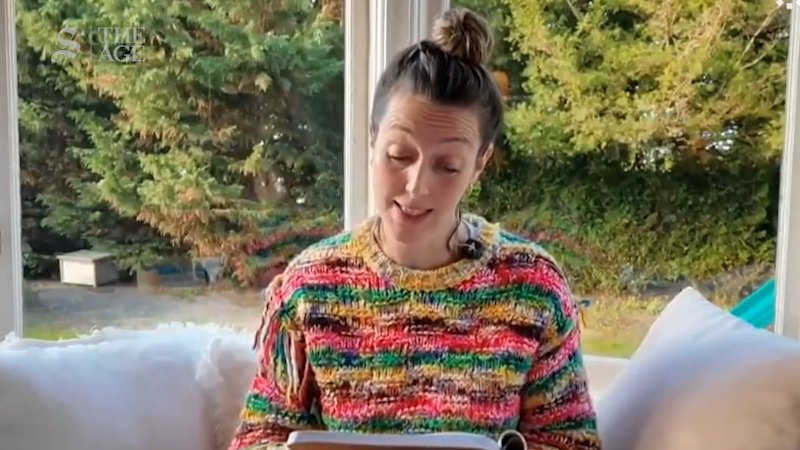
Silence.
In the relentless, twenty-four-hour churn of modern celebrity culture, silence is the one sound that travels faster than a scream, reverberating through newsrooms, legal chambers, and living rooms with a suffocating weight that makes everyone lean in closer to catch the slightest tremor of a breath. When a man who built a twenty-year empire on the sheer, hypnotic velocity of his own voice suddenly stops speaking in his own defense, the vacuum doesn't stay empty for long. Someone always steps forward to fill it.
In the case of Russell Brand, that someone was his wife, Laura Gallacher.
Consider the sheer psychological choreography of that moment. For decades, Brand was the ultimate verbal shapeshifter, a man capable of talking his way out of tabloid scandals, political debates, and personal implosions with a dizzying cascade of Cockney slang, Victorian vocabulary, and spiritual platitudes. Yet when the allegations of sexual assault and abuse surfaced in 2023—followed by police interviews, intense media scrutiny, and the subsequent legal reckoning—the loudest man in the room stepped back from the podium. Instead, the world heard the words "I am not guilty" delivered not in his familiar, theatrical baritone, but through the steady, measured cadence of the woman who shares his home and raises his children.
It is easy to treat this as another headline in the endless scroll of celebrity turmoil. Most news outlets did exactly that, reducing the event to a brisk summary of dates, legal denials, and biographical bullet points. They missed the real story entirely. The real story isn't merely about what a famous comedian said or didn't say; it is about the invisible human architecture that holds up—or collapses—when public accusation collides with private loyalty.
The Anatomy of a Surrogate Voice
To understand why a statement read by a spouse carries such a distinct emotional charge, step away from the blinding glare of London media circles and step into a quiet, hypothetical kitchen on a rainy Tuesday morning.
Picture a woman named Clara. Her husband, a local community leader known for his charisma and public generosity, has just been accused of severe misconduct. Before the lawyers even draft a formal response, the phone begins to ring. Neighbors stop making eye contact at the school gates. The local paper calls for a comment. Suddenly, Clara is no longer just a wife or a mother; she becomes an unwitting press secretary, a character witness, and a human shield all at once.
When Clara steps onto her front porch to read a statement proclaiming her husband's innocence, she isn't just reciting legal boilerplate. Every syllable she utters is weighed against her own credibility. If the public believes her, her husband buys time and sympathy. If the public doubts her, she risks being painted as either hopelessly naive or coldly complicit.
This is the exact tightrope Laura Gallacher walked when she read Russell Brand’s declaration of innocence.
Public relations strategists have understood this dynamic for generations, though they rarely speak of it in human terms. In crisis management, a proxy statement serves a very specific function: it softens the edges of defiance. When an accused man looks into a camera and says, "I am not guilty," audiences instinctively search his face for arrogance, anger, or deception. His reputation—especially if it was built on manic energy or boundary-pushing humor—works against him. People hear the persona before they hear the plea.
When his wife reads those exact same words, the emotional frequency changes. The tone shifts from combative to domestic. The visual framing reminds the observer that behind the polarizing public figure sits a family unit, a quiet life in Oxfordshire, and young children who cannot yet read the headlines. Whether intentional or purely organic, the effect is profound: it transforms an abstract legal battle into a deeply personal domestic drama.
The Weight of Words Under Scrutiny
Of course, empathy for the human complexity of the room does not erase the gravity of what brought everyone there in the first place. To tell this story honestly, we have to hold two massive, uncomfortable truths in the same hand without dropping either one.
First, there are the facts of the public record. In September 2023, a joint investigation by The Times, The Sunday Times, and Channel 4’s Dispatches published accounts from multiple women alleging rape, sexual assault, and emotional abuse against Brand between 2006 and 2013—the height of his mainstream fame across BBC Radio 2, Channel 4, and Hollywood films. Following those reports, the Metropolitan Police in London received additional allegations, leading to multiple police interviews under caution and formal legal proceedings that stretched through 2024 and beyond.
Second, there is Brand’s unwavering, categorical denial. From his initial video response posted to his millions of online followers before the documentary even aired, through subsequent legal filings and statements relayed by his wife, his position has never budged: every relationship he engaged in was consensual, and the accusations represent a coordinated attack on his character and independent media platform.
When you strip away the partisan shouting matches on social media, you are left with a stark, irreconcilable collision of narratives. On one side stand women who carried private trauma for over a decade before stepping into the terrifying spotlight of public testimony. On the other stands a man insisting his life is being dismantled by falsehoods, flanked by a partner who has chosen to stand beside him in front of the cameras.
Why does this specific dynamic unsettle us so deeply?
Because most of us have never been cross-examined in a courtroom or trended globally on X, yet almost all of us know what it feels like to stake our reputation on someone else’s word. We know the quiet terror of vouching for a friend, a sibling, or a partner when the whispers start to circle. You search your own memories for clues you might have missed. You replay old conversations in the dark, looking for hairline fractures in the person you thought you knew. And once you decide to stand beside them, you realize there is no halfway measure. Your own name becomes collateral.
The Long Shadow of the Stand-By-Your-Man Script
History gives us a crowded gallery of spouses thrust into this exact role, and the outcomes rarely leave anyone unscathed.
Think back to 1992, when Hillary Clinton sat beside Bill Clinton on 60 Minutes to address rumors of infidelity during his presidential campaign. Millions watched her parse the pain and loyalty of their marriage in real time, a performance that simultaneously saved his candidacy and locked her into decades of polarizing scrutiny. Think of Camille Cosby, who issued fiercely worded statements defending Bill Cosby long after dozens of women had come forward, insisting the public was witnessing a rush to judgment rather than justice. Or consider Huma Abedin, standing quietly beside Anthony Weiner at a Manhattan podium in 2011, her expression rigid with the unbearable tension of trying to project stability while her private life imploded on live television.
In every one of these moments, society demanded an immediate verdict not just on the accused, but on the woman beside him.
If she leaves immediately, critics accuse her of abandoning a partner in his darkest hour before a single gavel has fallen. If she stays and speaks on his behalf, another chorus accuses her of betraying other women and shielding abuse. There is no script that satisfies both camps. The spouse becomes a Rorschach test for the public’s own anxieties about marriage, loyalty, and accountability.
Laura Gallacher’s public posture has always been notably quieter than the man she married. An illustrator, author, and sister to television presenter Kirsty Gallacher, Laura largely avoided the relentless red-carpet circuit that defined Brand’s earlier marriage to pop star Katy Perry. When she and Brand married in 2017 after an on-and-off courtship spanning years, the narrative Brand sold to his audience was one of redemption—the reformed wild man finally anchored by domestic peace, sobriety, and fatherhood.
That carefully cultivated image of transformation is precisely why the allegations cut so deep into his brand, and why Laura’s voice carried such strategic and emotional weight when she read his denial. Her presence served as living proof of the man he claimed to have become. By reading his statement, she wasn't just relaying his plea of "not guilty" to the press; she was signaling to the world that the domestic sanctuary they built together remained intact behind closed doors.
Behind the Legal Language
It helps to look closely at what happens inside a family when a legal battle stretches from months into years.
In movies, justice moves at the speed of a two-hour screenplay. Someone is accused, a dramatic courtroom scene unfolds, a witness breaks down on the stand, and the credits roll. Real life—especially under the British legal system—is agonizingly slow. Investigations take months. Crown Prosecution Service reviews drag across seasons. Preliminary hearings address procedural minutiae while the actual trial dates sit far out on the horizon.
During those long stretches of legal limbo, life inside the house has to continue. Breakfast still needs to be made. Homework still needs to be checked. Yet every trip to the grocery store carries the low-grade hum of paranoia. Who is staring? Who has already decided the verdict? Who is secretly filming on their phone from across the street?
In that environment, reading a formal statement isn't a theatrical flourish; it is often an act of survival and boundary-setting. When a defendant speaks off the cuff—especially someone with Russell Brand’s penchant for sweeping metaphors and rhetorical detours—a single poorly chosen phrase can hand prosecutors ammunition or trigger a fresh wave of headlines. Having a prepared, tightly vetted statement read calmly by a spouse removes the unpredictability. It draws a clean line between the chaotic noise of the internet and the formal record of the defense.
Yet even the most carefully constructed firewall cannot block out the doubt that creeps into the public square.
I remember watching the footage of that statement being delivered, struck not by the legal phrasing, but by the sheer stillness required to pull it off. Anyone who has ever had to deliver devastating or high-stakes news to a room full of people knows that physical sensation: your throat tightens, your pulse pounds in your ears, and every muscle in your face fights to stay neutral while your stomach drops. You realize that once the words leave your mouth, you can never pull them back. They belong to the archive forever.
What We Lose When We Turn Tragedy Into Spectacle
Here is where we, the audience, have to look in the mirror.
When a story like this breaks, our collective appetite for certainty kicks into overdrive. We want heroes and villains clearly labeled in bold type before lunch. We dissect body language in three-second video clips, pausing frames to analyze the angle of a jaw or the blink rate of an eye, convincing ourselves we possess forensic intuition. We treat real human suffering—both the trauma described by complainants and the collateral devastation experienced by innocent family members—like plot twists in a prestige drama.
That hunger for instant certainty is dangerous because it confuses noise with truth.
Truth in complex cases doesn't emerge from a trending hashtag or a viral monologue. It emerges slowly, painfully, through sworn testimony, cross-examination, documentary evidence, and the rigorous scrutiny of a court of law. Until that process runs its full course, every outside observer is operating in the fog, filling in the blank spaces with their own biases, past wounds, and political tribes.
Russell Brand’s supporters look at his wife reading his statement and see a courageous family standing firm against a coordinated smear campaign. His critics look at the exact same moment and see a wealthy, influential man hiding behind his partner’s credibility to evade accountability for past harm. Both groups are watching the exact same video, hearing the exact same four words—"I am not guilty"—and walking away with completely opposite realities.
The Unfinished Echo
Years from now, long after the legal filings are archived and the media cycle has moved on to fresh scandals, the technical details of this case will blur in the public memory. People will forget the exact dates of the hearings, the specific phrasing of the press releases, and the commentary of pundits who claimed to know everything from afar.
What tends to survive in the collective memory isn't the legal brief. It is the image.
A quiet room. A sheet of paper held steady in two hands. And a voice speaking someone else’s plea into the microphone while the entire world waits to see who will still be standing when the quiet finally breaks.