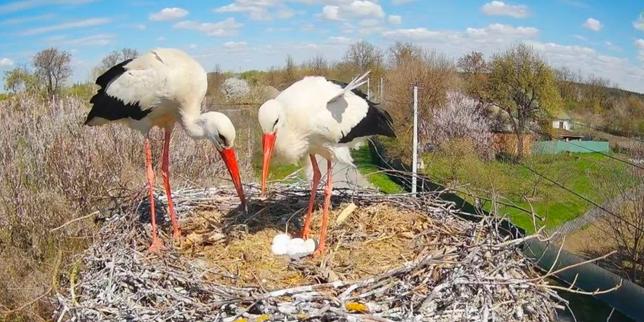
Millions of people are glued to a livestream of two storks in a war-torn Ukrainian village. They call them Vasyl and Marunka. They watch them build a nest, lay eggs, and endure the bitter spring chill. The media frames this as a beautiful symbol of resilience, a "Loft Story" for the avian world that offers hope amidst devastation.
It is nothing of the sort.
This collective obsession is a classic symptom of ecological anthropomorphism—the psychological urge to project human emotions, narratives, and morality onto wild animals. We are treating a brutal, instinct-driven survival mechanism as a reality TV show. In doing so, we are completely misunderstanding avian biology and cheapening the actual human tragedy unfolding on the ground.
Stop looking for human metaphors in the animal kingdom. Nature does not care about your narrative.
The Evolutionary Reality vs. The Disneyfied Myth
The lazy consensus driving the popularity of wildlife livestreams is that these animals exhibit "loyalty," "love," and "hope." Viewers weep when a male stork brings a twig to his mate. They cheer when the pair braves a storm together.
Let us look at the actual science. Ornithologists have documented white stork (Ciconia ciconia) behavior for decades. What we call "marital bliss" is actually rigid, programmed ecological territory defense.
- Storks are not loyal to each other; they are loyal to real estate. White storks do not mate for life in the human sense. They mate for the nest. The male arrives first to claim the best territory. Whichever female arrives next and proves viable gets the job. If a stronger female drives Marunka out tomorrow, Vasyl will breed with her without a second thought.
- The "tender" greeting rituals are stress responses. The elaborate bill-clattering and wing-flapping viewers find so charming are highly ritualized displays designed to diffuse aggression and signal ownership. It is a calculated behavioral mechanism to prevent them from killing each other in close quarters.
- Infanticide is standard operating procedure. If food supplies drop due to weather or conflict-disrupted agriculture, these "loving parents" will ruthlessly throw their weakest chick out of the nest or eat it alive to save the others. It is called facultative brood reduction.
When you watch a stork cam, you are not watching a romance. You are watching a high-stakes, mechanical struggle against natural selection.
The Danger of the Digital Zoo
I have spent years analyzing how mass media shapes public perception of environmental crises. I have seen conservation campaigns collapse because they relied on warm, fuzzy feelings instead of hard ecological data. The problem with the "Loft Story" framing is that it creates a false sense of connection that actually harms conservation efforts.
We tune in to see wild animals adapting to a war zone, and we celebrate it as a triumph of nature. This leads to a dangerous cognitive bias: the belief that wildlife is infinitely resilient.
It is not.
The disruption of habitats in Eastern Europe due to military activity—heavy artillery, soil contamination, destroyed wetlands—is catastrophic. A couple of storks successfully nesting on a pole does not mean the ecosystem is winning. It means two individuals got lucky. By focusing on the exceptional survivors, we tune out the silent extinction of less charismatic species that do not make for good livestreaming content. No one is setting up a 24-hour camera for the disrupted insect populations or the contaminated soil microbes, yet the storks cannot survive without them.
Dismantling the Public Fascination
Why do we need to project human narratives onto wildlife?
Because dealing with raw, unvarnished reality is too uncomfortable. Facing the sheer randomness of nature—or the calculated horror of human warfare—leaves people feeling powerless. Projecting a narrative of "hope and rebirth" onto a pair of birds is a cheap psychological coping mechanism. It allows viewers to feel like they are engaging with a meaningful story without requiring them to take any real action or confront uncomfortable truths.
Is it harmful to watch these streams?
The act of watching is benign. The mindset it fosters is toxic. When we view wildlife through the lens of entertainment, we stop respecting them as wild entities. We start treating them as assets for our emotional consumption. This leads directly to terrible policy decisions, where public funding gets funneled toward "cute" megafauna while the unglamorous, foundational elements of ecosystems are left to rot.
The Cost of Our Emotional Indulgence
There is a dark irony in global audiences using Ukrainian wildlife as an emotional security blanket while the human population of that country endures systemic trauma.
A stork does not experience patriotism. It does not know it is nesting in Ukraine. It does not understand war. It reacts to noise, blast waves, and resource scarcity. To elevate a bird's basic survival instincts into a symbol of human national resilience is an insult to the actual, conscious resilience of the people living under those dropped bombs.
If you want to support resilience, donate to humanitarian aid or ecological remediation groups clearing landmines from agricultural fields. Stop crying over a bird that would eat its own offspring if the temperature drops three degrees.
Turn off the livestream. Face the reality of the crisis. Stop demanding that nature act as your therapist.