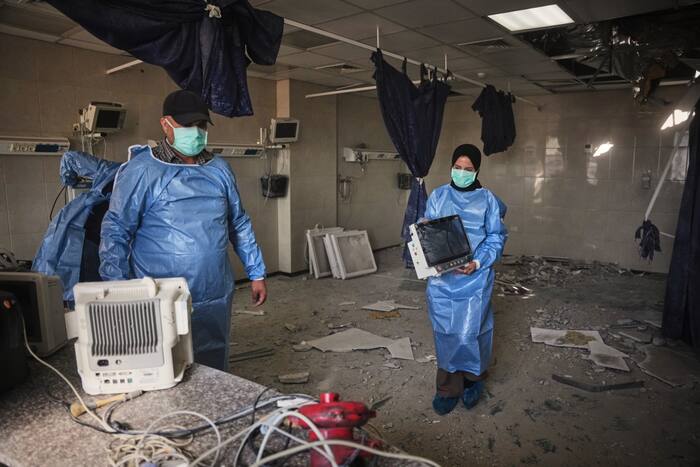
Silence.
That is the first thing you notice before the dust settles, a heavy, ringing vacuum that swallows the rhythmic beep of a cardiac monitor and replaces it with the hiss of ruptured oxygen lines. For anyone who has ever sat beside a loved one’s hospital bed at three in the morning, watching the green line rise and fall on a screen, a hospital represents the ultimate human bargain. We surrender our vulnerability to concrete walls, sterile corridors, and exhausted strangers in scrubs, trusting that the red crescent or red cross painted on the roof acts as an invisible shield against the chaos outside.
In Gaza, that bargain has been shattered beyond recognition.
When an Israeli airstrike hits a hospital compound—whether it is Al-Ahli, Al-Shifa, Nasser, or Kamal Adwan—the headlines usually reduce the event to a cold ledger of casualty counts, competing military claims, and satellite imagery. We read about "operational infrastructure" or "collateral damage." We scroll past numbers that have grown too large for the human brain to process. Yet behind every strike on a medical facility lies a slower, quieter catastrophe that outlasts the smoke by months and years. The true story is not just the wall that came down; it is the biological and psychological machinery of survival grinding to a halt for over two million people.
The Anatomy of a Slow-Motion Collapse
To understand what happens when a hospital is struck in a sealed-off enclave, imagine a crowded passenger jet losing one engine over the open ocean, only to have the crew discover that the mechanics have been locked out of the cargo hold and the reserve fuel tanks have been punctured.
That is not an exaggeration. It is the daily operational reality of Gaza’s healthcare system.
Before the war began in October 2023, Gaza’s medical infrastructure was already fragile, strained by seventeen years of blockade, chronic shortages of spare parts, and power grids that flickered out for hours every day. There were thirty-six hospitals serving a population of roughly 2.2 million people, nearly half of them children. Doctors performed miracles with expired reagents, patched-up dialysis machines, and generators held together by ingenuity and scavenged wire.
Then came the bombardment, and with it, a systematic unraveling of every pillar that keeps modern medicine alive.
According to data verified by the World Health Organization, hundreds of attacks on healthcare facilities, ambulances, and medical workers have been documented across the Gaza Strip since the conflict erupted. By mid-2024, fewer than a third of Gaza’s hospitals remained even partially functional, and none were operating at full capacity. When a strike hits a hospital—whether directly damaging a surgical ward, cratering the courtyard where thousands of displaced families have pitched tents, or severing the solar panels and diesel generators on the roof—the damage cascades outward like dominoes falling in the dark.
Consider what happens next.
Without electricity, the incubators in the neonatal intensive care unit go cold within minutes. Without running water, surgeons cannot scrub their hands between amputations, turning routine post-operative recovery into a breeding ground for drug-resistant sepsis. Without sterilized instruments, doctors are forced to perform procedures using vinegar as an antiseptic and kitchen salt dissolved in tap water as saline.
Inside Ward Three
To see how abstract statistics translate into human flesh, step into a hypothetical composite scene built from the verified testimonies of Palestinian surgeons and international medics from Médecins Sans Frontières who have worked inside Gaza’s remaining wards.
Call him Dr. Tariq. He has not been home in forty-two days. His scrubs are stiff with dried sweat and iodine, and his eyes carry the hollow, bruised look of a man surviving on sweet tea and twenty-minute naps on a cardboard box behind the triage desk.
At 2:14 a.m., the building shakes. It is not the distant thud of an artillery shell two neighborhoods away; it is the violent, bone-rattling concussion of a strike hitting the eastern wing of the compound, where hundreds of displaced families had been sleeping on the tiled floors because they believed a hospital was the last safe place left on earth.
Shrapnel tears through the reinforced glass of the emergency room. Ceiling tiles rain down onto the gurneys. In the sudden darkness, before the backup generator coughs back to life, the only light comes from the flashlights of mobile phones held between the teeth of nurses trying to find a vein in a six-year-old boy’s arm.
Outside, people are screaming, not out of panic, but out of disorientation. Where do you run when you are already inside the sanctuary?
Dr. Tariq faces an impossible triage equation that no medical school prepares you for. He has four operating tables, three bags of O-negative blood left in the refrigerator, and forty-seven new patients bleeding on the floor. He has to decide, in less than ten seconds per body, who gets the anesthesia and who gets a piece of gauze soaked in saline and a prayer.
This is the invisible wound of every hospital strike. Even the doctors who survive the blast are hollowed out by moral injury—the agonizing weight of having the training to save a life while being stripped of every tool required to do it.
Why Hospitals Become the Last Shelters
A question often lingers in the minds of readers watching this unfold from thousands of miles away: Why are so many civilians inside hospital compounds in the first place, and why do these facilities keep ending up at the center of military operations?
The answer lies in the brutal geography of Gaza. Covering just 141 square miles—roughly twice the size of Washington, D.C.—it is one of the most densely populated strips of land in the world. When evacuation orders sweep across entire neighborhoods, hundreds of thousands of people have nowhere to flee across an international border. The gates to Egypt and Israel are shut.
In every past conflict, civilians learned a simple survival instinct: walk toward the blue flag of the United Nations or the white walls of a hospital. Under international humanitarian law—specifically the Fourth Geneva Convention—hospitals are granted special protected status. Attacking them is a grave breach of the rules of war unless they are being used to commit acts harmful to the enemy, and even then, strict rules of proportionality and advance warning apply.
Israel’s military has repeatedly stated that Hamas fighters embed themselves within and beneath medical complexes, using tunnels, command centers, and ambulance networks to shield military operations behind sick and wounded civilians. Those allegations have fueled intense, bitter disputes over forensic evidence, tunnel shafts, and the presence of armed militants on hospital grounds.
Yet for the mother holding a feverish toddler in the hallway of Al-Aqsa Martyrs Hospital, geopolitical debates over dual-use infrastructure mean nothing. She is there because her apartment building is rubble, the UN school down the street was hit three days ago, and the hospital still has a well that pumps brackish water for two hours each morning.
When a strike hits that courtyard, it destroys more than concrete. It obliterates the psychological concept of sanctuary. Once people realize that even an intensive care unit offers no immunity from the sky, the entire social fabric enters a state of permanent, unremitting terror.
The Silent Casualties Nobody Counts
If you look closely at the casualty reports coming out of Gaza, you will notice a glaring blind spot. The numbers track those killed instantly by blast trauma, collapsing roofs, and shrapnel. They rarely capture the quiet deaths happening in the shadows of a broken healthcare system.
Think about the fifty thousand pregnant women in Gaza, roughly five thousand of whom give birth every single month. Without functioning maternity wards, women undergo emergency Cesarean sections without general anesthesia, biting down on rolled-up cloth while surgeons cut through muscle and tissue. Premature babies, born weeks early due to maternal malnutrition and acute stress, die because there are no working ventilators to keep their tiny lungs inflated.
Think about the thousands of patients with kidney failure who need dialysis three times a week to filter toxins from their blood. When a hospital loses power or its water purification system is destroyed by debris, dialysis sessions are cut from four hours to ninety minutes, and eventually canceled altogether. Death from untreated kidney failure is not dramatic. There is no explosion for television cameras to film. It is a slow, agonizing swelling of the body, confusion, fluid filling the lungs, and finally, silence.
Cancer patients watch tumors grow unchecked because chemotherapy drugs have run out and the sole oncology hospital in Gaza was forced to shut its doors early in the war. Diabetics fall into fatal comas because insulin cannot be kept refrigerated in tents where summer temperatures soar past ninety degrees.
When you destroy a hospital, you do not just kill the people inside it on the day of the strike. You issue a delayed death sentence to thousands of chronically ill people across the surrounding neighborhoods for months to come.
The Collapse of the Medical Workforce
Buildings can eventually be rebuilt if concrete and steel are allowed across a border. A generation of specialized doctors cannot be poured from a mixer.
Gaza has lost hundreds of doctors, nurses, paramedics, and hospital administrators—not just senior surgeons, but the institutional memory of an entire medical community. Among the dead are heads of orthopedic departments, leading pediatricians, and the handful of specialists trained in complex reconstructive microsurgery.
Those who are still alive work under conditions that defy human endurance. Many have lost their own spouses, children, and parents in strikes while they were on duty treating other people’s families. There is documented video of a Palestinian doctor finishing a procedure in an emergency room only to pull back a sheet on the next gurney and recognize the face of his own son.
Even international emergency medical teams, rotating in for brief two-to-four-week deployments through organizations like the World Health Organization and Medical Aid for Palestinians, describe leaving Gaza profoundly changed. Veteran trauma surgeons who have worked in Mosul, Aleppo, and Haiti report that they have never seen a concentration of pediatric blast injuries—children missing limbs, burned over sixty percent of their bodies, orphaned in a single instant—combined with such a total absence of basic surgical supplies.
Without painkillers like morphine or fentanyl, children scream during daily dressing changes for severe burns. Nurses hold their hands and apologize because there is nothing left in the pharmacy cabinet except paracetamol.
A Pattern Written in Concrete and Ash
History tells us that when healthcare becomes a casualty of war, recovery is measured in decades, not years.
We saw it in Syria, where the systematic targeting of hospitals in eastern Aleppo forced doctors into underground basements and left entire provinces without basic obstetric or trauma care long after the front lines shifted. We saw it in Yemen, where bombed clinics and shattered water treatment plants triggered the largest cholera outbreak in modern history, killing thousands of children who never stepped near a battlefield.
In every one of those conflicts, the world expressed shock at the first hospital strike. By the tenth, shock hardened into grim routine. By the twentieth, the destruction of medical infrastructure was treated as an inevitable byproduct of urban warfare rather than a red line crossed.
Gaza represents the most concentrated collapse of a modern healthcare system in the twenty-first century. A population that once boasted some of the highest literacy rates and medical training standards in the Middle East has been pushed back into nineteenth-century battlefield medicine. Infectious diseases like hepatitis A, acute watery diarrhea, and polio—a virus eradicated in Gaza a quarter-century ago—have resurfaced in overcrowded tent camps where raw sewage flows beside cooking fires.
It is easy to feel paralyzed by the scale of this devastation, to look at the competing narratives and entrenched politics and conclude that nothing can be done until a permanent ceasefire holds. That is a comforting lie we tell ourselves to excuse looking away.
Even amid active conflict, life-saving interventions remain possible if political will exists: guaranteed humanitarian corridors for medical evacuations so critically injured children can reach functioning hospitals abroad; unimpeded entry of fuel, anesthesia, sterilization equipment, and mobile field hospitals; and strict, enforceable accountability whenever protected medical sites are struck. Every single vial of insulin and every generator repair kit allowed through a border crossing translates directly into a heartbeat that does not stop.
What Remains in the Dark
Return for a moment to the corridor of that damaged hospital after the dust has settled.
The eastern wing is a jagged skeleton of exposed rebar and shattered concrete. Half of the remaining beds have been wheeled out into the parking lot under makeshift tarps because the ceiling above the surgical ward is cracked and threatening to cave in. The air smells of pulverized plaster, burnt diesel, and blood.
Inside the one remaining intact room, a nurse sits on an overturned plastic crate beside an incubator that is running on the last two hours of a dwindling battery reserve. Inside the glass box, an infant weighing barely three pounds struggles to draw breath, his chest rising and falling in tiny, rapid flutters.
The nurse has no spare oxygen cylinder. She has no replacement battery. She has no certainty that the roof above her head will still be there when the sun comes up.
Yet she does not leave her post. She reaches her hand through the circular porthole of the incubator, places one finger gently against the infant’s palm, and stays right there in the dark, refusing to let him face the night alone.