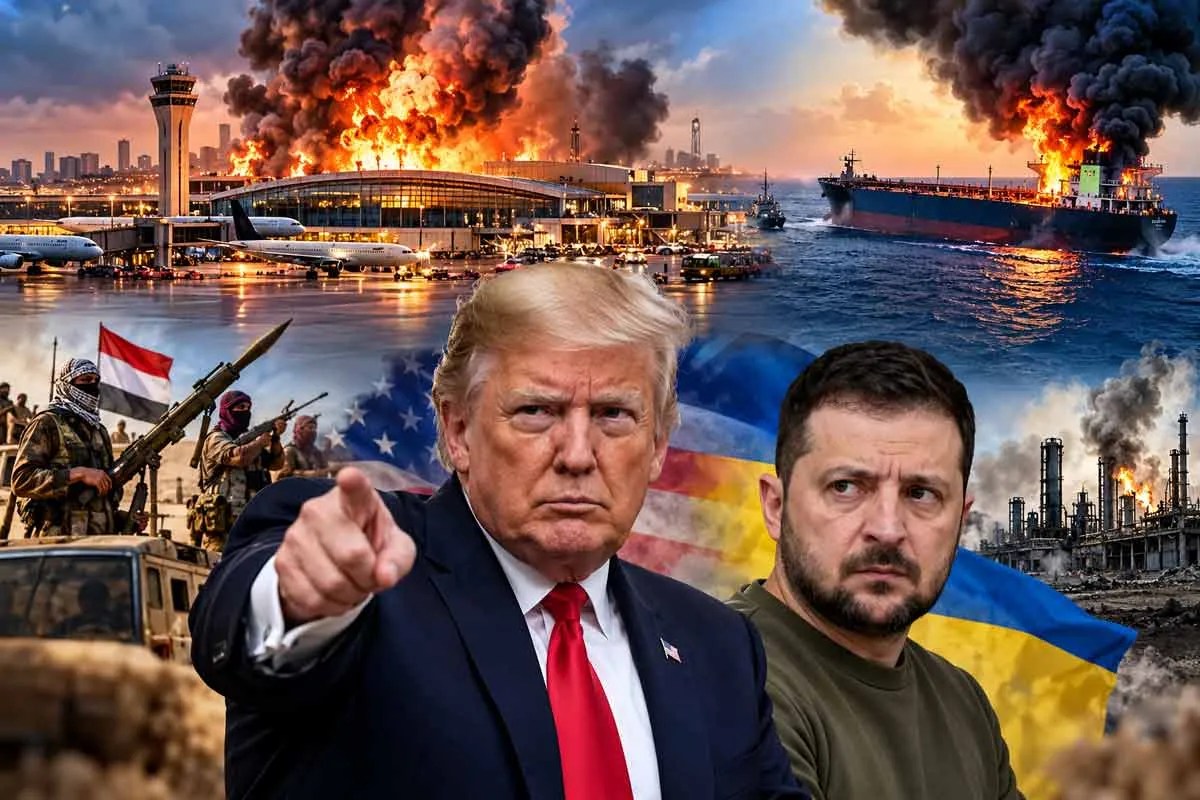
The lazy consensus echoing across mainstream security desks is predictable. Following the devastating strikes on King Khalid International Airport in Riyadh, mainstream pundits immediately pivoted to the standard script. They hyperventilate over regional stability, blame American deterrence failure, and cheerlead for direct U.S. military intervention alongside the Saudi-led coalition. Donald Trump drops rhetoric about joining punitive strikes, and the armchair generals instantly demand an escalation cycle.
They are asking the wrong question entirely. The issue is not whether American air power can pulverize Houthi launch sites in Yemen. The real issue is that doing so plays precisely into an asymmetric trap designed to bleed Western resources while empowering Tehran's long-term regional posture.
Let us dismantle the core misconceptions driving this panic.
The Myth of Decisive Air Campaigns Against Decentralized Forces
Military strategists love to talk about crushing insurgencies from 30,000 feet. I have watched billions of dollars in ordnance get thrown at decentralized, cave-dwelling asymmetric networks with zero strategic outcome. The Houthis are not a conventional state army with centralized command nodes that crumble under precision bombardment. They have spent a decade adapting to the most sophisticated air campaigns on earth.
When commentators demand that the White House join Riyadh's retaliatory strikes, they assume that dropping ordnance on Sana'a alters the calculus for a militia whose core ideological currency is perpetual resistance to foreign intervention. It does the exact opposite. It validates their narrative, hardens domestic recruitment, and transforms a regional proxy conflict into a marquee anti-imperialist crusade.
The Real Strategic Calculus Nobody Wants to Admit
Riyadh's air defense architecture—bolstered by Patriot and advanced interceptor batteries—missed critical intercepts, resulting in catastrophic civilian casualties and infrastructure paralysis. That is an engineering and operational failure inside the Kingdom's defensive posture, not a crisis that demands American pilots flying combat missions over the Arabian Peninsula.
What happens the moment the United States formalizes direct combat operations alongside the Saudi coalition? You take full ownership of a grinding, un-winnable counter-insurgency. You relieve Riyadh of the burden of fixing its own tactical failures, and you hand Iran a low-cost, high-yield mechanism to tie down American carrier strike groups and exhaust interceptor missile inventories that the Pentagon desperately needs elsewhere.
People point to Trump’s posturing on foreign interventions and try to map it onto traditional neoconservative interventionism. That is a category error. The transactional reality of modern American foreign policy dictates that security partners must shoulder the costs of their own airspace security. Subcontracting Saudi Arabia's defense back to the U.S. taxpayer creates a moral hazard of monumental proportions.
The Uncomfortable Truth About Energy Markets and Regional Containment
The panic over Riyadh airport closures and oil infrastructure threats stems from a foundational misunderstanding of modern energy resilience. Yes, disruptions cause immediate speculative spikes. But rushing headlong into a kinetic escalation cycle in Yemen does not secure trade routes; it widens the theater of vulnerability. Every time Western militaries bite on a provocation, they expand the operational surface area for asymmetric retaliation against commercial shipping and regional energy hubs.
Containment requires economic strangulation and localized intelligence dominance, not expensive kinetic whack-a-mole. If the Saudi-led coalition wants to restore deterrence, the answer lies in tightening maritime interdiction around Hudaydah, shutting down illicit smuggling routes from the Red Sea, and upgrading indigenous point-defense systems.
Stop asking when the U.S. is going to rescue Riyadh from its own defense vulnerabilities. Start asking why anyone believes repeating a decade of failed airstrikes will yield a different outcome.


