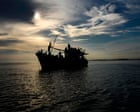
The wood of a fishing trawler is not meant to hold a hundred lives. It is meant for nets, ice, and the silver, cold scales of mackerel. When you pack two hundred human beings into a space designed for a crew of ten, the wood begins to groan before the boat even leaves the shallows. It is a wet, splintering sound. It sounds like a warning. But when the shore behind you is burning, or locked in the suffocating grip of a military junta, the warning of the wood is nothing compared to the silence of staying.
For the Rohingya fleeing Myanmar, the sea is not a scenic expanse. It is a gamble with a stacked deck.
Two weeks ago, two crowded vessels slipped into the dark waters of the Andaman Sea. They never arrived. According to the United Nations, hundreds of people are now feared dead, swallowed by a stretch of water that has become one of the deadliest migratory routes on earth. The dry press releases call them "suspected casualties." They list numbers, coordinates, and dates. But numbers do not suffer from thirst. Coordinates do not hold their children above the rising tide as the planks split beneath their feet.
To understand why someone boards a boat they know might sink, you have to look at what they are leaving behind.
The Calculation of Survival
Imagine standing on a shoreline. Behind you is a camp where the heat is a physical weight, where the rations are dwindling every month, and where you are legally forbidden to work, travel, or hope. This is Cox’s Bazar in Bangladesh, where nearly a million Rohingya refugees live in bamboo and tarpaulin shelters. Before that, behind the camp, is Rakhine State in Myanmar—a place of scorched villages and systemic violence.
The choice to step onto a smuggler’s boat is not made in a vacuum. It is a cold, desperate mathematical equation.
"If we stay here, we die slowly," a young man named Rafique once said, explaining his decision to risk the crossing to Malaysia. "If we go on the boat, we might die quickly. But there is a chance, even a tiny one, that we live."
The human brain is wired to seek agency. When every door is locked, a window over a sheer drop begins to look like an exit. The smugglers know this. They sell tickets to Malaysia not as a journey, but as salvation. They charge thousands of dollars—sums scraped together by selling wedding rings, borrowing from relatives, and skipping meals—for a spot on a deck so crowded that passengers cannot bend their knees for days at a time.
The water in the Andaman Sea is deceptively blue. Under the afternoon sun, it looks like glass. But under the weight of an overloaded hull, it is an unstable floor.
What Happens When the Engine Dies
A boat at sea is a closed system. Once the shore fades into a gray line on the horizon, you are entirely dependent on three things: the engine, the fresh water supply, and the mercy of the weather.
On these vessels, the engines are often salvaged truck motors, cooled by seawater pumped through crude hoses. They are prone to seizing. When an engine dies in the middle of the Bay of Bengal, the silence is terrifying. The boat begins to drift. Without momentum, it cannot cut through the waves; it rolls with them, taking on water with every tilt.
Then comes the thirst.
The plastic jerrycans of water are the first things to be rationed, then fought over, then exhausted. The sun beats down with a dry, salt-caked heat that shrivels the skin and confuses the mind. People begin to drink the sea. It is a desperate act that only hastens the end, driving the kidneys to failure and the mind into delirium.
When a boat capsizes, there are no life vests. There are no flares. There is only the sudden, violent rush of dark water, the weight of heavy clothes pulling bodies down, and the vast, indifferent silence of the ocean. The UN estimates that one in every eight people who attempt this crossing do not make it. In terms of percentage, it is far more lethal than the Mediterranean crossing. Yet, the boats keep leaving.
The Blind Eye of the Coastlines
There is a cruel geography to these tragedies. The boats drift through the territorial waters of multiple nations—Myanmar, Bangladesh, India, Thailand, Indonesia, Malaysia. Each country has radar. Each has a navy. Each has coast guards equipped with high-tech patrol craft.
Yet, time and again, these distressed vessels are treated like toxic waste, pushed back and forth across maritime borders in a lethal game of pass-the-parcel.
A fishing boat with a broken engine might drift for weeks within sight of land, its passengers waving orange shirts and plastic water jugs, while authorities debate whose responsibility they are. The legal term is non-refoulement—the international principle that forbids returning refugees to a place where they face persecution. But at sea, far from the eyes of journalists and lawyers, the law of the land seems to evaporate. The boats are towed back into international waters, given a crate of water and a bag of rice, and left to the current.
We tend to look at these events as natural disasters, like typhoons or earthquakes. We call them "tragedies." But a tragedy implies an unavoidable fate. This is not unavoidable. It is the predictable result of a collective, regional refusal to look.
The sea does not keep records, and it does not offer graves. When a wooden boat breaks apart in the deep water, the only evidence left behind is a floating flip-flop, a plastic oil drum, or a oil slick reflecting the sky. Back in the camps, the phones simply stop ringing. Mothers wait for a WhatsApp message or a crackly voice call from Kuala Lumpur confirming a safe arrival. Days turn into weeks. The silence becomes permanent.
In the mud of the camps, life goes on because it must, but the horizon remains a constant, terrible temptation. The blue water waits, beautiful and hungry, offering the only wild gamble left to a people who have been stripped of everything else.