The kitchen table in Elena Vance’s house carries the scars of thirty years of elections. There are coffee ring stains from late-night tallying sessions, ink smears from hurriedly signed declaration forms, and the faint, permanent indentations left by ballpoint pens pressing down through yellowed carbon paper.
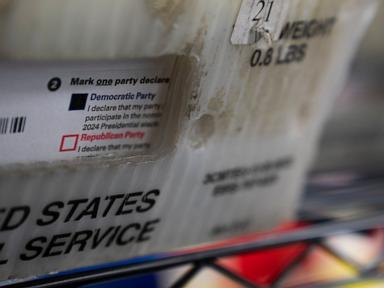
For Elena, an election is never a television graphic or a pundit's raised voice. An election is weight. It is the physical heft of a rectangular envelope sliding into a sorting tray, the rustle of confidentiality sleeves, and the quiet, agonizing uncertainty of whether a vote cast from a distance will actually count when the dust settles.
Weeks ago, that uncertainty metastasized. Across the country, legal filings piled up like dry brush before a lightning storm. Arguments swirled through federal appellate courts and petitions made their way upward to marble steps in Washington, targeting the administrative machinery of mail-in voting. Rules were challenged. Deadlines were questioned. Postmarks became battlegrounds. For millions of citizens who rely on absentee or mail ballots—the elderly whose joints no longer tolerate long lines, the shift workers whose hours do not bend to the rigid clock of a precinct, the service members stationed thousands of miles from home—a cold fog settled over the upcoming midterms.
Then came the order.
The Supreme Court cleared the docket. It left the rules intact, declining to short-circuit the established procedures that allow mail ballots to flow as normal. No dramatic fanfare accompanied the decision. No trumpet sounded from the bench. Just a procedural refusal to disrupt the gears already turning in county basements and postal sorting facilities.
Yet the silence of that ruling carried an earthquake's worth of relief.
Consider what happens when a court intervenes at the eleventh hour to freeze or alter voting procedures. The friction is immediate and violent. Election supervisors, already working on skeleton crews and operating under the strain of institutional exhaustion, must suddenly pivot. Software is rewritten overnight. Instructions mailed to households become obsolete overnight. Ballots printed with one set of signature requirements suddenly violate a newly minted injunction. Confusion spreads like a contagion. Voters lose faith not because their candidates lost, but because the rules of the game shifted while they were running across the field.
By letting the ballots flow, the high court averted a logistical freefall. But to understand why that matters, we must look past the legal briefs and examine the quiet machinery of how ordinary people make their voices heard.
Hypothetical scenario: Imagine Marcus, a sixty-eight-year-old retired truck driver living in a rural county thirty miles from the nearest polling station. His knees are ground down to bone-on-bone friction. Standing in line for two hours on a Tuesday morning is not a civic duty for Marcus; it is an endurance test that his body simply fails. For Marcus, the mail-in ballot is not a convenience. It is his only tether to the democratic compact. When legal clouds gather over mail ballots, Marcus does not worry about constitutional jurisprudence. He worries about whether his kitchen table vote will be thrown into a legal trash heap because a judge three states away decided that a postmark rule needed a last-minute rewrite.
The history of voting from afar is as old as the nation itself, though it was born out of blood and separation. During the Civil War, soldiers fighting in muddy trenches needed a way to register their will without deserting their posts. States scrambled to pass emergency legislation so that men holding muskets could drop folded slips of paper into regimental ballot boxes. Those early attempts were messy, controversial, and fiercely debated. Critics claimed distance invited fraud; proponents argued that a soldier bleeding for the republic deserved a voice in its survival regardless of his coordinates.
Over the decades, that principle expanded. Absentee voting evolved from a wartime accommodation into a routine option for citizens with valid excuses, and eventually, in many jurisdictions, into an accessible baseline for anyone who preferred the quiet contemplation of a kitchen table over the cacophony of a crowded gymnasium.
The pandemic accelerated this evolution, turning what was once a quiet administrative backup plan into the primary highway of civic participation. Millions of voters discovered the profound dignity of taking time to research ballot measures, check candidates' records, and cast their votes without the pressure of a looming line behind them. Turnout numbers climbed. Participation broadened.
Yet, with that shift came a cultural friction. Voting had long been ritualized as a public pilgrimage—a secular liturgy performed in school gymnasiums under the watchful eye of neighbors. Shifting that ritual to the mailbox felt to some like a loss of communal sacredness. More dangerously, it became a political football. Every administrative detail—signature verification, drop boxes, cure periods, postmark deadlines—was weaponized into a narrative of suspicion.
This is where the recent Supreme Court action assumes its true weight. By refusing to inject judicial chaos into the final stretch of the election cycle, the court essentially affirmed a basic operational truth: you cannot rewrite the rules while the race is already underway.
To watch an election office function in the weeks leading up to an election is to witness a marvel of decentralized human coordination. It is an army of temporary workers, often retirees and civic-minded students, sitting under harsh fluorescent lights in municipal buildings, running envelopes through high-speed sorting machines, checking signatures against driver's license files with magnifying glasses, and separating challenged ballots with agonizing care.
In county office 402, a woman named Sarah spends her mornings holding envelopes up to the light. She has done this for twelve years. She knows the handwriting of her county's oldest residents. She knows when a shaky signature belongs to an aging veteran whose hands are trembling with Parkinson's rather than an attempt at malfeasance. Sarah does not care about partisan talking points. She cares about the integrity of the pile in front of her. Every envelope represents a human being who took the time to participate. When legal clouds threaten to invalidate those envelopes wholesale, Sarah’s work becomes a heartbreaking exercise in futility.
When the Supreme Court let the ballots flow, it allowed Sarah and thousands of workers like her to finish what they started. It protected the sweat equity of local administration.
Critics of mail-in voting often point to the potential for administrative errors or mail delays as reasons to restrict the practice. And it is true that paper leaves a trail, that postal sorting facilities face mechanical hiccups, and that human error is an inescapable byproduct of any system run by mortals. But democracy has never been sterile. It is, by definition, a messy, sprawling negotiation among millions of imperfect minds.
The alternative—erecting artificial barriers, creating sudden legal ambiguities, and pulling the rug out from under voters who followed every instruction given to them—does not secure an election. It strangles it. It sends a chilling message to the citizen who did everything right, only to find their voice silenced by a procedural technicality born of partisan warfare.
Consider the sheer cognitive load required to vote in a modern election. Voters must parse judicial rulings, check registration statuses, track down local drop-off box locations, and interpret shifting deadlines that change from one court filing to the next. When the rules are stable, that load is heavy enough. When courts step in at the eleventh hour to upend those rules, the cognitive load becomes a wall designed to keep people out.
By stepping back and letting the established system run its course, the Supreme Court did something radical: it chose stability over chaos. It acknowledged that public trust in elections is fragile, and that nothing shatters that trust faster than moving the finish line while the runners are sprinting toward it.
The mail ballots will now move through the postal service's orange-and-blue network, carried by mail carriers in weather-beaten trucks, sorted by automated scanners that read barcodes with laser precision, and ultimately deposited onto the long wooden tables where local workers will open them one by one.
There is no magic in this process. There is only work. Meticulous, boring, essential work performed by people who believe that counting votes is the closest thing we have to secular prayer.
The cloud has lifted, not because the underlying debates have vanished, but because the machinery of democracy has been granted the space to do what it was built to do. In millions of homes tonight, citizens will sit at their kitchen tables, pen in hand, holding a piece of the future between their fingers. They will seal the envelope, walk out to the mailbox, and raise the little red flag. And somewhere, in a county basement under flickering fluorescent lights, an election worker will reach out, take the envelope from the tray, and lay it gently on the stack.