Listen to the rain.
In Manchester, in the winter of 1965, the rain did not fall so much as it hung in the air, a cold, gray mist that soaked into the clay of the pitch. The ball was not the sleek, aerodynamic sphere of synthetic polymers we know today. It was a heavy, brown orbit of stitched cowhide. When the rain came, the leather drank. It grew dark. It grew heavy. It doubled in weight, becoming a sodden lump of water and leather, laced with a thick seam that could slice open a forehead.
Thud.
A young man with thick, black-rimmed spectacles and a gap-toothed grin rose into the gray sky. He met the ball with his forehead.
Thud.
To the thousands shivering in the stands, it was a moment of pure defensive grit. A cleared corner. A transition. A battle won. But inside the skull of Nobby Stiles, a delicate, three-pound organ of soft tissue suspended in fluid was being slammed against a wall of bone.
He did this thousands of times. He did it in training. He did it on Saturdays. He did it because that was the job. No one warned him that each thunderous clearance was a tiny, microscopic withdrawal from a bank account he didn't know he owned. Decades later, the debt would be called in.
The Boy Who Danced
To understand the tragedy of what happened to Nobby Stiles, you must first remember the joy.
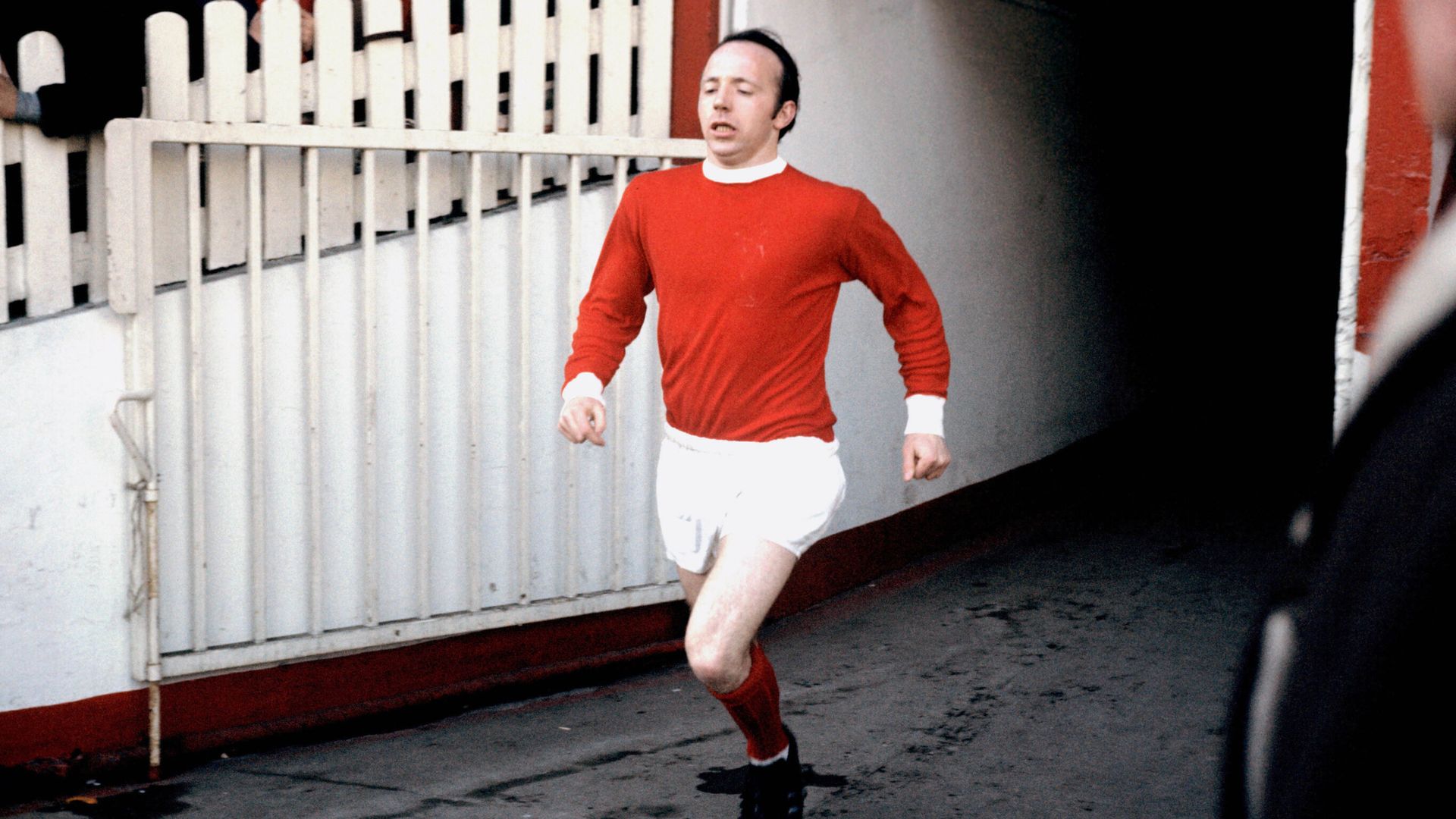
On a warm July afternoon in 1966, Wembley Stadium was a cauldron of eighty thousand screaming souls. England had won the World Cup. Amid the champagne and the weeping giants of English football, one figure captured the nation’s heart. It was Nobby.
He was not a gilded athlete of towering stature. He was short. He was nearly blind without his thick glasses. He played without his dentures, leaving a cavernous, joyful gap in his smile. But on that sacred turf, he danced. With the Jules Rimet trophy held aloft in his right hand and his dentures in his pocket, he hopped and skipped across the grass, a picture of pure, unadulterated ecstasy.
He was the heartbeat of the team. A fierce, uncompromising midfielder who would run through a brick wall for his country and his club, Manchester United. He was the man who marked Eusébio, the greatest player of his generation, out of the game. He did it with intelligence, timing, and a physical intensity that defined an era.
But football, the game that gave him everything, was quietly, systematically stealing him away.
The Great Disappearing Act
The theft was slow at first. It began with misplaced keys. A forgotten name. A sudden flash of uncharacteristic anger in a man known for his gentle nature off the pitch.
His family watched the decline with a growing sense of dread. The man who had organized midfield lines and read the game with chess-like precision began to get lost in his own home. The dancing boy of Wembley was fading behind a veil of confusion.
To understand what was happening inside his brain, imagine a beautiful, intricately woven tapestry. Each thread is a neuron, communicating thoughts, memories, and movements. Now imagine someone taking a pair of shears and making tiny, random snips, day after day, year after year.
The medical community has a name for this silent destruction: Chronic Traumatic Encephalopathy, or CTE.
For a long time, CTE was thought to be the exclusive curse of boxers, the "punch-drunk" syndrome that haunted retired fighters. We now know better. The brain does not care if the blow comes from a leather-gloved fist or a waterlogged football. The physics are identical.
When Nobby headed that wet leather ball, the rapid deceleration caused his brain to bounce back and forth inside his skull. This trauma triggered the release of a rogue protein called tau. Under a microscope, tau looks like a sticky, toxic sludge. It builds up slowly, spreading through the brain, choking off healthy cells, and strangling memory, emotion, and cognitive function.
It is a death by a thousand cuts. Or rather, a death by a thousand headers.
The Silent Epidemic
Consider the sheer volume of impact. A professional footballer in Nobby’s era would head the ball dozens of times a day in practice, hundreds of times a week, for decades.
And the balls they used were brutal instruments. When dry, they were heavy. When wet, they became leaden. A wet leather ball could weigh over twenty ounces, traveling at speeds of up to sixty miles per hour. Impacting that mass with a human head is the equivalent of being struck by a flying brick.
But this is not just a historical tragedy. It is a modern one.
While today's synthetic balls do not absorb water, they travel faster. Much faster. The kinetic energy delivered to a modern player's head during a high-speed cross is often higher than it was in the 1960s. The danger has not disappeared; it has simply changed its face.
The statistics are devastating. Research has shown that former professional footballers are three and a half times more likely to die from neurodegenerative diseases than the general public. For defenders—the men who head the ball the most—that risk climbs even higher.
It is a terrifying realization for those who spent their youth playing the game. Every headache, every forgotten word, every moment of temporary confusion becomes a haunting question mark.
Is it just aging? Or is it the ball?
The Battle After the Whistle
Nobby Stiles died in October 2020 at the age of seventy-eight. He spent his final years in a specialized care home, unable to recognize his own family, unable to remember the day he danced at Wembley.
But his death was not the end of the story. It was the catalyst for a fight.
His son, John Stiles, became the voice of a grieving family and a generation of neglected heroes. He spoke out about the anger and the betrayal felt by the families of these players. He pointed out the cruel irony: the very institutions that grew wealthy on the backs of Nobby and his teammates were painfully slow to acknowledge the damage the game was causing.
"It killed my dad," John said in a poignant address. "And it is killing others as we speak."
The battle was not just for recognition, but for support. Many retired players from the golden era of English football did not make the astronomical wages of today’s stars. They retired to modest lives, and when dementia struck, their families were left to shoulder the immense emotional and financial burden of full-time care.
For years, the response from footballing authorities was a wall of bureaucratic silence and demands for more research. It was a classic delay tactic, reminiscent of the tobacco industry's response to lung cancer or the NFL's early denial of concussion links.
But you cannot ignore a brain under a microscope.
After Nobby’s death, his family donated his brain to science. The post-mortem analysis was definitive. His brain was riddled with severe CTE. There was no room for debate. The game had broken his mind.
The Path Forward
How do we preserve the beauty of the game while protecting the humans who play it?
It is a question that requires us to look honestly at the sport. The solutions are not simple, and they require a shift in how we think about athletic toughness.
- Restricting Heading in Youth Sports: Children’s brains are even more vulnerable to injury than adults. Many countries have now introduced guidelines banning or strictly limiting heading in training for players under a certain age.
- Limiting Heading in Professional Training: The vast majority of head impacts do not happen during the ninety minutes of a Saturday match. They happen on Tuesday, Wednesday, and Thursday during repetitive training drills. Limiting these drills is a massive step toward safety.
- Mandatory Brain Charity Funding: The wealth of modern football is staggering. A tiny fraction of the billions flowing through the sport could easily fund comprehensive care for every retired player suffering from neurodegenerative disease.
It is about changing the culture. For generations, playing through a head injury was seen as a badge of honor. A player would be bandaged up, their vision blurry, and sent back onto the pitch to fight. We now know that playing with a mild concussion—subjecting an already injured brain to a second impact—is incredibly dangerous.
It is not heroic. It is tragic.
The image of Nobby Stiles dancing on the Wembley turf in 1966 remains one of the most iconic moments in sports history. It represents a time of innocence, a time when football was just a game of passion and national pride.
But now, when we look at that photograph, we must see the shadow that hung over it. We must see the cost of that joy.
Nobby’s dance was beautiful. But the music has stopped, and the bill has arrived. The only way to truly honor his legacy is to ensure that the young men and women who lace up their boots today do not have to pay for the glory of the game with their minds.