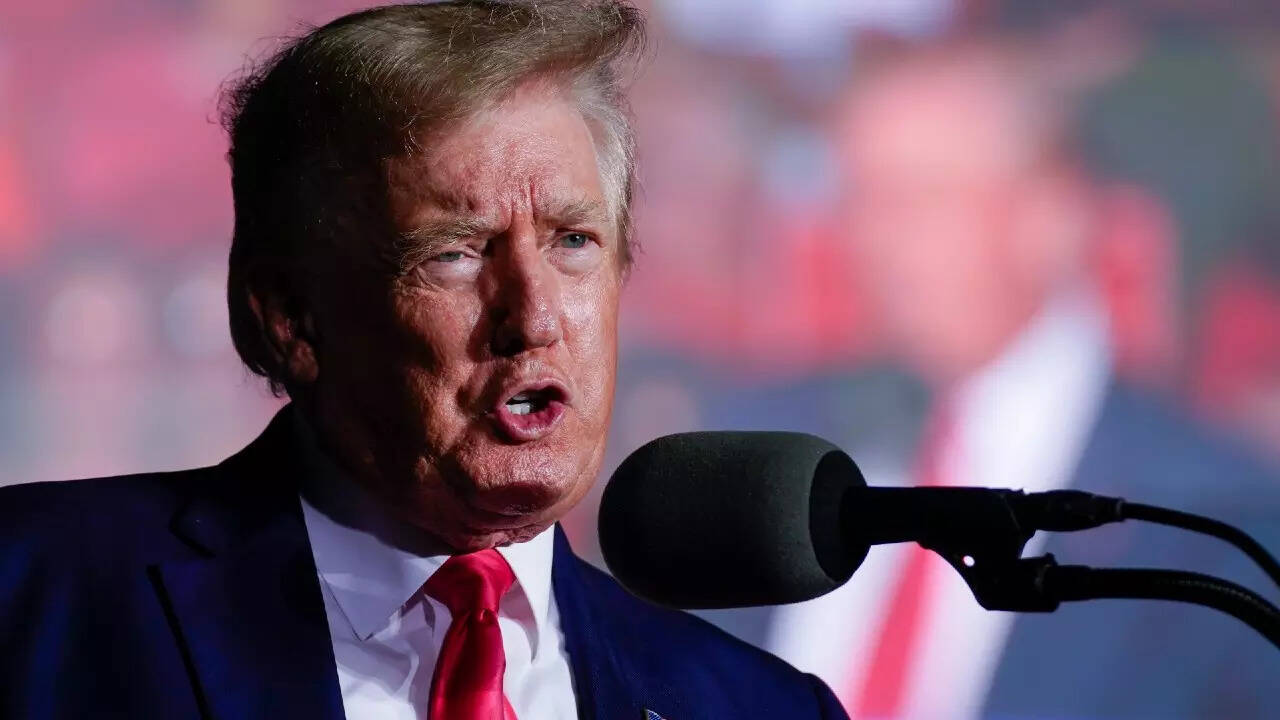
The human body at eighty years old is a finely tuned machine running on borrowed time. Joints creak in the quiet mornings. The eyes require a bit more light to resolve the fine print of a morning brief. Memory, once a lightning-fast filing cabinet, becomes a vast library where the librarian occasionally takes the long route to find a file. Most people at this milestone are content with the quiet victories of tending a garden, reading to grandchildren, or simply enjoying a cup of coffee without a schedule.
Now, add the nuclear codes.
Picture a man waking up in a mansion surrounded by manicured lawns, the weight of a divided superpower pressing down on his chest before his feet even touch the floor. Donald Trump, at eighty years old, stands as the oldest person ever inaugurated to the American presidency. To his supporters, his age is a badge of survival, a testament to an indestructible vitality that defies biology. To his critics, it is a ticking clock, a terrifying vulnerability in a world that moves at the speed of a fiber-optic cable.
But step back from the American political circus for a moment. This is not a uniquely American story. It is a global reality.
We live in an era of the political patriarch. Across the globe, nations are entrusting their futures to men and women who watched the dawn of the space age through black-and-white television sets.
The Global Gerontocracy
To understand the scale of this phenomenon, we have to look beyond Washington. Trump is an octogenarian leader, yes, but on the global stage, he is practically a junior statesman.
Consider Cameroon. Deep in the heart of Central Africa, Paul Biya has held the presidency since 1982. He is ninety-three years old. Generations of Cameroonians have lived, grown old, and died knowing only one leader. Biya’s public appearances are rare now, fleeting moments captured by state television that resemble a carefully choreographed ritual rather than active governance. The machinery of state moves around him, powered by the sheer momentum of his decades-long tenure.
Then there is Mahmoud Abbas, leading the Palestinian Authority in his late eighties, navigating one of the most volatile geopolitical minefields on earth. In Iran, Ayatollah Ali Khamenei wields supreme power at eighty-seven.
Why do we do this to ourselves? Why do societies repeatedly hand the steering wheel to drivers who are well past the age of retirement?
The answer lies in our primal craving for stability. Institutional memory is a powerful drug. When a nation faces economic ruin, war, or social upheaval, there is a deep, almost instinctual comfort in a leader who can look at the crisis and say, "I have seen this before." An eighty-year-old leader has lived through the Cold War, the rise of the internet, inflation crises, and shifting cultural tides. They offer a steady hand in a storm.
But a steady hand can also be a rigid one.
The Friction of Time
The human brain changes. Neurologists tell us that cognitive processing speed peaks in early adulthood and undergoes a slow, inevitable decline. It is not necessarily a loss of intelligence, but a loss of velocity.
Imagine a young tech executive processing data like a modern smartphone—instant, multi-tasking, constantly refreshing. An octogenarian leader processes data like a massive, mainframe computer from the 1990s. It can still solve the problem, and perhaps with greater wisdom, but the cooling fans are running loud, and it takes time to churn through the data.
In politics, time is a luxury that vanished with the advent of social media and algorithmic warfare. A crisis no longer unfolds over days; it explodes in minutes. Deepfakes, cyberattacks, and hypersonic missile deployments require split-second decisions. The terrifying question hanging over any elderly leader is simple: What happens when the world moves faster than the executive brain can process?
This is where the invisible stakes become painfully visible. When a leader stumbles over a word, freezes at a podium, or misremembers a name, it is not just an embarrassing clip for late-night television. It is a data point analyzed by foreign intelligence agencies. Adversaries look for signs of rust in the armor. Allies look for reassurance that the hand on the wheel is steady.
The human element here is tragic. We are asking individuals to perform the most stressful job on earth at a time when their bodies are naturally crying out for rest. The presidency ages young men; it turns dark hair silver in a matter of four years. For a man who enters the office already old, the physical toll is a silent partner in every executive decision.
The Generational Chasm
There is another, deeper cost to the rise of the octogenarian leader. It is the alienation of the young.
The median age of the global population is around thirty. In many developing nations, particularly in Africa, more than sixty percent of the population is under the age of twenty-five. When a country's leader was born before the discovery of DNA’s double helix, a profound disconnect occurs.
How can a leader who struggles to understand the data privacy implications of TikTok effectively regulate the artificial intelligence revolution? How can someone whose worldview was forged in the mid-twentieth century truly grasp the existential anxiety of a twenty-year-old facing a shifting climate and an automated job market?
It creates a strange, stagnant political culture. The youth feel locked out of their own future, viewing government not as a vehicle for progress, but as a prestigious nursing home. The energy, the radical ideas, and the raw ambition of the younger generations are bottled up, kept away from the levers of power by an elite class that refuses to let go.
Yet, we cannot dismiss the value of age entirely. History is littered with the disasters of young, hot-headed rulers who marched their nations into ruin out of arrogance and a lack of perspective. An older leader has context. They know that most crises pass. They know that rhetoric has consequences. They have buried friends, witnessed empires fall, and learned the hard way that power is fleeting. That kind of wisdom cannot be downloaded or taught in a Harvard seminar; it must be suffered through.
The Twilight of the Patriarchs
We are witnessing the final act of a specific generation of leadership. The leaders born in the shadow of World War II and the early Cold War are reaching the natural end of their journeys.
Donald Trump’s presidency is part of this grand finale. It is a manifestation of a society holding onto a familiar past, terrified of stepping into an uncertain, hyper-accelerated future. We judge these leaders harshly, parsing every step, every cough, and every pause for signs of decay. But perhaps we should also view them with a degree of empathy. They are flawed, ambitious, power-hungry human beings who have chosen to spend their twilight years in the arena, exposed to the harsh, unforgiving glare of global scrutiny.
The sun is setting on the era of the octogenarian ruler. The world is becoming too fast, too complex, and too volatile for the old ways of governing to hold indefinitely. Change is coming, driven by the unstoppable march of biology.
The old man sits in the Oval Office, the shadows lengthening across the historic furniture. The phones are ringing. The cables are arriving from distant capitals. The world demands his attention, his strength, and his youth—commodities that no amount of power or wealth can ever buy back. He picks up the pen to sign an executive order, his hand steady for now, while outside the window, the future waits impatiently for its turn.