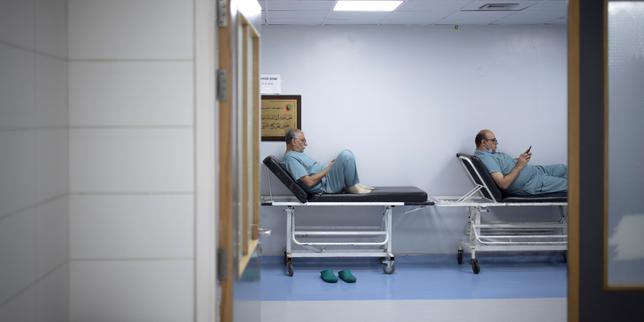
The fluorescent lights of the Secours populaire hospital in Nabatiyeh do not flicker, but they feel fragile. Outside, the hills of southern Lebanon roll toward a horizon that has spent months swallowing the thunder of artillery and the sharp, sudden cracks of airstrikes. Inside, the air smells of rubbing alcohol, old dust, and the distinct, metallic tang of adrenaline that lingers in a room long after the emergency has passed.
A nurse hands over a chart. Her fingers are steady, but her eyes are bloodshot. She has not slept a full night since the escalation began. This is the reality of healthcare on a fault line. It is not just about stanching blood or setting bones. It is about the profound, exhausting labor of keeping your own mind intact while repairing the broken bodies of your neighbors. Building on this topic, you can find more in: The Manila Gambit and the Strategic Calculation behind the Quad Convergence.
When we think of war zones, we tend to focus on the immediate debris. We count the cratered roads, the shattered concrete, the mounting casualty figures. But the deepest damage is often the invisible kind, carved directly into the nervous systems of the people who stick around to clean up the mess.
The Phantom Alarms
To understand what it means to run a hospital in southern Lebanon right now, you have to understand the nature of sound. Experts at BBC News have shared their thoughts on this trend.
In Nabatiyeh, sound is a physical weight. Every distant boom requires a split-second calculation. Was that an iron dome interception? An outgoing rocket? A drone buzzing like a malicious hornet directly overhead? For the doctors and nurses at the Secours populaire, these sounds are the metronome of their working lives.
Consider a hypothetical doctor named Tariq. He represents a composite of the very real medical professionals holding this facility together. Tariq is mid-suture when the walls vibrate. His hands do not shake—years of training prevent that—but his heart rate spikes instantly to a hundred and forty beats per minute. He finishes the stitch. He checks the monitor. He moves to the next bed.
But his brain has just filed away another micro-trauma.
The human body is not built to sustain this level of chronic vigilance. Under normal circumstances, the brain's amygdala triggers a fight-or-flight response, floods the system with cortisol, and then subsides once the threat passes. In southern Lebanon, the threat never passes. The cortisol simply keeps pumping, corroding sleep cycles, digestion, and emotional reserves.
The caregivers are running on fumes, treating patients who are also running on fumes. It is a closed loop of collective trauma.
When the Healers Become the Homeless
The irony of the Secours populaire hospital is that it has become a sanctuary for the very people who are supposed to be providing the sanctuary.
Many of the staff members no longer commute. They cannot. The roads leading to their villages are either choked with debris or targeted by drones. Some have seen their own homes reduced to gray dust while they were on twelve-hour shifts in the ward. They change out of their blood-stained scrubs, walk down the hall, and lie down on a cot in a makeshift dormitory inside the hospital itself.
They are displaced persons in their own workplace.
This collapse of the boundary between life and work changes the psychological calculus of medicine. When a casualty arrives via a screeching ambulance, a doctor here does not just see a medical case. They see a mirror. They look at the dust-covered face on the gret and wonder if their own family is currently buried under a similar pile of masonry a few miles away.
The clinical detachment that doctors usually employ as a shield is entirely useless here. The shield has melted.
The Logistics of Survival
It is easy to romanticize this endurance as pure heroism. We love to build monuments to the resilience of healthcare workers. But if you talk to the staff in Nabatiyeh, they do not want to be called heroes. They want electricity. They want clean water. They want a reliable supply of anesthetics.
The math of running a frontline hospital is brutal.
- Power: The state grid is a memory. The hospital relies almost entirely on diesel generators that guzzle fuel and money, turning the simple act of keeping the refrigerators cold into a daily logistical triumph.
- Supplies: Supply lines from Beirut are precarious. A single strike on a coastal highway can delay shipments of essential antibiotics for days.
- Staffing: As the conflict drags on, more families flee north. The remaining staff must absorb the workload of those who have left, leading to thirty-six-hour shifts that blur the lines between reality and exhaustion.
This is the structural violence that accompanies the physical bombs. It is the slow, grinding erosion of the systems that keep people alive. When a society’s medical infrastructure is pushed to the brink, the definition of a preventable death changes completely. A treatable infection becomes fatal. A manageable chronic condition becomes a death sentence.
The Internal Frontier
But the real crisis lies elsewhere, away from the pharmacy shelves and the generator rooms. It is unfolding in the quiet spaces between emergencies.
During a rare moment of stillness in the afternoon, the hospital can feel strangely ordinary. Sunlight streams through the windows, illuminating dust motes dancing in the air. For a second, you can forget where you are. Then, a door slams down the hall, and three people instinctively duck.
That involuntary reflex is the watermark of prolonged conflict.
The mental health toll on these workers is an unfolding disaster that will outlast the physical reconstruction of the country by decades. Psychological first aid is virtually non-existent for the staff; they are too busy administering physical first aid to everyone else. They compartmentalize. They push the fear, the grief, and the moral injury down into a dark corner of their minds, hoping the box stays closed until the shift ends.
But the box always leaks. It manifests as sudden bursts of irritability, profound apathy, or a numbness that frightens them more than the bombs do. When you lose the capacity to feel fear, you often lose the capacity to feel much of anything else.
Holding the Line
Why do they stay?
It is a question that hangs in the humid air of the wards, unspoken but heavy. They stay because the alternative is unthinkable. If the doctors leave, if the nurses pack their bags, the entire community of Nabatiyeh loses its anchor. The hospital is more than a medical center; it is proof that civilization still exists in a landscape that feels increasingly feral.
Every time a nurse cleans a wound, every time a surgeon extracts a piece of shrapnel, they are performing an act of defiance. They are asserting that human life still has value, that order can still be carved out of chaos.
Late in the evening, the sirens sound again from the street outside. The headlights of an approaching vehicle cut through the darkness of the driveway, casting long, distorted shadows across the concrete floor of the admissions area. The staff moves into position without a word. They don’t run, but they don't hesitate either. They simply step forward into the glare, ready to receive whatever the night has broken.