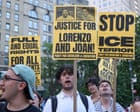
The light in Maine during early July has a clean, cold clarity that makes everything look sharper than it is. On a Monday morning in Biddeford, the sun was just beginning to hit the frame of a modest home on Pool Street. Inside, a twenty-six-year-old named Johan Sebastián Durán Guerrero was getting ready for work. His daughter was still pad-padding around the floor in blue pajamas patterned after the cartoon dog Bluey.
He was a young father, a Colombian national with a valid Social Security number and work authorization, trying to navigate the bewildering labyrinth of the American immigration court system. He had been attending his hearings. He was doing what the system asked. Also making headlines recently: Why the Red Sea Diplomatic Standoff in New York Matters More Than the Resolution.
Outside, idling in the quiet morning, sat unmarked vehicles.
They were manned by agents from Immigration and Customs Enforcement (ICE). They were not there for Johan. They were watching the address, hoping to catch someone else—an unnamed individual with a deportation order. When Johan walked out of his door, stepped into his car, and started the engine, the agents closed in. Further details regarding the matter are detailed by Al Jazeera.
What followed is a sequence of events now frozen in a blur of terrifying bystander video and official press releases. The government says Johan tried to flee and that an officer, "fearing for public safety," fired his weapon. Witnesses tell a far more devastating story. They say that as Johan was dragged from the driver's seat, bleeding, his final words to the officers were a desperate plea: I tried to stop.
From the window, his wife and his little girl in the Bluey pajamas watched him die on the asphalt.
The Ghost in the Machine
We often talk about immigration in the abstract. We discuss borders as if they are lines drawn in sand, and enforcement as if it is a mathematical equation of inputs and outputs. We use words like "jurisdiction," "removal," and "operational capacity." But these terms are just a polite vocabulary designed to mask a physical reality.
The reality is that ICE operates as a parallel, heavily armed domestic force with immense latitude and virtually no local accountability.
Consider the mechanics of a modern ICE vehicle stop. Unlike local police departments, which are bound by municipal oversight, public records laws, and local community relations, federal immigration officers often move through neighborhoods like ghosts. They ride in unmarked SUVs with tinted glass. They do not wear body cameras in many of the jurisdictions where they operate.
When they pull someone over, it is not for a broken taillight. It is a high-stakes, high-tension confrontation based on "resemblance" or geographical proximity.
Only six days before Johan was shot in Maine, a fifty-two-year-old homebuilder named Lorenzo Salgado Araujo was driving his work van through Houston, Texas. He was a Mexican national who had lived in the United States for thirty-five years. He had built a life, a business, and a reputation. He had no criminal record and was on the verge of securing his legal status.
On July 7, ICE agents on a "targeted enforcement operation" spotted two white vans near a target address. Lorenzo's van looked like the target's van.
The agents did not have body cameras. When they forced the van to stop, the situation dissolved into violence. The Department of Homeland Security later claimed Lorenzo "weaponized" his vehicle to run over an agent. But the three crew members riding in the van with Lorenzo told their attorney a completely different story: there was no agent in front of the vehicle, and the shots that killed Lorenzo came from the sides.
Two cities. Two white vans. Two men dead who were never the targets of the warrants.
The Illusion of the Split Second
There is a defense mechanism built into the American legal consciousness that instantly activates whenever law enforcement pulls a trigger. It is the doctrine of the split-second decision. We are told that officers face impossible, immediate choices, and that we cannot judge their actions from the safety of a comfortable armchair.
But this defense ignores how the stage was set in the first place.
Imagine a theater director who builds a set filled with dry tinder, leaves open kerosene lamps dangling from cheap string, and then expresses shock when a spark starts a fire. The tragedy was not the spark. It was the deliberate design of the room.
Legal experts point out that the vast majority of local police departments in the United States have strict policies prohibiting officers from shooting at moving vehicles. The reason is simple and practical: shooting a driver does not stop a car; it turns a controlled vehicle into an unguided, multi-ton missile. Yet, federal immigration agents routinely ignore this basic tenet of modern public safety.
"If you created a playbook of how to create dangerous situations that will inevitably lead to unjustified violence, here we are," says Rachel Moran, a law professor who studies police accountability.
The administration has responded to the growing fury by ordering a temporary pause on most vehicle-related stops. But a pause is not a policy. It is a political sigh of relief, a brief intake of breath hoping the news cycle will move on before the next white van is pulled over on a quiet street.
The tension on the ground is not about policy adjustments or the deployment of more body cameras. It is about a fundamental, unanswered question: Who are these streets actually for?
If a father cannot drive to work in Maine, or a builder cannot transport his crew in Texas without risking an unmarked vehicle box-in and a lethal volley of gunfire, then the concept of public safety has been turned completely inside out.
Johan’s daughter will eventually outgrow those blue pajamas. But she will never outgrow the memory of the early morning light on Pool Street, the sound of the tires, and the sudden, permanent silence that followed.