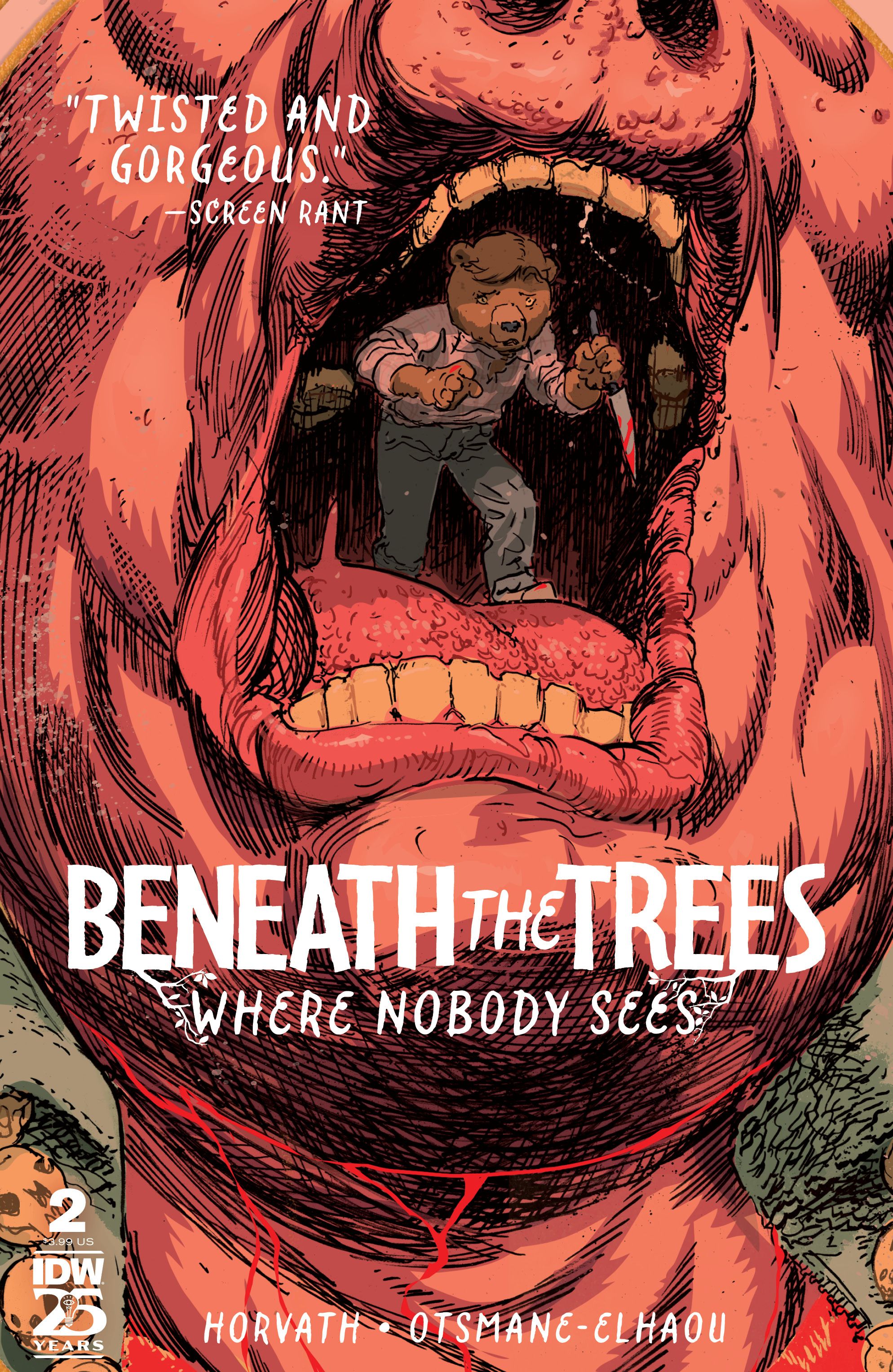
Patrick Horvath did something weird. He took the visual language of Richard Scarry’s Busytown—you know, those cozy, bustling villages filled with polite bears in overalls and pigs driving pickle cars—and he doused it in the cold, clinical bloodthirst of Dexter. It shouldn’t work. On paper, it sounds like a gimmick that would wear thin after ten pages. Yet, Beneath the Trees Where Nobody Sees became a breakout hit for IDW Publishing because it understands a fundamental truth about horror: the scariest monsters are the ones who look like your neighbors.
Woodhaven is perfect. It’s a literal storybook town where everyone knows everyone and the worst crime is usually a bit of local gossip. Samantha is the town’s local hardware store owner. She’s a brown bear. She’s also a meticulous, ritualistic serial killer. Meanwhile, you can read similar developments here: The Ghost Behind the Door How Kiyoshi Kurosawa Stopped Screaming and Started Watching.
But Sam isn’t the problem. Well, she is a problem, but she’s a controlled one. She has rules. She leaves Woodhaven to do her "work," ensuring her home remains a sanctuary of peace and quiet. The conflict kicks off when a second killer—someone who doesn't play by the rules—starts leaving bodies right in the middle of Woodhaven's idyllic streets.
The Cognitive Dissonance of Cute Gore
There is a specific kind of whiplash you get when reading this series. You’re looking at these soft, painterly textures and rounded character designs that scream childhood nostalgia. Then, you turn the page and see a graphic, visceral crime scene. Horvath, who writes and illustrates the series, uses this contrast to heighten the tension. To see the full picture, we recommend the detailed article by E! News.
Honestly, it’s brilliant. Most horror comics rely on jagged lines and dark, muddy palettes to convey dread. By keeping the art style bright and "safe," the violence feels ten times more invasive. It feels like a violation of the reader's own memories. When Sam is standing in her kitchen, the warm lighting makes you forget for a second that she’s a monster. That’s the trap.
The pacing is surprisingly deliberate. It’s not a jump-scare-a-minute kind of book. It’s a slow-burn procedural. We spend a lot of time in Sam’s head, hearing her internal monologue as she tries to figure out who is messing up her town. She’s frustrated. She’s indignant. It’s almost funny how relatable her annoyance is, until you remember she’s upset because someone else’s murder is making it harder for her to be a murderer.
Why Sam is a Revolutionary Protagonist
We’ve seen the "likable serial killer" trope before. From Hannibal Lecter to Joe Goldberg, the "high-functioning sociopath" is a staple of modern fiction. However, Beneath the Trees Where Nobody Sees adds a layer of community pressure that those other stories lack.
Sam isn't just hiding from the law; she’s hiding from a community that genuinely loves her. She has to maintain the hardware store. She has to attend town meetings. She has to be "Sam the Bear." The psychological toll of this mask is depicted with an incredible amount of nuance. It’s not just about the kills; it’s about the exhaustion of pretending to be "nice."
There’s a scene early on where Sam interacts with her neighbors, and you see the flicker of genuine irritation behind her eyes. It’s a masterclass in character acting through comic art. You see the performance. You see the cracks.
Some critics have compared the book to Animal Crossing meets Seven, but that’s a bit reductive. It’s more of a commentary on the "small-town secret." Every small town has that one person everyone ignores, that one dark history no one talks about. Horvath just made that history literal and covered in fur.
The IDW Surprise and the Market Impact
Let’s talk industry for a second. IDW has been through a lot lately. They’ve lost some big licenses and have had to pivot toward more original creator-owned content. Beneath the Trees Where Nobody Sees was exactly what they needed. It proved that there is a massive appetite for "high-concept" horror that pushes boundaries.
The first issue went through multiple printings. That doesn't happen by accident in a crowded market.
Word of mouth drove this book. People saw a cover with a cute bear holding a bloody knife and posted it on social media. But they stayed for the writing. The mystery of who the "other" killer is provides a solid backbone, but the real draw is Sam’s evolution. You find yourself rooting for her to catch the intruder, which is a testament to how well Horvath has manipulated the reader's empathy.
It makes you complicit. By the time you’re three issues in, you’re part of Woodhaven. You want the status quo returned, even if that status quo includes a serial killer running the hardware store.
Breaking Down the Visual Language
The color palette is essential here. Horvath uses watercolors and soft pencils. There are no harsh digital inks. This gives the book a tactile, organic feel. It feels like a book you would find in the attic of an old house.
- The character designs are distinct. You never confuse the mayor with the mailman.
- The backgrounds are dense with detail. Woodhaven feels lived-in.
- The gore is handled with a "medical" precision. It’s not gratuitous for the sake of being edgy; it’s a reflection of Sam’s clinical worldview.
If the art was even slightly more "comic-booky," the impact would be lost. It needs that storybook aesthetic to create the necessary friction.
Is There a Deeper Meaning?
Is it a satire of the suburbs? Probably.
Is it a deconstruction of the slasher genre? Definitely.
But mostly, it’s a character study. It’s about the things we bury. We all have "trees" in our lives—places where we hide the parts of ourselves that aren't fit for public consumption. Sam’s "trees" just happen to involve actual bodies.
The title itself, Beneath the Trees Where Nobody Sees, is a play on the "Teddy Bears' Picnic" song. It subverts the idea of childhood innocence. It suggests that the woods aren't a place of wonder, but a place of disposal. It’s a grim reality wrapped in a soft blanket.
The series is a limited run, which is the right call. A story like this needs a definitive ending. It needs to burn bright and fast before the "shock" of the premise wears off. By keeping the scope narrow, Horvath ensures that every panel matters.
How to Collect the Series
If you’re looking to get into the book now, you have a few options. The individual issues are becoming collectors' items, especially the 1:10 and 1:25 incentive covers. However, for most people, the trade paperback is the way to go.
- Check your local comic shop first. They usually have the back issues or the collected volume.
- Digital platforms like Kindle or Comixology are great for the "pure" reading experience without worrying about condition.
- Keep an eye out for the "reprint" covers. IDW has released several versions because the initial demand was so high.
There’s also talk of a sequel or a spin-off, though nothing is set in stone. The "Woodhaven Universe" certainly has room to grow, but Horvath has been quiet about exactly what comes next. For now, we have these six issues of pure, unadulterated tension.
Actionable Insights for Horror Fans
If you're a fan of the genre, don't sleep on this. It's rare to see a book that balances tone this effectively. To get the most out of the experience:
- Read it twice. Once for the story, and a second time to look at the backgrounds. Horvath hides a lot of clues in the store shelves and the town's architecture.
- Compare it to the "Golden Age" of children's illustrators. Look at Beatrix Potter or Maurice Sendak. You’ll see exactly where Horvath is pulling his influences from and how he subverts them.
- Pay attention to the letters page. If you can get the individual issues, the interaction between the creator and the fans adds a layer of context to the production process.
- Follow Patrick Horvath on social media. He often posts process shots and early sketches that show how he developed the look of Woodhaven.
This comic is a reminder that the medium is still capable of surprising us. It’s not just about capes and tights. Sometimes, it’s about a bear, a knife, and a very quiet town.
Go to your local comic shop and ask for Beneath the Trees Where Nobody Sees. If they don't have it, tell them to order the trade. It is the most uncomfortable, beautiful, and gripping horror story in years. It’s a book that stays with you, long after you’ve put it down and looked nervously at the treeline outside your own window.