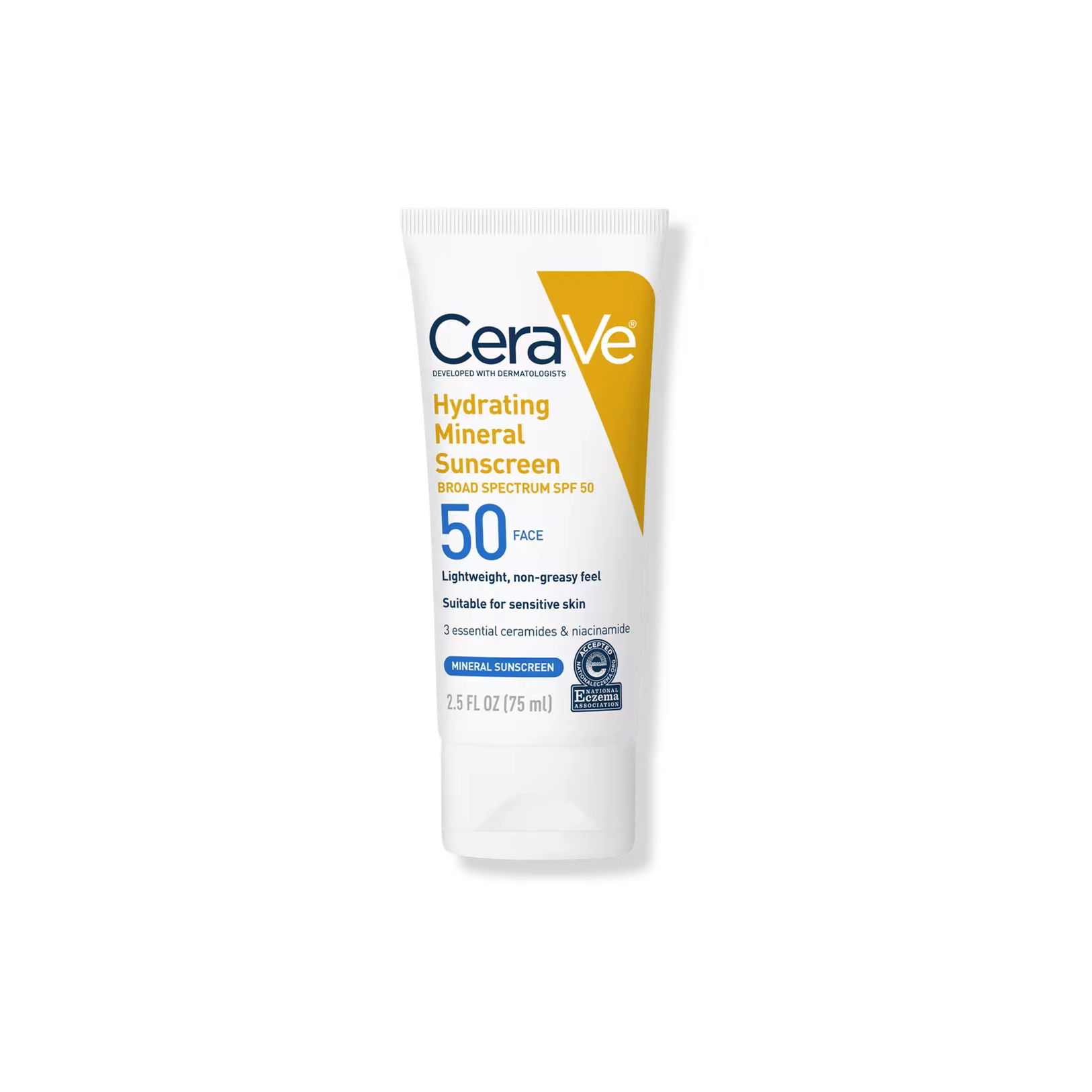
Finding a sunscreen that doesn't make you look like a Victorian ghost is harder than it should be. Honestly, most of us just want protection that doesn't feel like library paste. When you pick up a tube of CeraVe Mineral Sunscreen SPF 50, you’re holding one of the most discussed drugstore products in the skincare community. It’s a polarizing beast. Some people swear it’s the only thing that saves their eczema-prone skin, while others complain it leaves a white cast so thick you could use it as house paint.
It works. It really does. But there is a massive learning curve here that nobody tells you about on the back of the bottle.
What's Actually Inside the Tube?
Most people think mineral sunscreen is just "natural" sunscreen. That’s a bit of a misnomer. The CeraVe Mineral Sunscreen SPF 50 relies on two heavy hitters: Zinc Oxide and Titanium Dioxide. These are physical blockers. They sit on top of your skin and reflect UV rays like a thousand tiny mirrors. Unlike chemical filters—think avobenzone or oxybenzone—these don't soak into your bloodstream or disrupt your hormones, which is why dermatologists like Dr. Dustin Portela often recommend them for people with high sensitivity.
But there’s more to it than just the minerals. CeraVe is owned by L'Oréal, and they’ve pumped their signature "three essential ceramides" (1, 3, and 6-II) into this formula. If your skin barrier is trashed from over-exfoliating or just plain genetics, these ceramides act like the mortar between your skin-cell bricks.
It also has niacinamide. This is a form of Vitamin B3 that helps with redness. If you’ve got rosacea or acne, this is a huge win. Hyaluronic acid is in there too, though, to be frank, the formula feels so thick that "hydrating" might not be the first word that comes to mind when you're struggling to rub it in.
The White Cast Elephant in the Room
Let's be real. If you have a deeper skin tone, this product is going to be a challenge. Because it uses 9% Titanium Dioxide and 7% Zinc Oxide, it is inherently white. There is no way around the physics of those minerals. On fair skin, it eventually settles into a matte finish. On olive or dark skin? It can look purple or ash-grey.
I’ve seen people try to fix this by mixing it with foundation. Don't do that. You’re diluting the SPF and creating "holes" in your protection where the sun can get through. If the cast is a dealbreaker for you, CeraVe actually makes a tinted version of their mineral sunscreen, though that one only comes in one shade and only hits SPF 30. It’s a trade-off.
Texture and the "Oiliness" Paradox
It’s oil-free. It says so right on the front. Yet, strangely, some users find it feels greasy after a few hours. Why?
It’s the "film-formers." To make a mineral sunscreen water-resistant (this one is rated for 80 minutes), chemists have to use ingredients that help the powder stick to your skin. On some skin types, this feels like a heavy layer that doesn't "breathe." If you have extremely oily skin, you might find this feels like wearing a mask. However, if you have dry, flaky skin, that "greasy" feeling is actually a protective occlusive layer that keeps moisture from evaporating.
The finish is definitely matte, though. Once it sets, it doesn't move. This makes it a decent primer for makeup, provided you wait at least fifteen minutes before applying your concealer. If you rush it, everything will pill. You’ll get those annoying little white rolls of product falling off your face. It's frustrating.
Why This Specific SPF Rating Matters
You might wonder why you’d pick the 50 over the 30. The difference in UVB protection is actually smaller than you’d think. SPF 30 blocks about 97% of rays, while SPF 50 blocks about 98%. It sounds negligible.
But here’s the kicker: most of us don't apply enough sunscreen. We use maybe a third of what we should. If you under-apply an SPF 50, you’re at least getting some decent coverage. If you under-apply an SPF 15, you’re basically unprotected. The CeraVe Mineral Sunscreen SPF 50 gives you that extra margin for error.
The Best Way to Apply (Without Looking Like a Mime)
You can’t apply this like a moisturizer. If you take a giant glob and rub it into your palms and then smash it onto your face, you’re going to have a bad time.
- Start with a hydrated base. If your skin is dry, the minerals will cling to the dry patches and look terrible. Apply a light moisturizer first and let it sink in completely.
- Work in sections. Do your forehead. Then one cheek. then the other.
- Use the "dot" method. Put tiny dots of sunscreen all over the area you’re working on.
- Pat, don't rub. Use your fingertips to gently pat the product into the skin. This helps the minerals lay flat against the surface rather than getting streaky.
- Give it time. It takes about 15 minutes for the "carrier" liquids to evaporate and for the sunscreen to set. The white cast often fades significantly during this window.
Comparing CeraVe to the Competition
How does it stack up against La Roche-Posay Anthelios Mineral or the high-end stuff like SkinCeuticals?
La Roche-Posay's mineral fluid is much thinner. It’s like milk. CeraVe is like a stiff cream. If you hate the feeling of anything on your face, you’ll probably prefer the fluid. But the CeraVe is usually half the price. For a family at the beach or someone on a budget, that price gap is massive.
Compared to "prestige" mineral sunscreens like EltaMD UV Physical, CeraVe lacks the sophisticated tinting and the "elegant" finish. EltaMD feels like skincare; CeraVe feels like a functional barrier. But again, CeraVe is accessible. You can buy it at a CVS in the middle of nowhere at 11 PM. There is value in that.
Common Misconceptions
People often think "mineral" means "reef safe." This is a complicated topic. While the ingredients in CeraVe Mineral Sunscreen SPF 50 are generally considered safer for marine life than oxybenzone, the term "reef safe" isn't actually regulated by the FDA. However, if you're heading to Hawaii or the Virgin Islands, this formula generally passes their strict requirements because it avoids the banned chemical filters.
Another myth: you don't need to double-cleanse. You absolutely do. Mineral sunscreen is designed to stick. A regular water-based face wash usually won't cut through the zinc. If you don't use an oil-based cleanser or a micellar water first, you’ll likely wake up with clogged pores or "sunscreen acne."
Is It Right For You?
This isn't a "one size fits all" product.
If you have highly reactive skin, allergy-prone eyes, or you’re recovering from a chemical peel, this is a gold standard. It doesn't sting. It doesn't burn. It just stays put.
If you are a person of color or someone who hates the feeling of "product" on their skin, you might find this frustrating. It’s heavy. It’s white. It’s stubborn.
But for a drugstore mineral option, it’s one of the cleanest formulas out there. No fragrance. No parabens. No chemical filters. Just pure, physical protection.
Your Practical Checklist for Success
- Check the expiration date. Mineral sunscreens can clump over time, making them impossible to spread.
- Warm it up. Rub the product between your fingers for three seconds before touching your face to make it more pliable.
- Don't forget the ears. Since this provides a physical block, it’s great for the tops of the ears which are notorious for skin cancer spots.
- Use a damp makeup sponge. If the cast is too much, lightly dabbing a damp sponge over your face after the sunscreen has set can pick up excess pigment without stripping the protection.
- Wash it off properly. Use an oil cleanser or a balm at night to ensure your pores are clear of the zinc residue.
The real trick to enjoying CeraVe Mineral Sunscreen SPF 50 is accepting that it’s a functional tool, not a luxury serum. It’s there to do a job. Once you master the application, it provides some of the most reliable protection you can find for under twenty dollars.