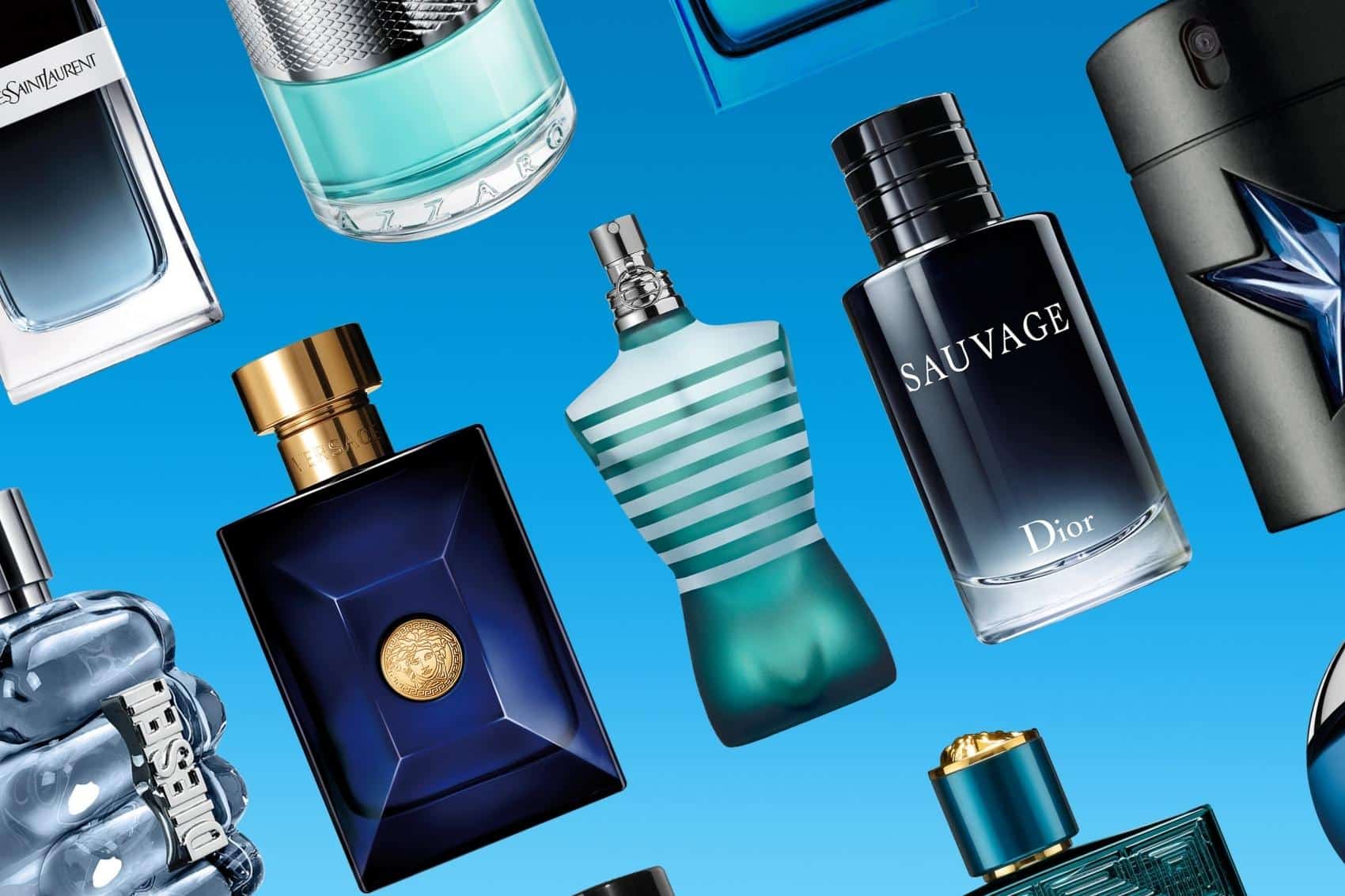
You’ve seen the wall. Walk into any Sephora or Nordstrom and the men’s fragrance aisle looks like an ocean. Dark navy, translucent turquoise, frosted cobalt—the sheer volume of cologne in a blue bottle is staggering. It’s a marketing phenomenon that has basically rewritten the rules of how men smell since the early nineties. Honestly, it’s getting a bit ridiculous.
Blue is safe. Blue is clean. When a guy doesn't know what to buy, he grabs the blue one. It’s the olfactory equivalent of a crisp white button-down shirt. You can't really mess it up, but you aren't exactly reinventing the wheel either. But here's the thing: "Blue" isn't just a color anymore. In the industry, it's a specific scent profile—the "Blue Fragrance"—defined by a very particular DNA of citrus, pepper, and a massive dose of synthetic molecules like Ambroxan.
The 1990s Shift: How Cool Water Changed Everything
Before 1988, men mostly smelled like forests, tobacco, or spice racks. Then Pierre Bourdon formulated Davidoff Cool Water. It was a revolution. It didn't smell like a library or a barbershop; it smelled like laundry hanging near the ocean. It used a molecule called Dihydromyrcenol in a way that hadn't been done before, creating that sharp, metallic freshness we now associate with "clean."
If you want to understand why every cologne in a blue bottle exists today, you have to look at the lineage of Cool Water. It paved the way for the "freshie" obsession. Suddenly, the goal wasn't to smell like a sophisticated gentleman of leisure. The goal was to smell like you just stepped out of a high-pressure shower. It was athletic. It was approachable.
Then came the mid-2010s, and the "Blue" genre reached its final, most powerful form.
The Holy Trinity of Blue: Sauvage, Bleu, and Y
If you're looking for a cologne in a blue bottle today, you are inevitably going to run into the three titans of the industry. These aren't just scents; they are billion-dollar assets for their respective fashion houses.
Bleu de Chanel (2010) is arguably the most important of the bunch. Jacques Polge, the master perfumer, created something that managed to be both "mass-appealing" and incredibly high-quality. It’s got that grapefruit opening and a woody finish. It’s polite. You wear it to an interview. You wear it to meet your girlfriend's parents. It’s the safe bet that actually smells expensive.
Then came Dior Sauvage in 2015.
Sauvage is a different beast entirely. It’s loud. It’s obnoxious to some, but addictive to others. Francois Demachy leaned heavily into Ambroxan, a synthetic version of ambergris that provides a salty, metallic, skin-like warmth that lasts for twelve hours. It's the king of "compliment getters," mostly because people can smell you from across the street. It’s the polarizing giant of the blue bottle world.
Finally, Yves Saint Laurent Y EDP joined the fray. It took the blue concept and made it sweet. Think green apple mixed with ginger and sage. It’s younger, louder, and incredibly "synthetic" in a way that feels modern rather than cheap.
The Chemistry of Why We Like Them
Why do we gravitate toward these? It’s not just the glass. There is actual science behind why a cologne in a blue bottle dominates sales charts year after year. Our brains are wired to associate the color blue with water, sky, and openness.
Biologically, "fresh" scents often signal hygiene and health. In a crowded environment, a heavy, spicy scent can feel claustrophobic or aggressive. A blue scent feels like a "breath of fresh air." Perfumers use specific chemical building blocks to achieve this:
- Linalool: Found in lavender, it provides a floral-woody cleanliness.
- Ambroxan: The secret sauce. It creates a physical "presence" in the air without being heavy.
- Calone: That "watermelon" or "sea breeze" note that defined the nineties.
- Bergamot: The sparkly citrus that almost every blue fragrance uses for its first 15 minutes of life.
The Problem with "Blue" Overload
The downside? Everyone smells the same. If you go to a club or a wedding, half the guys there are wearing Sauvage. It’s the "Live, Laugh, Love" of the fragrance world. It’s tasteful, but it’s ubiquitous.
Serious collectors often look down on the cologne in a blue bottle category because it lacks "soul." These scents are designed by focus groups. They are tested to ensure that 95% of people find them "pleasant." That sounds good, but "pleasant" is often the enemy of "interesting." If you want to stand out, the blue bottle is rarely the way to do it.
But sometimes, you don't want to stand out. Sometimes you just want to smell good. There’s no shame in that.
Navigating the Best Options by Budget
You don't have to spend $150 to get a decent cologne in a blue bottle. The market is flooded at every price point, from the drugstore shelf to the high-end boutique.
The Budget King: Nautica Voyage For about $20, you get a scent created by Maurice Roucel, one of the greatest perfumers alive. It smells like salty apples and lotus. It’s green-blue. It’s simple, it’s effective, and it’s sold millions of bottles for a reason. It doesn't smell "expensive," but it smells incredibly clean.
The Middle Ground: Versace Dylan Blue This is basically a "greatest hits" album of every other blue fragrance. It has the citrus of Chanel, the ambroxan of Dior, and a weird little incense note that makes it feel slightly darker. It’s often found at discounters for a great price. If you want one bottle that does everything, this is usually my recommendation for guys on a budget.
The High-End Alternative: Percival by Parfums de Marly If you have money to burn and want a cologne in a blue bottle that feels "niche," this is it. It basically takes the Abercrombie & Fitch "Fierce" DNA—that mall scent of the early 2000s—and rebuilds it with incredibly high-quality ingredients. It’s smoother, it lasts longer, and the bottle is a heavy, gorgeous royal blue.
Seasonality: When to Spray What
A common mistake is thinking all blue scents are for summer. They aren't.
Light blue bottles (think Dolce & Gabbana Light Blue Pour Homme) are for the heat. They are watery and citrusy. They evaporate quickly. If you wear them in the winter, they'll disappear in minutes.
Dark blue bottles (think Bleu de Chanel Parfum or Armani Code) usually have more "weight." They have resins, tonka bean, or woods. These are your winter blues. They can stand up to the cold air without losing their punch.
How to Wear Blue Fragrances Without Being "That Guy"
We’ve all been in an elevator with someone who clearly bathed in Dior Sauvage. Don't be that guy. Because these scents are built on synthetic molecules designed for "projection" (how far the scent travels) and "sillage" (the trail you leave behind), you need less than you think.
Two sprays on the neck is usually plenty. Maybe one on the wrist if you’re feeling spicy.
Also, consider where you’re going. A blue scent is perfect for the gym, the office, or a casual lunch. It’s less "romantic" for a candlelit dinner. For that, you might want something warmer—something in a brown or clear bottle with notes of vanilla or leather.
Beyond the Big Names: Some Forgotten Blues
Not every cologne in a blue bottle is a blockbuster. Some gems have been lost to time or overshadowed by the marketing budgets of Dior and Chanel.
Bvlgari Aqua Pour Homme is a masterpiece of "dark sea" scent. It doesn't smell like a shower; it smells like seaweed and ocean depths. It’s salty, murky, and fascinating. It’s for the guy who wants to be "blue" but wants to smell like the actual ocean, not a fantasy version of it.
Then there's Polo Blue. The original EDT is a bit dated now, but the Gold Blend or the Parfum versions are surprisingly sophisticated. They use ginger and sage to give a "fuzzy" texture to the freshness that feels more mature than the screechy sweetness of YSL.
Final Verdict on the Blue Obsession
The blue bottle isn't going anywhere. It’s a pillar of the grooming industry because it works. It taps into a primal desire for cleanliness and a modern desire for easy, grab-and-go style.
Is it boring? Kinda. Is it effective? Absolutely.
If you’re building a fragrance collection, you probably need one good blue scent. You don't need five. Pick the one that reacts best with your skin—because yes, your skin chemistry changes how these molecules smell. What smells like "heaven" on your friend might smell like "metallic bug spray" on you. Always test on skin, never just on the paper strip.
Your Next Steps for Finding the Right Blue Scent
Stop buying blind. It's the biggest mistake men make with fragrances. Marketing and bottle design are meant to trick your brain into liking a scent before you even smell it.
- Visit a counter with clean skin. Don't wear any scent that day.
- Spray two different blue fragrances, one on each wrist.
- Leave the mall. Seriously. Walk around for at least two hours. Let the "top notes" (the initial citrus) fade so you can smell the "dry down" (the scent that stays with you for 6 hours).
- Check for longevity. If a $100 bottle disappears in two hours, it's not worth your money, no matter how pretty the blue glass is.
- Look for "Parfum" or "Eau de Parfum" versions if you want better longevity. "Eau de Toilette" is usually thinner and more citrus-heavy.
- Consider a sample set. Brands like Sephora often sell "favorites" kits that include several blue scents and a voucher for a full-size bottle. This is the smartest way to find your signature without wasting money on a bottle you'll end up using as a bathroom air freshener.
The "perfect" blue fragrance is the one you forget you're wearing until someone leans in and tells you that you smell incredible. It shouldn't announce your arrival; it should linger as a pleasant memory of your departure.