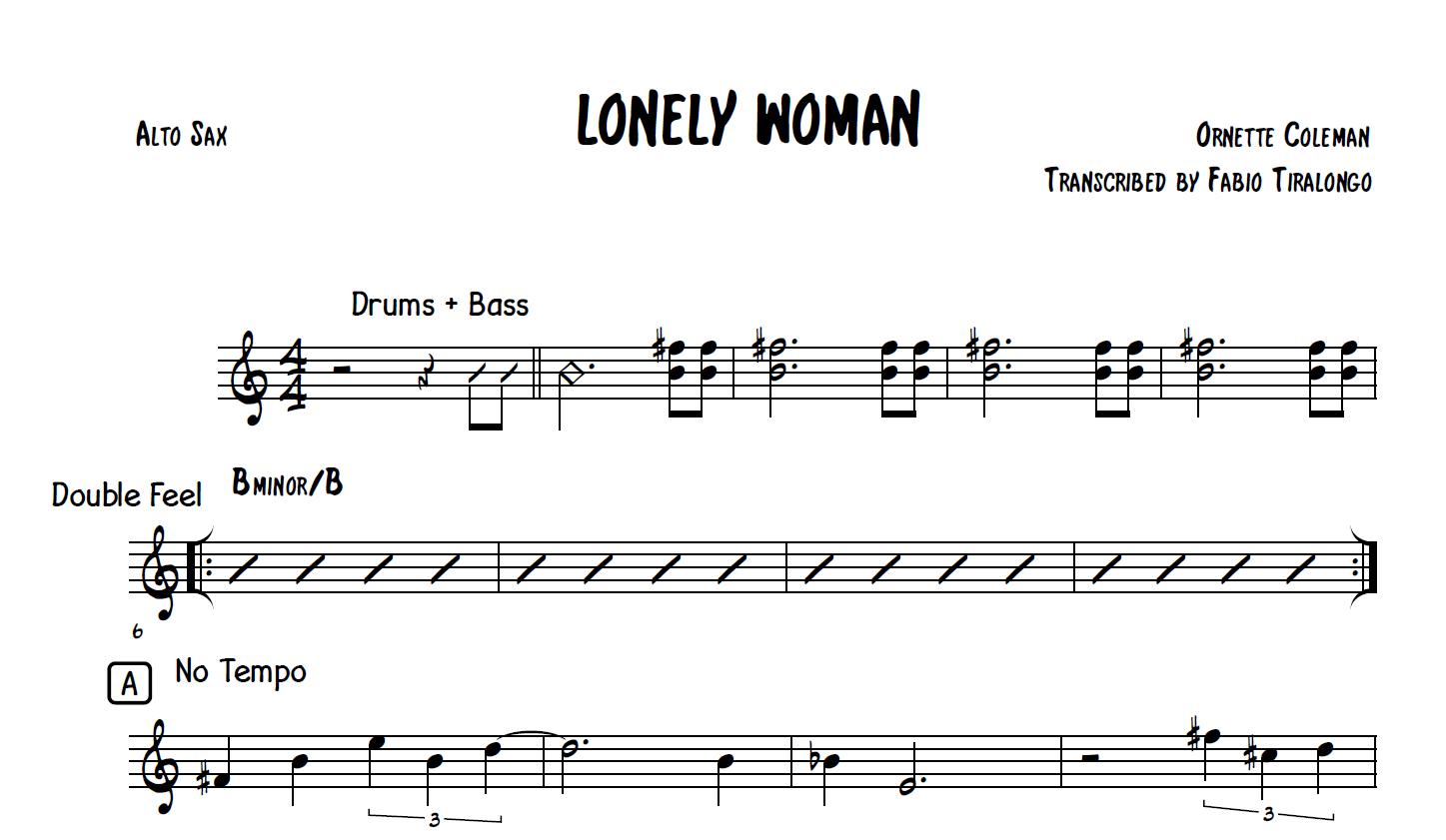
It starts with a moan. Not a musical note in the traditional sense, but a literal, physical sagging of sound. If you’ve ever sat in a dimly lit room and felt the weight of the walls closing in, you’ve basically heard the opening of Lonely Woman by Ornette Coleman. This isn't just a jazz track. Honestly, it’s more like a ghost story told through a plastic saxophone.
When the album The Shape of Jazz to Come dropped in 1959, people didn't just listen to it—they argued over it. Some called it the future. Others called it a scam. But "Lonely Woman" was the hook that no one could shake off. It’s got this weird, paradoxical energy where the drums are sprinting at a million miles per hour while the melody just... drifts. It’s devastating. It feels like watching a car crash in slow motion while someone whispers a secret in your ear.
The Day Jazz Broke: The Birth of a New Sound
Most jazz in the fifties was about the "changes." You had a set of chords, and you played over them. Simple, right? Ornette Coleman thought that was a prison. He wanted to play the feeling of the song, not the math of the song.
When he walked into the Atlantic Studios in Los Angeles on May 22, 1959, he brought Don Cherry, Charlie Haden, and Billy Higgins with him. They weren't just making a record. They were burning the rulebook. The melody of Lonely Woman by Ornette Coleman was actually inspired by a painting Ornette saw in a department store. It depicted a wealthy woman who had everything but looked utterly hollow inside. He saw that expression and heard a sound.
Don Cherry’s pocket trumpet and Ornette’s white plastic Grafton alto sax play the head of the tune in a sort of loose, weeping unison. They aren't perfectly in tune. That’s the point. Real crying isn't in tune. If it were "perfect," it would be fake. Charlie Haden’s bass anchors the whole thing with a double-stop drone that feels like a heartbeat skipping. It’s heavy. It’s thick. It’s the sound of 1959 realizing that the post-war dream was maybe a little bit lonely after all.
Why the "Plastic" Saxophone Actually Mattered
People love to point out that Ornette played a plastic saxophone. They used it as an insult back then. "He can't even afford a real horn," the critics snickered. But that plastic Grafton had a specific, brittle tone that a brass Selmer couldn't replicate. It sounded human. It sounded like vocal cords straining.
In Lonely Woman by Ornette Coleman, that thin, piercing timbre allows the melody to float above the chaotic rhythm section. Billy Higgins is playing a fast, shimmering ride cymbal pattern that feels like bebop on stimulants. Usually, the soloist follows the drummer. Here? They exist in two different time zones. It creates this incredible tension. You feel like you're falling, but the melody is holding you up by your collar.
The Five Spot Residency and the Jazz War
If you want to understand why this song matters, you have to look at what happened at the Five Spot Café in New York. Ornette’s quartet played there for months, and it turned into a battlefield. Leonard Bernstein once stood up and yelled that Ornette was a genius. Meanwhile, Max Roach—a literal god of jazz drumming—reportedly walked up to Ornette and punched him in the mouth.
Why? Because "Lonely Woman" threw away the safety net. It proved that you didn't need a piano to hold the harmony together. By removing the piano, Ornette gave the musicians "harmolodic" freedom. They could shift keys whenever the emotion shifted. To a traditionalist, this was anarchy. To a younger generation, it was the first time jazz felt like it was actually reflecting the chaos of modern life.
The Anatomy of the Melancholy
There’s a specific moment in the track, about halfway through, where the melody seems to collapse under its own weight. The way Charlie Haden pulls at the bass strings—it’s visceral. Haden once mentioned in an interview that playing with Ornette required a different kind of listening. You couldn't just rely on your scales. You had to listen to the air in the room.
The song doesn't have a bridge in the way a Cole Porter tune does. It doesn't resolve. It just cycles through this deep, indigo blues feeling. It’s been covered by everyone from Old and New Dreams to Branford Marsalis, and even John Zorn. Each version tries to capture that "cry," but there’s something about the original 1959 recording that remains untouchable. It’s the sound of a man who spent his years working as an elevator operator, studying theory books in his spare time, finally getting to say what he felt.
What Most People Get Wrong About Free Jazz
There’s a common myth that Lonely Woman by Ornette Coleman is just "random noise." That’s total nonsense. If you sit down and actually hum the melody, it’s incredibly catchy. It’s a folk song from a planet that hasn't been discovered yet. It’s structured, but the structure is elastic.
The "Free Jazz" label actually came from a later album, but "Lonely Woman" is where the DNA was spliced. It wasn't about being weird for the sake of being weird. It was about "Humanity over Harmony." Ornette once said that when someone is laughing, they don't laugh in the key of C. When they cry, they don't cry in B-flat. He wanted music to be that honest.
Legacy and the Sound of Modern Loneliness
We live in a world that is more connected and more isolated than ever. That’s why this track still hits. It’s the ultimate soundtrack for the "scrolling at 3 AM" generation. It captures that specific type of loneliness that exists even when you're surrounded by people.
When you hear those final, fading notes of the horn, it doesn't feel like a conclusion. It feels like the person just walked out of the room. The silence that follows is part of the composition.
How to Truly Experience This Track
To get the most out of this piece, don't treat it like background music. It’s too demanding for that.
- Listen on Vinyl or High-Res Audio: The separation between Billy Higgins' cymbals and Haden's bass is crucial. If you listen on crappy laptop speakers, you lose the "throb" of the low end.
- Ignore the "Jazz" Label: Forget what you think jazz is supposed to sound like. Listen to it like it's a piece of ambient or experimental rock. It shares more DNA with Sonic Youth or Radiohead than it does with Glenn Miller.
- Follow the Bass: Instead of focusing on the saxophone, try to track Charlie Haden’s movements for the full five minutes. He is the one telling the real story underneath the surface.
- Read the Room: This is a "lights off" song. It’s a "rainy window" song. Give it the space it deserves to breathe.
If you’re just starting your journey into Ornette Coleman’s world, "Lonely Woman" is the front door. Once you walk through it, your ears will never quite work the same way again. And that’s a good thing.