The Pentagon has a massive, highly predictable problem with its missiles. For decades, if the U.S. military needed a solid rocket motor to power an interceptor, a tactical missile, or a hypersonic weapon, it had exactly two doors to knock on: Northrop Grumman and Aerojet Rocketdyne. This cozy duopoly created a slow-moving, expensive supply chain that simply cannot keep up with current global demand.
Enter X-Bow Systems. The Albuquerque-based defense tech startup is systematically chipping away at that long-standing stranglehold, pulling in strategic defense contracts to scale its automated production. By focusing on modular, software-driven manufacturing, X-Bow isn't just trying to build a better motor. It's aiming to completely upend how the military buys and scales propulsion technology. Learn more on a similar issue: this related article.
The Bottleneck in American Missile Production
You can't build a modern defense infrastructure without solid rocket motors. They're the literal backbone of everything from shoulder-fired weapons to heavy-duty hypersonic systems. But the traditional manufacturing process is deeply flawed. It's capital-intensive, painfully slow, and relies on massive, fixed facilities that bake propellants over weeks.
When global consumption of munitions skyrocketed, the Pentagon quickly realized its domestic industrial base lacked any real surge capacity. You can't just flip a switch to double production when your core process depends on legacy infrastructure and hand-crafted chemical mixes. If one major factory suffers an accident or a supply disruption, entire defense programs grind to a halt. More analysis by Forbes highlights comparable perspectives on this issue.
The military desperately needed a non-traditional supplier to inject actual competition into the market. That's why the Department of Defense is spreading capital across agile players capable of producing energetics on demand.
3D Printing Propellant to Shortcut the Supply Chain
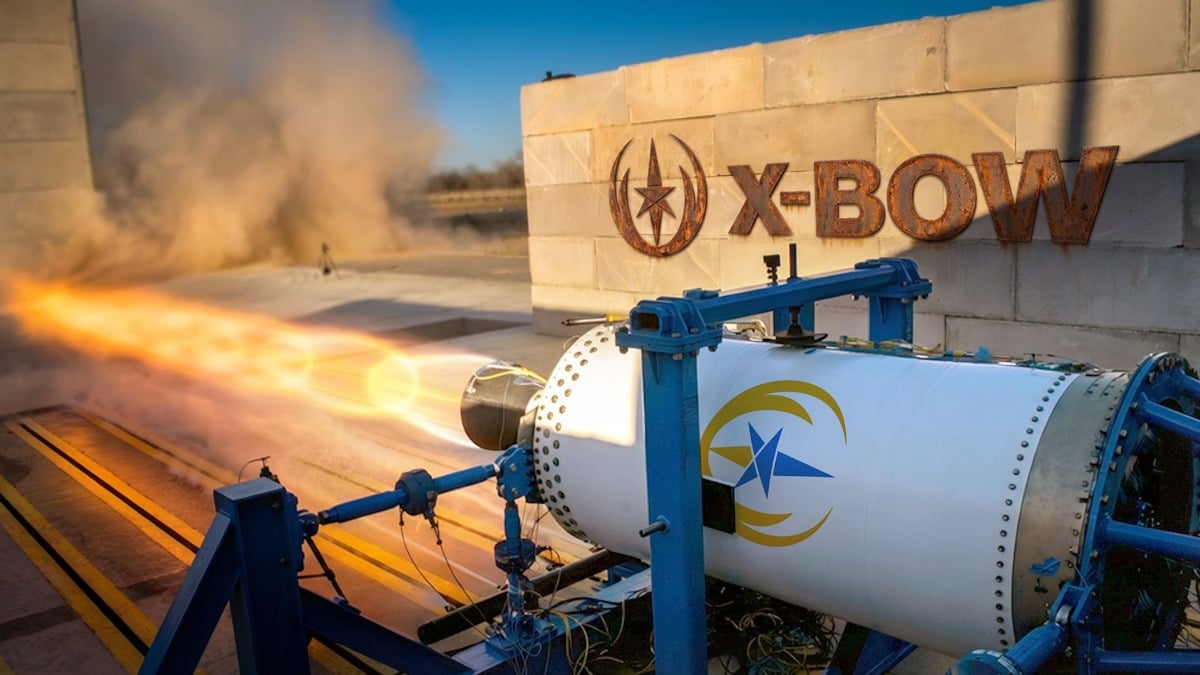
X-Bow's primary weapon against the legacy defense primes is its patented Additive Manufacturing of Solid Propellant technology. Instead of casting propellant into molds using traditional, labor-intensive techniques, X-Bow treats rocket fuel like a digital file. They 3D print the solid energetic material.
This approach strips away months of tooling and design validation. If the military needs to tweak the burn rate or geometry of a motor for a specific mission, engineers alter a digital blueprint and send it to the printer. It shifts the entire manufacturing paradigm from heavy industrial chemistry to agile software iteration.
The real validation of this approach is happening at scale. X-Bow recently brought its industrial-scale production system online at its facility in Luling, Texas. The company is actively scaling up toward producing millions of pounds of solid propellant annually.
Moving Production to the Tactical Edge
The most radical concept coming out of X-Bow's pipeline isn't just how they mix fuel, but where they can do it. The company developed a containerized, mobile manufacturing unit known as the Rocket Factory in a Box.
[Traditional Factory] -> Fixed Location -> Long Transit -> Vulnerable Logistics
[Rocket Factory in a Box] -> Containerized -> Deployable -> Production at the Edge
Think about the logistical nightmare of shipping highly volatile, fully assembled rocket motors across oceans during an active conflict. X-Bow's mobile setup flips that entirely. The self-contained units can be shipped via standard logistics networks and deployed exactly where the capacity is needed.
By decentralizing production, the military gains a massive strategic advantage. You no longer have a single, high-value factory acting as a central point of failure for national defense. If one production node goes down, three more can be deployed to take its place.
Expanding From Prototyping to High Volume Field Deployment
Critics used to dismiss 3D-printed rocketry as an expensive science project that would never survive the realities of high-volume military procurement. That argument doesn't hold up anymore. X-Bow has racked up hundreds of millions in contracts, pushing its technology straight into active operational programs.
The company secured a major deal with AEVEX to supply tactical drone takeoff systems, marking the first high-volume operational deployment of its 3D-printed propellant. They've also successfully redesigned critical Navy rocket components, clearing preliminary design reviews for major defense systems like the Mk 72 and Mk 104 motors. They aren't just a research partner anymore; they're becoming a primary production house.
To support this rapid expansion, X-Bow acquired Evolution Space, absorbing their space-proven solid rocket motor capabilities and a strategic manufacturing site at the Stennis Space Center in Mississippi. Combined with heavy financial backing from venture funds and defense heavyweights like Lockheed Martin, X-Bow now has both the capital and the footprint to seriously compete.
The next immediate phase relies on execution. For defense tech companies, the jump from venture-backed darling to trusted Pentagon supplier is incredibly brutal. X-Bow must prove its automated systems can consistently maintain the rigorous quality controls required for military-grade energetics while ramping up output. If they can maintain their rapid delivery timelines while churning out millions of pounds of propellant, the old defense duopoly will officially be a thing of the past.