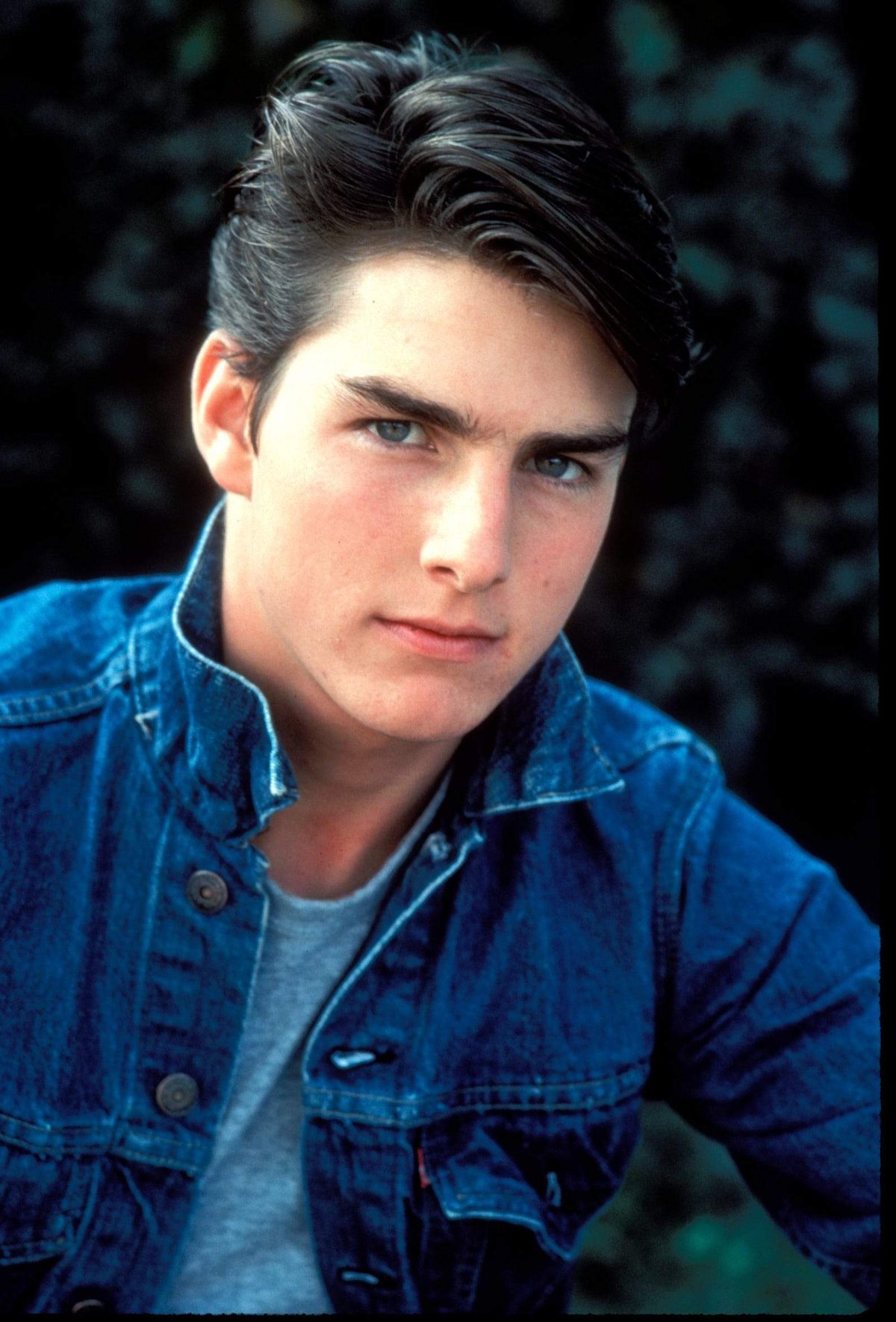
Before the couch-jumping, the death-defying stunts on the Burj Khalifa, and the status as Hollywood’s unofficial savior, there was just a kid from Syracuse with a chipped tooth and a relentless, almost frightening amount of energy. People look at young Tom Cruise now through the lens of a forty-year career, but if you go back to the early eighties, you see something different. You see a guy who wasn't necessarily the best actor in the room, but he was definitely the one who wanted it the most. He was the kid who would do anything to stay in the frame.
It’s easy to forget how raw he was.
In 1981’s Taps, he wasn't even the lead. That was Timothy Hutton and Sean Penn. But Cruise, playing a high-strung military cadet named David Shawn, practically vibrates off the screen. He was intense. Maybe too intense. But that intensity is exactly what defined the first decade of his career. He didn't just play characters; he attacked them.
The Risky Business of Becoming an Icon
Most people think Top Gun was the start, but young Tom Cruise really became a household name because of a pair of Ray-Bans and some floorboards. Risky Business (1983) is a weird movie if you actually sit down and watch it today. It’s much darker and more cynical than the "dancing in my underwear" meme suggests. Director Paul Brickman actually fought to keep the movie’s moody, electronic atmosphere, which contrasted sharply with Cruise’s boyish, slightly panicked performance as Joel Goodsen.
That slide across the floor? It was improvised.
Well, mostly. The floor was waxed to high heaven, and Cruise just went for it. That single moment did more for his career than any monologue could have. It established the "Cruise Persona": a mix of upper-middle-class vulnerability and a desperate, winning smile. He looked like the boy next door, but there was a flicker of something manic behind his eyes.
Honestly, his teeth back then are a great metaphor for his early career. They were slightly crooked. One was famously discolored from a hockey puck incident. He hadn't yet become the polished, porcelain-grinned superstar we know today. He was still a work in progress, which made him relatable to the massive teenage audience of the 1980s.
The Transformation from Teen Idol to Serious Actor
By the mid-eighties, Cruise was at a crossroads. He could have stayed in the "Brat Pack" lane. He could have done five more versions of Legend (the Ridley Scott fantasy film that, let's be real, is beautiful but a bit of a mess). Instead, he made a pivot that most 24-year-olds wouldn't have the guts or the foresight to make.
He went to school. Not literal school, but the school of acting legends.
Working with the Masters
Think about the run he had between 1986 and 1992. It’s actually insane. He worked with:
- Martin Scorsese in The Color of Money. He spent weeks learning how to play pool for real because he didn't want a stunt double. Paul Newman reportedly loved his work ethic but thought he was a bit of a "handful" because of his energy.
- Dustin Hoffman in Rain Man. This is where young Tom Cruise proved he could play the "straight man" to a powerhouse performance and still hold the screen. He plays a selfish jerk who slowly finds his soul, and it’s arguably one of his best nuanced performances.
- Oliver Stone in Born on the Fourth of July. This was the big one. He traded the flight suit for a wheelchair. He stopped being a "movie star" and became an "actor." He earned his first Oscar nomination, and suddenly, the industry realized this wasn't just a kid with a nice smile.
He was obsessed. He spent time with Vietnam veterans, stayed in the wheelchair for long stretches, and pushed himself to a point of physical exhaustion. That’s the thing about Cruise—even back then, he didn't have an "off" switch.
The Top Gun Effect and the Burden of Fame
We have to talk about Maverick. Top Gun (1986) changed the Pentagon’s recruitment numbers and changed the way movies were marketed. It was basically a two-hour music video. But for young Tom Cruise, it was a trap. He became the face of American exceptionalism.
He was the guy in the bomber jacket.
Suddenly, he couldn't go anywhere. The level of fame he hit in 1986 is something very few humans ever experience. It’s that Michael Jackson or Princess Diana level of "can’t walk down the street." Most actors would have spiraled. They would have gone the "tortured artist" route or burned out on drugs. Cruise did the opposite. He became more disciplined. He became a producer. He realized that if he wanted to survive Hollywood, he had to own the machine, not just be a gear in it.
He started looking at the business side. He watched how Tony and Ridley Scott directed. He watched how Jerry Bruckheimer produced. He was a sponge. While other young actors were partying at the Roxbury, Cruise was reportedly in the editing room or studying scripts. It sounds boring, but that’s why he’s still here and most of his 80s peers are doing regional theater or voiceover work for car commercials.
Why Young Tom Cruise Still Matters Today
If you look at his early work, you see the blueprint for the modern blockbuster lead. He wasn't a brooding method actor like Sean Penn, and he wasn't a pure comedian. He was the "Everyman Plus."
He represented a specific type of American aspiration.
The most interesting thing about young Tom Cruise is that he was often cast as characters who were arrogant and needed to be humbled. Whether it was Days of Thunder (which is basically Top Gun on wheels) or A Few Good Men, the arc was always the same: A cocky young guy realizes he doesn't know everything and has to work harder than everyone else to win.
That mirrored his real life.
He struggled with dyslexia as a kid. He grew up in a household that wasn't exactly stable. He went to 15 different schools in 14 years. When you understand that, his early performances make more sense. The "Cruise Smile" wasn't just a charm offensive; it was a survival mechanism. It was a way to fit in, to dominate a room, and to mask the fact that he was constantly playing catch-up.
Real Talk: The "Uncanny Valley" of the 90s
By the time we got to Interview with the Vampire (1994), the "young" version of Cruise was fading into the "Mega-Star" version. Anne Rice famously hated the casting at first. She called it "bizarre." But then she saw the movie. She saw that Cruise had tapped into a cold, predatory loner vibe that nobody knew he had. It was a turning point. He wasn't the boy next door anymore. He was something else. Something a bit more untouchable.
Actionable Insights for Fans and Film Buffs
If you want to truly understand the evolution of Hollywood stardom, you have to watch his early filmography in order. It's a masterclass in career management.
- Watch the "Learning Phase": Start with Taps and The Outsiders. Look at how he tries to steal scenes even when he has almost no lines. In The Outsiders, he's the one doing backflips in the background for no reason other than to be noticed.
- Analyze the "Mentor Phase": Watch The Color of Money and Rain Man back-to-back. Notice how he adapts his acting style to match the legends he's working with. He’s not competing with Newman or Hoffman; he’s absorbing their energy.
- Study the "Physicality": Pay attention to how he moves. Even in the early days, Cruise was a physical actor. Whether it’s the way he runs (the famous "Cruise Run" started early) or the way he handles props, he uses his whole body.
- Check the Credits: Notice when he starts getting involved in the production side. By the time Mission: Impossible (1996) rolled around, he was a producer. He took control of his destiny early on, which is the biggest lesson any creative can take from his career.
The story of young Tom Cruise isn't just about a lucky break or a pretty face. It’s about a guy who decided he was going to be the biggest star in the world and then actually did the work to make it happen. He wasn't the "natural" that people think he was. He was a grinder. He was a kid who took his flaws and turned them into a brand that has lasted longer than almost any other in the history of cinema.
If you're looking for the secret sauce of his longevity, look at the 1983 version of him. He looks like he’s running out of time, and forty years later, he’s still running. He just has better teeth now.