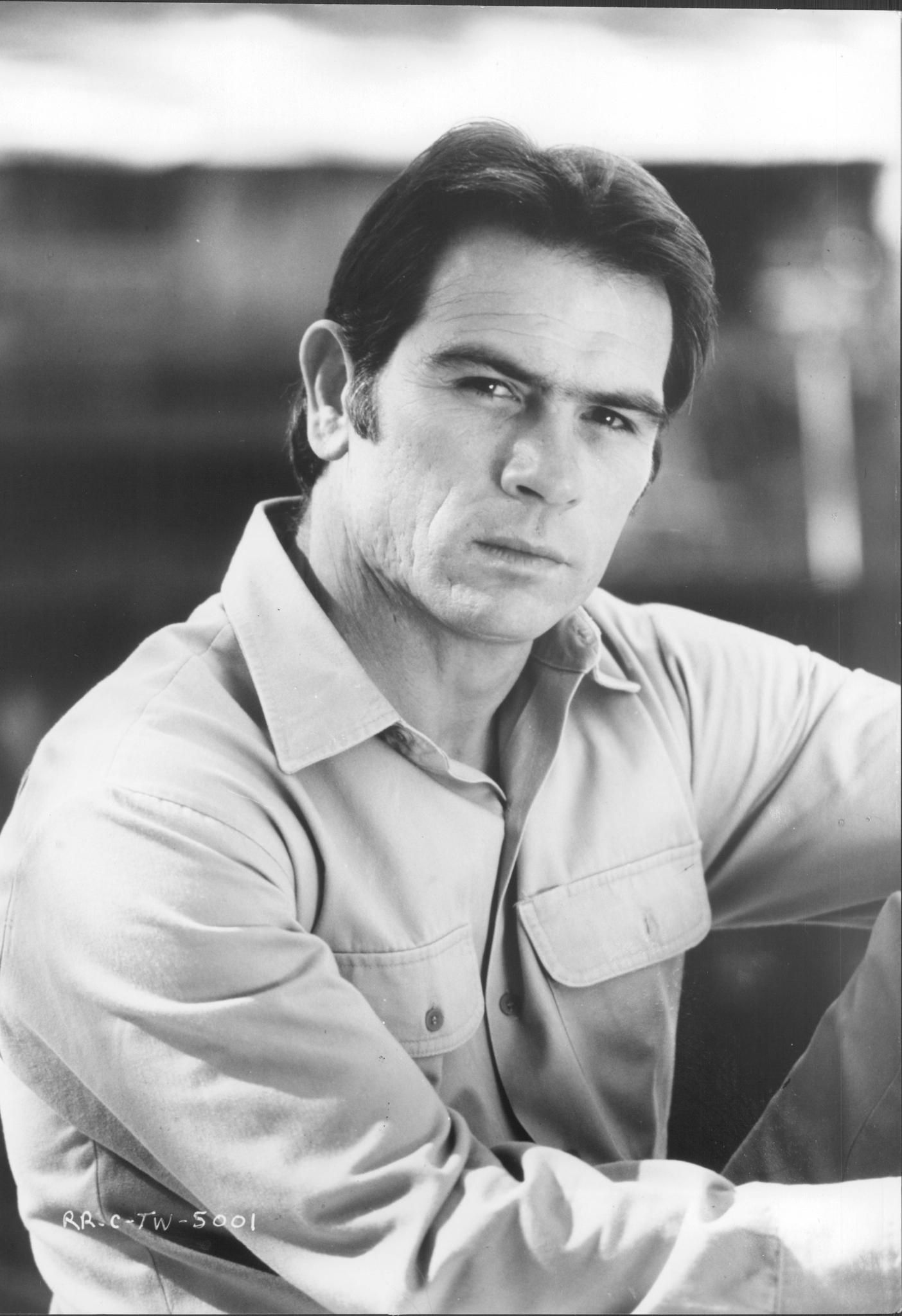
You know that face. It’s a roadmap of Texas canyons and high-desert grit. Most people think Tommy Lee Jones was born looking like a grumpy 60-year-old rancher who just found a trespasser on his land. But the story of young Tommy Lee Jones is actually a wild, Ivy League-to-Broadway ride that most fans completely miss.
He didn't just walk onto the set of The Fugitive or Men in Black with that weathered authority. He built it.
Honestly, the "Texas tough guy" persona is only half the truth. Behind that stone-faced exterior is a guy who majored in English literature at Harvard, roomed with a future Vice President, and spent his early twenties running around New York City in tights for Shakespeare plays.
From San Saba to the Ivy League
Tommy Lee Jones was born in 1946 in San Saba, Texas. It’s a small town, the kind where your family’s history is baked into the dirt. His dad was an oil field worker and his mom did everything from law enforcement to cosmetology. It wasn't an easy childhood. His parents married and divorced each other twice.
When his dad took a job in Libya, 13-year-old Tommy stayed behind. He’d won a scholarship to St. Mark’s School of Texas in Dallas.
Imagine that culture shock.
You’ve got a kid used to settling things with his fists suddenly surrounded by the Dallas elite. He had to learn to be a "gentleman" while playing offensive guard on the football team. But it worked. He was good enough at football and smart enough at English to land a scholarship to Harvard.
The Al Gore Connection
This is the part everyone loves to bring up because it sounds like a sitcom premise. For four years, young Tommy Lee Jones roomed with Al Gore. Yeah, that Al Gore.
They lived in Mower B-12 and later Dunster House. They shot pool. They watched Star Trek. They even played in a country music band together to try and impress girls. While Gore was leaning into politics, Jones was obsessing over Flannery O’Connor and playing guard for the Harvard Crimson.
He was actually a beast on the field. In 1968, he played in the legendary "Harvard Beats Yale 29-29" game—a tie that felt like a win. He was an All-Ivy League selection. He had the physical stats for the NFL, but at 6'1" and 200 pounds, he knew he was too small for the pros.
So, he did the most logical thing a Texas football star could do. He moved to New York to become an actor.
The New York Hustle and "Love Story"
Ten days.
That’s how long it took him to get a job on Broadway. He debuted in 1969’s A Patriot for Me. He wasn’t a star yet, just a guy in the background playing multiple small roles, but he was in.
Then came 1970.
He landed a tiny part in the massive tear-jerker Love Story. Coincidentally, he played a Harvard student named Hank Simpson. The author of the book, Erich Segal, later admitted that the lead character, Oliver, was actually based on a mix of Jones and Al Gore.
If you watch Love Story today, you’ll see a young Tommy Lee Jones with a remarkably smooth face. The lines aren't there yet. But the intensity? That’s always been there. It’s in the eyes.
The Soap Opera Years
Most people forget he was a soap star. From 1971 to 1975, he played Dr. Mark Toland on One Life to Live.
Soap operas are a grind. It’s a lot of dialogue, fast turnarounds, and no room for ego. It’s where he sharpened that "no-nonsense" delivery. He wasn't interested in being a "matinee idol." He was a working actor.
Breaking the Mold in the 70s
By the mid-70s, Jones moved to Los Angeles. Hollywood didn't quite know what to do with him at first. He didn't have the soft, pretty-boy look of the era. He looked like a guy who could fix your truck or kill you with a look.
He started getting cast as villains or "unsettling" types.
- Jackson County Jail (1976): He played an escaped convict.
- The Amazing Howard Hughes (1977): He played the lead. This was a turning point. He captured the eccentric, brilliant, and tortured nature of Hughes in a way that made people realize he could carry a project.
- Eyes of Laura Mars (1978): He played a detective/killer opposite Faye Dunaway.
But the real shift happened in 1980.
He played Doolittle "Mooney" Lynn in Coal Miner's Daughter. He was Sissy Spacek’s husband. It was the first time the general public saw him as something other than a "heavy." He was charming, volatile, and deeply human. He got his first Golden Globe nomination for it.
The Myth of the "Grumpy" Actor
There’s a famous story from the set of Batman Forever. Jim Carrey, who played The Riddler, walked up to Jones in a restaurant. Jones looked him dead in the eye and said, "I hate you. I really don't like you. I cannot sanction your buffoonery."
People use that to say he’s a jerk.
But if you look at his career, he’s just a guy who takes the work seriously. He’s a Harvard-educated intellectual who also happens to run a 3,000-acre cattle ranch. He’s a world-class polo player.
He doesn't "do" the Hollywood game. He doesn't want to talk about his feelings on a red carpet. He wants to act, get the check, and go back to his horses in San Saba.
Why We Still Care About Young Tommy Lee Jones
Looking back at young Tommy Lee Jones reveals a blueprint for longevity. He never relied on being "pretty." He relied on being presence-heavy.
He proved that you don't need to change who you are to fit into the industry. You just need to be so good at what you do that the industry changes to fit you. By the time he hit his peak in the 90s with The Fugitive and JFK, he had twenty years of theater, soaps, and gritty indies under his belt.
He was prepared.
Actionable Takeaways from the Jones Career Path
If you're looking at his life for inspiration, there are a few things to keep in mind:
- Education isn't a distraction: Being a "tough guy" and a "literary scholar" aren't mutually exclusive. His English degree likely helped him analyze scripts better than half his peers.
- The "Slow Burn" works: He didn't win his Oscar until he was in his late 40s. Success doesn't have an expiration date.
- Divertify your skills: He’s an actor, a director, a rancher, and a polo player. Having a life outside of your primary career keeps you grounded (and probably keeps you from going crazy in a town like LA).
- Embrace your "look": He never tried to hide his rugged features. He leaned into them until they became his greatest asset.
Tommy Lee Jones is a reminder that being authentic—even if that authenticity is a bit prickly—is the fastest way to becoming an icon. He’s the eighth-generation Texan who conquered the Ivy League and then conquered Hollywood, all without ever losing his drawl or his dignity.



