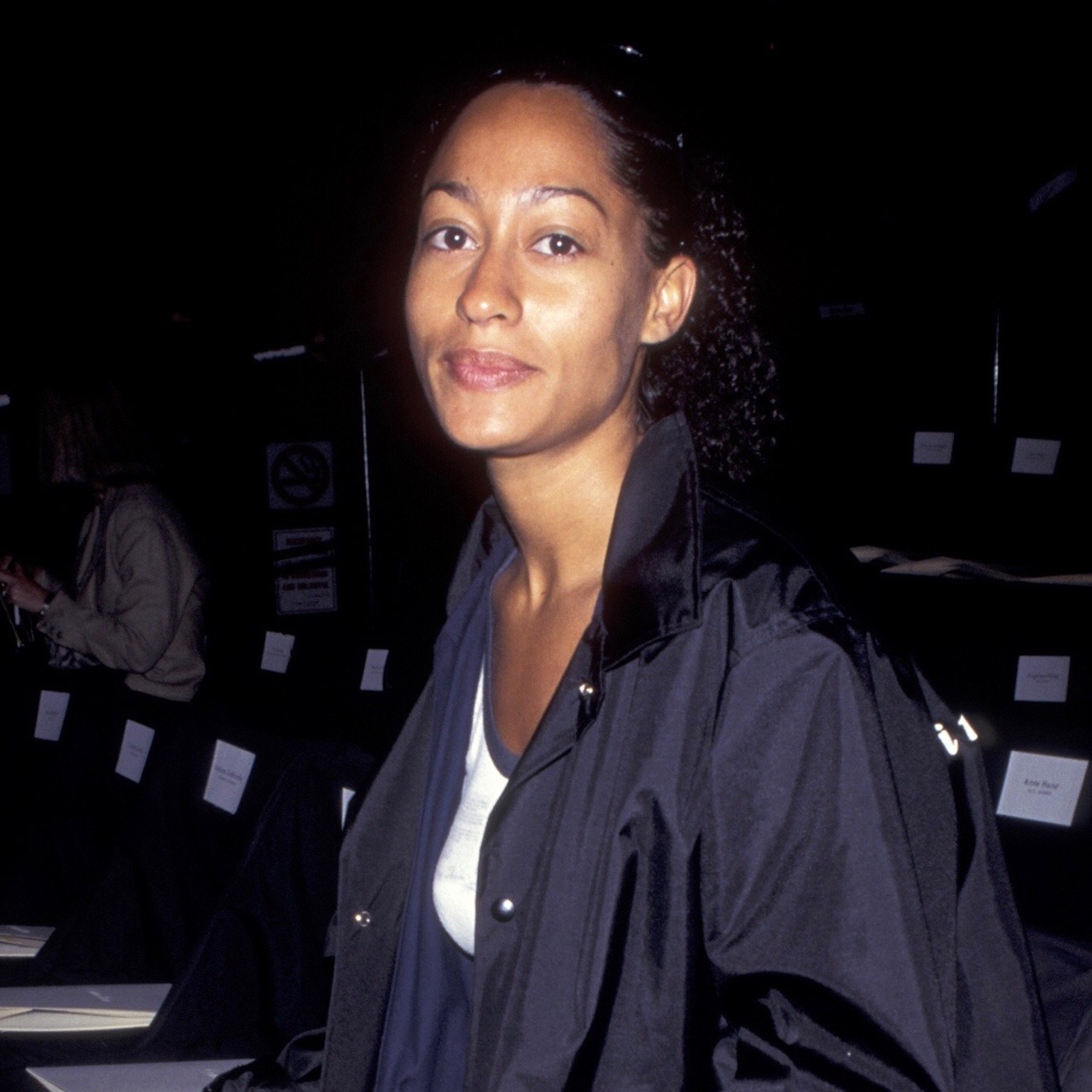
Before she was Bow Johnson on Black-ish or the pattern-clashing fashion mogul we follow on Instagram today, Tracee Ellis Ross was just a girl trying to figure out if she should be a model, a stylist, or an editor. Most people forget that. They see the hair and the Golden Globe and assume it was a straight line from being Diana Ross’s daughter to becoming a TV icon. It wasn't. Young Tracee Ellis Ross didn't just inherit a spotlight; she spent years vibrating on a completely different frequency than the rest of the 1990s fashion world.
She was everywhere and nowhere.
If you look back at the archival footage from the early 90s, you see this specific kind of chaotic brilliance. She had this "it" factor that wasn't about being the daughter of a legend. It was about how she wore a suit. It was about her face. Honestly, she looked like she knew a secret that the rest of the industry was still trying to figure out.
The Modeling Years: Not Just a Famous Name
People always ask if she had it easy because of her mom. Sure, the door was open. But walking through it is the hard part. In the early 90s, Tracee was a regular on the runways. We're talking Mugler. We're talking Galliano. This was the era of the "Supermodel," but Tracee brought something weirder and more theatrical.
She wasn't just walking; she was performing.
There is this iconic clip from a 1992 Thierry Mugler show where she is walking alongside her mother. Most kids would be terrified. Not her. She had this fierce, wide-eyed stare that basically told the audience she belonged exactly where she was standing. She worked as a fashion editor at Mirabella and New York Magazine before the acting bug really bit. That’s the thing about her—she actually knows the industry from the inside out. She wasn't a "nepotism baby" who just showed up for the paycheck; she was doing the grunt work of styling shoots and pulling clothes long before she had a glam team of her own.
Finding Her Own Voice Away from the "Boss"
Growing up in the shadow of Diana Ross is a lot for anyone. Tracee has been very vocal about how she had to "find her own beat." In her early twenties, her style was much more experimental than the polished, disco-glam of her mother. She leaned into the 90s grit. Think oversized blazers, massive curls that weren't tamed by three different serums, and a kind of awkward-cool that eventually became her trademark on Girlfriends.
She once told InStyle that she used to go into her mom's archives—which, can you imagine?—and find things to repurpose. But she never tried to be Diana. She was focused on being Tracee. That distinction saved her career. If she had tried to sing or do the "Diva" thing early on, the public would have eaten her alive. Instead, she chose the path of the character actor.
Why the "Girlfriends" Era Changed Everything
If we are talking about young Tracee Ellis Ross, we have to talk about Joan Clayton. When Girlfriends premiered in 2000, Tracee was in her late 20s. She was the anchor. Joan was neurotic, high-strung, incredibly stylish, and deeply flawed. It was the first time many of us saw a Black woman on screen who was allowed to be "too much" without being a caricature.
Joan's wardrobe was basically Tracee's real-life closet.
She brought her own shoes to set. She styled her own hair. That show lasted eight seasons because Tracee understood the assignment: make the "perfect" woman relatable by showing her cracks. The chemistry she had with Golden Brooks, Persia White, and Jill Marie Jones wasn't just acting. It was a cultural shift. They represented different archetypes of Black womanhood that hadn't been explored with that much depth on a sitcom before.
The Beauty Standards She Broke
Tracee’s hair is a whole topic on its own. Now, we have Pattern Beauty, and everyone embraces their natural texture. But back in the 90s and early 2000s? The pressure to have bone-straight, relaxed hair was intense.
Tracee didn't do that.
She kept her curls. She let them be big. She let them be frizzy. For a whole generation of girls watching her, that was a revolution. You didn't realize it at the time, but seeing her on a billboard with that hair was a permission slip. She didn't conform to the "vixen" look of the era. She was goofy. She made ugly faces. She was, quite frankly, a dork. And that was her superpower.
Facts Most People Get Wrong About Her Early Career
- She wasn't an "overnight" success. Her first film role was in Far Harbor (1996), but she worked in the magazine industry for years before that.
- She actually went to Brown University. She didn't just jump into Hollywood. She got a degree in theater, graduating in 1994. She’s an Ivy Leaguer who happens to be a fashion icon.
- The "Ross" name wasn't a golden ticket to every role. She has spoken about the "heavy lifting" required to prove she had the comedic timing to lead a show. Hollywood is notoriously skeptical of the children of legends.
The Evolution of a Style Icon
Looking back at photos of her from 1995 or 1998, you see the blueprint for what she does now. She was mixing high-end couture with vintage finds before "high-low" was a buzzword. She has this innate sense of silhouette. Whether it was a slip dress or a power suit, she understood that clothes are armor.
It's also about her energy. Tracee has always had this "joy as a form of resistance" vibe. Even when she was a young woman navigating a tough industry, she looked like she was having the time of her life. That hasn't changed.
She's 50+ now, but that young Tracee Ellis Ross spirit—the one that isn't afraid to look silly or take a fashion risk—is exactly what keeps her relevant. She didn't age out of her cool; she grew into it.
How to Channel That "Early Tracee" Energy Today
If you want to pull from her early 90s playbook, it’s actually pretty simple. It isn't about buying the most expensive labels. It’s about the following:
- Embrace the volume. Whether it's your hair or your pants, don't be afraid to take up space.
- Invest in a "hero" blazer. Tracee was the queen of the oversized blazer long before the current trend took over TikTok.
- Prioritize comfort in your skin. The reason those old photos look so good isn't the outfit; it's her posture. She looks comfortable.
- Mix textures. Silk with wool. Leather with cotton. She was a master of the "touchable" outfit.
The takeaway from looking back at her early years is that she never waited for someone else to define her. She was Diana’s daughter, yes, but she was also a student, a writer, a model, and a clown. She gave herself permission to be all of those things at once.
Next Steps for the Tracee Obsessed:
To really understand her impact, go back and watch the first season of Girlfriends. Look past the plotlines and watch her physical comedy. Notice how she uses her body to tell a story. Then, go find the 1992 Mugler show on YouTube. Compare the two. You’ll see a woman who was always in control of her narrative, even when the world tried to simplify her into just a "celebrity kid."
Study her early red carpet appearances from the late 90s. You won't find many misses, mostly because she wasn't following trends—she was just dressing for the woman she was becoming. That’s the real lesson of her early career: the most stylish thing you can be is yourself, loudly and without apology.