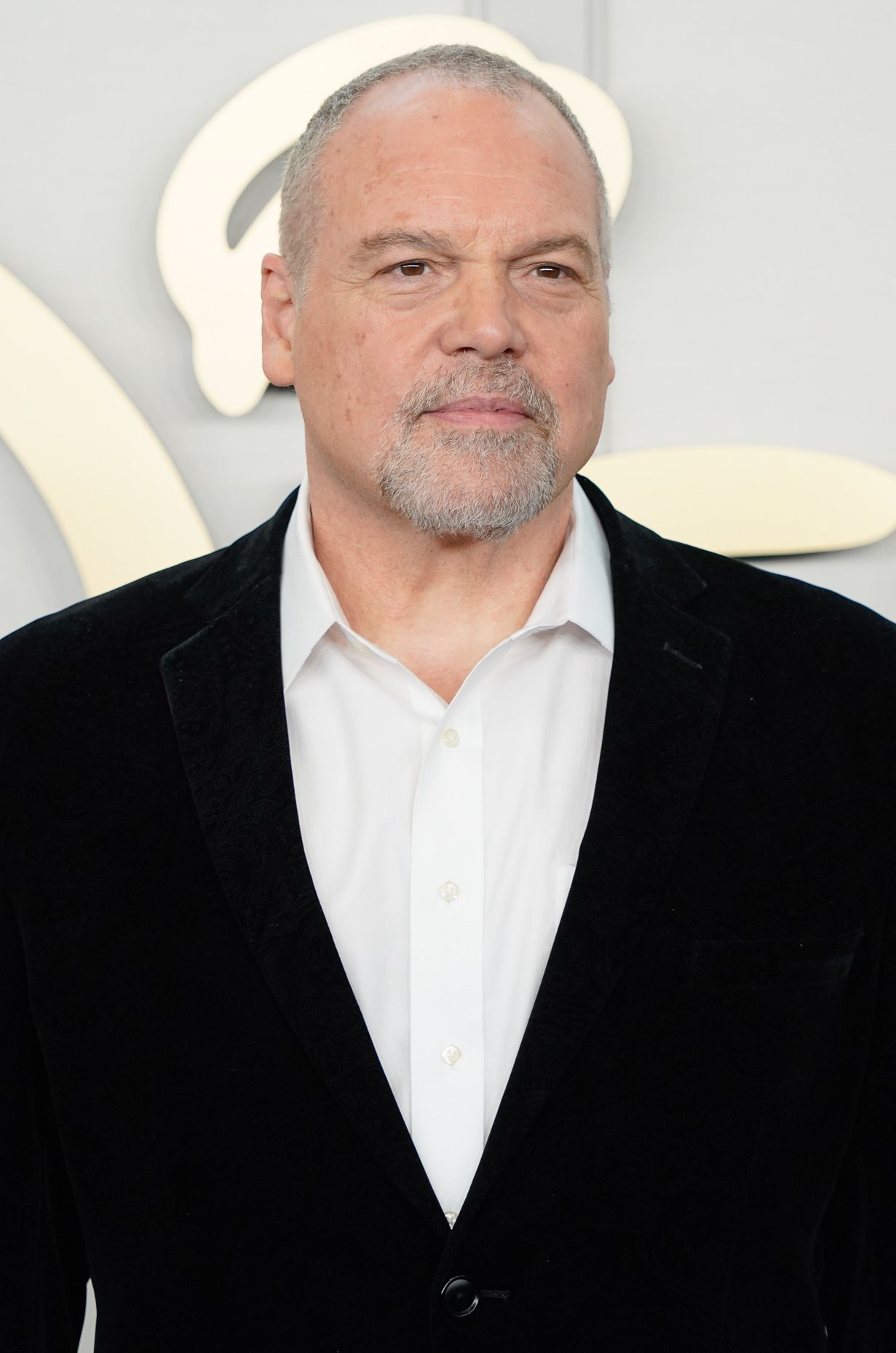
The first time the world really noticed a young Vincent D'Onofrio, he was screaming in a bathroom in 1987.
Most people didn't even know his name yet. They just knew the face of Private Leonard "Gomer Pyle" Lawrence in Stanley Kubrick’s Full Metal Jacket. He looked terrifying. Unhinged. Massive. It was a performance so raw that it felt like he’d just walked off a Marine base and into a nightmare.
But here is the thing: he wasn't that guy. Not even close. Before the 70-pound weight gain and the shaved head, D'Onofrio was a lanky, 6'3" kid from Brooklyn who spent his nights bouncing at the Hard Rock Cafe and his days obsessing over the Stanislavski method. He was a theater rat.
The Bouncer from Brooklyn
D'Onofrio didn't just fall into acting. He grew up around it—his dad was a theater production assistant—but the path was anything but glamorous. Honestly, his early 20s were a grind.
Imagine him in the late 70s and early 80s. He’s towering over people at New York clubs, literally working as a bodyguard for Robert Plant and Yul Brynner. Can you picture that? A young, intense D'Onofrio keeping the peace while probably running lines in his head.
He wasn't just a tough guy, though. He was studying. Hard. He trained at the American Stanislavski Theater and the Actors Studio. This wasn't about "getting famous." For him, it was about the "work." He did Off-Broadway plays like Of Mice and Men and Sexual Perversity in Chicago. He was a deliveryman. He was a construction worker in Colorado for a bit. He was basically living the quintessential "struggling artist" life, but with a physical presence most actors would kill for.
Then came the tape.
The 70-Pound Transformation
Most actors would be happy just to get a call from Stanley Kubrick. D'Onofrio didn't just get a call; he changed his entire biology.
Matthew Modine, who had already been cast in Full Metal Jacket, told D'Onofrio about the role. Originally, the character of Pyle was written as a "skinny redneck." Kubrick, being Kubrick, decided it would be more tragic if the guy was big and clumsy.
D'Onofrio took it to the extreme. He gained 70 pounds. That is a world record for a single film role, by the way. He went from a fit 210 pounds to a staggering 280.
It wasn't just "getting fat." It was a total erasure of his identity. He later said people treated him differently. They thought he was slow. Women stopped looking at him. He even tore the ligaments in his knee because his body couldn't handle the sudden weight during the obstacle course scenes.
When you watch that movie today, you aren't seeing a "young Vincent D'Onofrio" playing a part. You’re seeing a man who literally destroyed his physical self to inhabit a soul.
The Chameleon Phase
What’s wild is what happened next. Most actors get pigeonholed after a breakout like that. Not him.
Within nine months of finishing Kubrick's masterpiece, he burned the weight off. He showed up in Adventures in Babysitting (1987) as Dawson, the garage owner. He had long blonde hair and muscles. The kids in the movie literally thought he was Thor.
The contrast is jarring. How is the sweaty, broken recruit from Full Metal Jacket the same guy as the "God of Thunder" in a Chicago garage?
He kept doing it:
- In Mystic Pizza (1988), he’s the sensitive, lovestruck fisherman Bill.
- In The Player (1992), he’s an idealistic, bitter screenwriter.
- In Ed Wood (1994), he played Orson Welles so convincingly that they had to dub his voice because he sounded too much like the legend.
He was becoming an "actor's actor." He didn't have a "brand." He just had roles.
Why We Still Talk About Him
There’s a reason why, decades later, we’re still fascinated by his early years. D'Onofrio represented a shift. He wasn't a "leading man" in the Tom Cruise sense, and he wasn't a "character actor" in the background.
He was—and is—a physical philosopher.
Whether it was his Emmy-nominated turn in the Homicide: Life on the Street episode "Subway" (where he spent the whole time pinned between a train and the platform) or his legendary "Edgar the Bug" in Men in Black, his commitment remained the same. He works from the outside in. He finds the walk, the weight, and the breath of a person before he ever worries about the lines.
If you're a young actor or just a fan of the craft, looking at D'Onofrio's early trajectory is a masterclass in patience. He didn't rush to be a star. He rushed to be truthful.
Actionable Insights for Fans and Creators
If you want to truly appreciate the range of a young Vincent D'Onofrio, do these three things this weekend:
- Watch "Full Metal Jacket" and "Adventures in Babysitting" back-to-back. It is the only way to understand the sheer physical audacity of his early career.
- Look for "The Whole Wide World" (1996). It’s a lesser-known gem where he plays Conan the Barbarian creator Robert E. Howard. It’s arguably his best "quiet" performance.
- Pay attention to the eyes. Even when he was 280 pounds, or covered in alien prosthetics, D'Onofrio’s eyes always tell a different story than his body. That’s the secret sauce.
Study the way he uses silence. In his early roles, he often says more when he isn't talking at all. That’s not luck; that’s the result of those years in the American Stanislavski Theater paying off.



