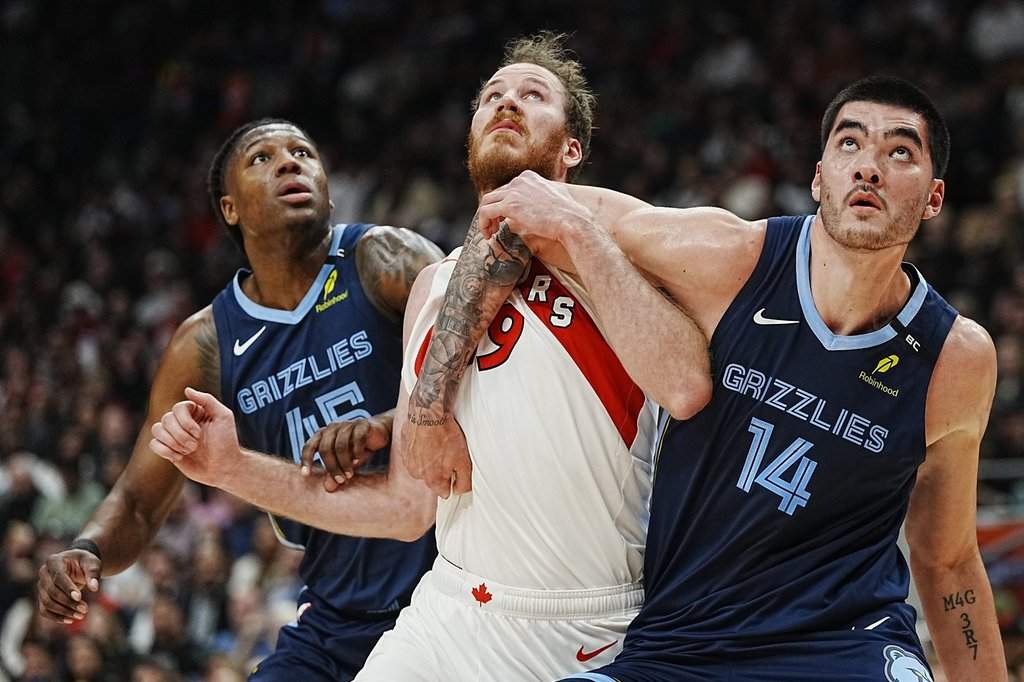
Zach Edey is silencing a decade of modern NBA orthodoxy by forcing the Memphis Grizzlies to bend their offense around a 7-foot-4 traditional center. Drafted ninth overall out of Purdue in 2024, the Toronto native entered the league tagged as an archaic relic unfit for perimeter-heavy basketball. Instead, Edey has stabilized Memphis's frontcourt through brutal screen-setting, elite offensive rebounding, and sheer physical gravity that collapses opposing defenses before he even touches the ball.
Front offices spent ten years shrinking their lineups. The league fell in love with switchable wings and five-out spacing, leaving traditional back-to-the-basket bigs stranded on the margins of rotations. When Memphis selected Edey in the lottery, the consensus among league evaluators was blunt. They believed his foot speed would get him played off the floor in pick-and-roll coverage, and they questioned whether a post-centric scorer could survive in an era obsessed with three-point volume.
Those evaluators missed the actual math of how the Grizzlies operate.
The Gravity of a 300-Pound Screen
Most fans watch the ball. Scouts watch the space created three feet away from it. Edey’s immediate impact in Memphis has nothing to do with nostalgic post-ups or 20-point scoring nights, though he flashes both. His real currency is screen assist volume and the panic he induces in opposing point-of-attack defenders.
When Edey sets a ball screen for Ja Morant or Desmond Bane, the defender has nowhere to go. You cannot simply fight over a 7-foot-4, 300-pound wall without losing two full steps. If the opposing big drops back to protect the rim against Morant’s downhill speed, Bane gets an uncontested pull-up jumper. If the opposing big hedges high to take away the three, Edey rolls into the paint with an angle that no help defender can legally contest without fouling.
This is a geometry problem, not a speed problem. The league spent years chasing versatility, only to realize that size remains the one basketball trait you cannot scheme around. By planting Edey in the middle of the floor, Memphis forces opponents to abandon their standard defensive rules. Teams that pride themselves on switching everything suddenly find their 6-foot-5 wings pinned under the basket against a man who can dunk without leaving his tiptoes.
Why the Purdue Skepticism Was Flawed
The pre-draft narrative surrounding Edey suffered from lazy pattern recognition. Analysts lumped him in with past college giants who dominated through sheer bulk against undersized NCAA frontlines before stalling out in the pros. That comparison ignored two critical differentiators.
First, Edey’s conditioning is an anomaly for a player of his mass. During his back-to-back National Player of the Year campaigns at Purdue, he routinely played upwards of 35 minutes a game while absorbing constant double-teams and physical punishment. Fatigue is what usually ruins supersized centers in the NBA, turning their feet to concrete by the fourth quarter. Edey maintains his base and sprint speed deep into games because his cardiovascular engine was built under Matt Painter's grueling, high-usage system.
Second, his hands are exceptionally soft. Big men often fail in the pros because they fumble pocket passes in traffic or bring the ball down to their waist where quick guards strip them. Edey catches everything above his shoulders. He keeps the ball high, absorbs contact without losing his balance, and finishes through arms that barely reach his elbows.
Surviving the Defensive Firing Squad
Offense was never the primary concern for the Toronto native. The real question was whether he could survive defensively when elite NBA offenses hunted him in space.
Let’s be honest about the limitations. Edey is never going to be Bam Adebayo switching onto point guards at the three-point line and sliding his feet for 24 seconds. When teams like Boston or Oklahoma City put him in high-screen actions 30 feet from the basket, he looks uncomfortable. If he steps up too far, quick guards blow past him for layups. If he retreats too deep, elite shooters bury open threes over his outstretched arms.
Memphis coaching staff solved this by refusing to ask him to be something he isn't. Instead of forcing Edey into aggressive perimeter switches, the Grizzlies built a defensive shell designed to funnel ball-handlers into his verticality.
- Aggressive perimeter funneling: Grizzlies wing defenders press up hard on the ball-handler's strong hand, denying the middle of the floor and forcing drives toward the baseline or directly into Edey’s chest.
- Low-man help rotations: When Edey steps up to contest a floater in the lane, the weak-side forward immediately slides under the rim to tag the rolling big man, taking away the easy lob.
- Verticality discipline: Rather than swiping down at the ball and collecting cheap fouls, Edey keeps both arms straight up, using his massive wingspan to alter shot trajectories without initiating illegal contact.
The results show up in opponent rim frequency and shot quality. Teams still attack him in space, and he still gives up the occasional open jumper to stretch fives. Yet the net math favors Memphis because his presence erases second-chance opportunities. A defensive possession is only finished when you secure the rebound, and Edey inhales misses at a rate that instantly kills opponent momentum.
The Jaren Jackson Jr. Equation
Every successful frontcourt pairing relies on complementary flaws. In Memphis, Edey’s arrival unlocked the best version of Jaren Jackson Jr., a former Defensive Player of the Year who spent years miscast as a full-time center.
Jackson is an elite weak-side shot blocker and a lethal perimeter threat, but he has historically struggled with two things: defensive rebounding and foul trouble. Asking Jackson to wrestle 270-pound centers for 82 games drained his legs and put him on the bench with three fouls before halftime.
Put Edey next to him, and the entire ecosystem shifts.
Edey takes the primary physical beating against opposing bruisers like Nikola Jokic, Domantas Sabonis, and Alperen Sengun. He absorbs the shoulder bumps, boxes out the biggest body on the floor, and clears the glass. That frees Jackson to roam as a free safety on defense, hunting blocks from the weak side where his timing and length are most destructive. On offense, Jackson’s ability to space the floor from beyond the arc prevents defenses from packing the paint around Edey’s post touches.
To understand how rare this balance is, consider a hypothetical example of roster construction. If you pair a traditional non-shooting center with a traditional non-shooting power forward, your spacing dies, and your star guard has zero driving lanes. If you pair two perimeter-oriented bigs together, you get bullied on the glass and give up 60 points in the paint every night. Memphis threaded the needle by pairing a massive interior anchor with a floor-spacing help defender, turning two distinct stylistic extremes into a cohesive unit.
The Toronto Pipeline and Late-Bloomer Advantage
Edey’s rapid adaptation to NBA physicality makes far more sense when you examine his unconventional path to the league. Unlike American AAU prodigies who play thousands of structured basketball games before turning 16, Edey grew up in Toronto playing hockey and baseball. He didn't even pick up a basketball seriously until his mid-teens.
That late start is an underrated asset.
Young players groomed in the AAU circuit often arrive in the NBA with deeply ingrained bad habits, entitlement issues, and severe wear-and-tear on their lower extremities. Edey arrived with fresh legs, zero ego, and a blue-collar willingness to do the dirty work that star players despise. Setting 40 bone-rattling screens a night isn't glamorous. Sprinting from rim to rim just to create a decoy threat doesn't show up in box scores. Edey embraces those thankless tasks because he is still actively learning the nuances of the sport at the highest level.
His footwork in the post has visibly tightened since his rookie debut. Early on, he relied heavily on raw strength to back defenders down, which occasionally resulted in offensive fouls when savvy veterans pulled the chair out from under him. He now uses subtle shoulder fakes, quick drop-steps, and a reliable right-handed hook shot that requires minimal dribbles. When double-teams arrive, he no longer panics or holds the ball low; he reads the weak-side skip pass and hits shooters in rhythm.
Where the Experiment Still Faces Friction
Pretending Edey is a finished product or an infallible superstar would ignore the harsh realities of NBA playoff basketball. Seven-game series are ruthless laboratories designed to expose single-point vulnerabilities, and Edey remains a prime target for elite offensive coaches.
The primary friction point is pace. Memphis wants to run. Ja Morant is at his absolute deadliest in chaotic, open-court transition where defenses cannot set their shell. While Edey runs the floor admirably for a man his size, he is naturally trailing the play by two or three seconds when Memphis pushes off a defensive rebound. In those early-clock moments, the Grizzlies effectively play four-on-five until Edey crosses half-court, forcing Morant and Bane to navigate tight spaces before the big man arrives to set a drag screen.
Furthermore, free-throw shooting and late-game situational substitutions remain delicate balancing acts. If a tight fourth-quarter game devolves into a three-point shootout or requires switching every screen to protect a narrow lead, the coaching staff still faces the agonizing choice between keeping Edey’s rebounding on the floor or going small with Jackson at the five.
Opposing teams will also test his perimeter discipline in high-stakes environments. When a team like Golden State or Dallas runs five-out sets with a center who can knock down catch-and-shoot threes, Edey has to cover an enormous amount of ground to contest the shot without surrendering a blow-by drive. Closing out under control from the paint to the arc when you weigh 300 pounds is a biomechanical nightmare.
The League-Wide Ripple Effect
What is happening in Memphis extends far beyond one player finding his rhythm in a new city. For years, NBA front offices operated under a copycat mentality. When Golden State won with small-ball death lineups, everyone drafted 6-foot-7 forwards. When Denver won with a point-center, everyone looked for passing bigs.
Edey’s success proves that market inefficiencies still exist if a franchise is willing to zig while the rest of the league zags. By zigging back toward sheer, unapologetic size, the Grizzlies forced Western Conference contenders to rethink their own center rotations. You cannot survive a seven-game series against Memphis by throwing a 6-foot-9 backup center into the fire and hoping for the best. You need legitimate bulk, real rim protection, and disciplined rebounding just to survive the physical toll of playing them.
Toronto’s towering export didn't change his game to fit the modern NBA, he simply made the modern NBA deal with him on his own terms.