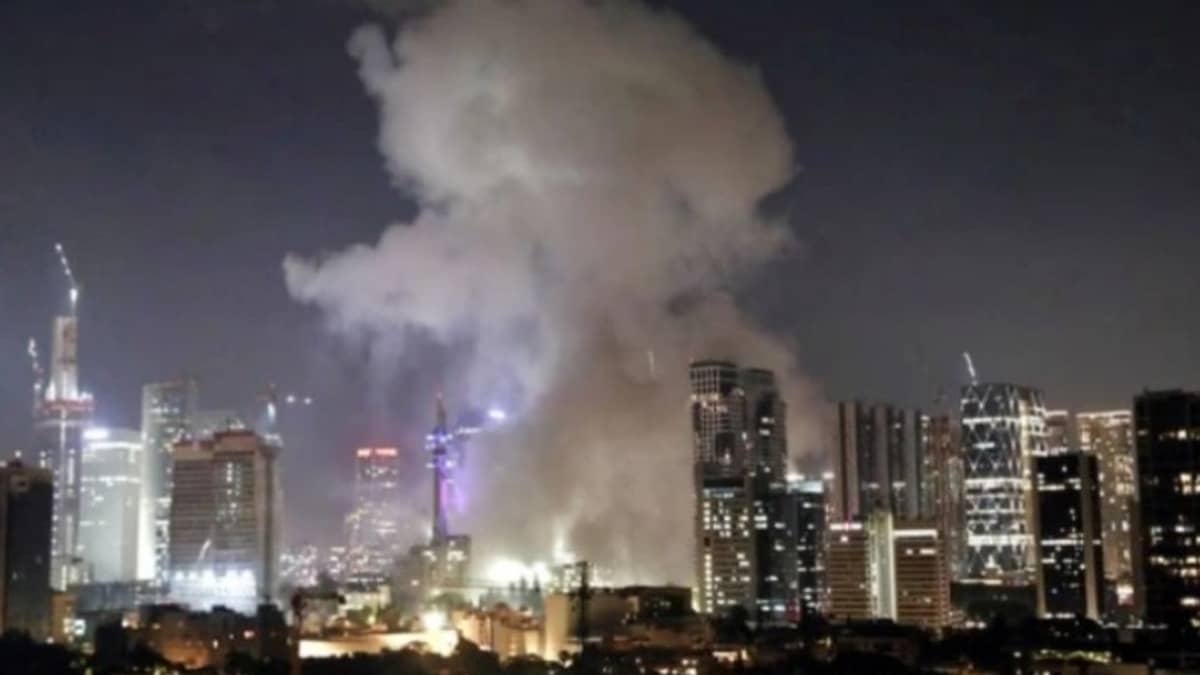
Fourteen members of the Islamic Revolutionary Guard Corps (IRGC) died this week in an explosion in Iran’s Zanjan province. While official state media outlets like IRNA and Fars News framed the incident as a tragic accident during routine ordnance clearance, the scale of the blast and the rank of those involved suggest a much deeper systemic failure within Iran’s domestic military infrastructure. This was not a minor mishap in a remote field. It was a catastrophic detonation that highlights the growing strain on the IRGC as it attempts to manage aging stockpiles while simultaneously pivoting toward rapid, unconventional weapons development.
The official narrative claims the personnel were engaged in "clearing unexploded ordnance" or disposing of "expired munitions." In the world of high explosives, "expired" is a polite term for unstable. When chemical stabilizers in TNT, RDX, or nitroglycerin-based propellants degrade over decades, the materials become hypersensitive to heat, friction, and even minor physical shifts. The Zanjan incident serves as a brutal reminder that the IRGC's massive internal security and regional logistics network is only as strong as its ability to safely handle its own inventory. Learn more on a similar issue: this related article.
The Mechanics of Degradation in Isolated Supply Chains
Ordnance disposal is a precision science, yet in Iran, it is increasingly becoming a desperate exercise in risk management. Decades of international sanctions have forced the IRGC to rely on domestically produced chemicals and reverse-engineered hardware. This creates a quality control gap. When you cannot easily source the highest grade of chemical stabilizers or modern diagnostic equipment to test the integrity of older shells, you are essentially sitting on a ticking clock.
Most modern militaries utilize X-ray technology and chemical analysis to determine if a stockpile is "serviceable" or "disposable." If the Zanjan team was indeed clearing ordnance, the question remains why fourteen men—a significant unit size for a disposal detail—were close enough to the blast radius to be killed instantly. In professional Explosive Ordnance Disposal (EOD) protocols, the number of personnel near the "hot zone" is kept to a bare minimum. A casualty count of fourteen implies either a massive failure in safety distance protocols or a secondary detonation that caught a secondary support team off guard. Additional analysis by TIME highlights related perspectives on this issue.
The Zanjan region, specifically its mountainous terrain, has long been used for training exercises and testing. It is a corridor that connects Tehran with the northwestern borders. Large-scale casualties in this sector suggest that the IRGC was moving or processing a significant volume of material. We aren't looking at a single dud grenade. We are looking at a bulk detonation of high-explosive yields.
Shadow Wars and the Sabotage Variable
While the Iranian government is quick to label these events as technical accidents to avoid projecting weakness, the specter of sabotage cannot be ignored. Over the last five years, Iranian military facilities have been plagued by "mysterious" fires, explosions, and cyber-attacks. From the Parchin military complex to the Natanz nuclear site, the pattern of industrial "accidents" often aligns with periods of heightened regional tension.
However, the "sabotage" explanation can also be a convenient crutch for a military leadership that refuses to admit to gross negligence. If the Zanjan explosion was indeed a result of human error during ordnance clearance, it points to a dilution of expertise. The IRGC has shifted much of its veteran talent to foreign theaters—Syria, Iraq, and Yemen—leaving domestic maintenance and disposal duties to less experienced cadres or conscripts overseen by a handful of aging officers.
The loss of fourteen members is a staggering blow to a regional command. To put this in perspective, that is nearly an entire specialized platoon. In any other professional military, an incident of this magnitude would trigger a total stand-down of all similar operations and a public inquiry into the chain of command. In Iran, the response is usually a swift burial and a brief mention in the state press, followed by a thick veil of secrecy.
The Cost of Domestic Autarky
Iran’s military-industrial complex prides itself on "autarky"—the ability to be completely self-sufficient. This pride has a hidden cost. When you manufacture your own fuses, your own propellant, and your own high explosives without the benefit of international safety standards or peer review, you inherit all the flaws of your specific manufacturing process.
If a batch of propellant is mixed with even a slight deviation in humidity or chemical purity, its shelf life drops from twenty years to five. If that inventory isn't tracked with a digital, fail-safe logistics system—something Iran has struggled to implement due to hardware sanctions—you end up with "forgotten" warehouses of unstable material.
The Zanjan blast is likely the result of a "sympathetic detonation." This occurs when one small charge triggers a larger, adjacent cache. This is the ultimate nightmare for EOD technicians. It suggests that the storage conditions were cramped or that the clearance operation was being rushed, perhaps to make room for newer shipments of drone components or missile parts that are currently the IRGC’s top priority.
Logistics vs Safety
- Stockpile Age: Much of the material being cleared dates back to the Iran-Iraq War or the early 1990s.
- Infrastructure Strain: Facilities built thirty years ago were not designed for the volume of explosives the IRGC now handles.
- Personnel Fatigue: Constant regional mobilization means domestic safety roles are often understaffed.
A Pattern of Industrial Attrition
This is not an isolated event. Over the past twenty-four months, similar "accidents" have occurred in Isfahan and Karaj. The common thread is always the same: a sudden explosion, a vague explanation about "technical issues" or "ordnance clearance," and a list of martyrs. This suggests a systemic breakdown in the IRGC's logistical safety wing.
When a military organization prioritizes rapid expansion and regional power projection over the boring, expensive work of warehouse maintenance and chemical stability testing, the result is inevitable. The Zanjan explosion wasn't just a localized tragedy; it was a symptom of an organization that is stretching its technical capabilities thinner than its materials can handle.
The IRGC finds itself in a precarious position. It must maintain a massive conventional arsenal to deter regional rivals, but that very arsenal is becoming a domestic liability. Every year that passes without a modernization of their disposal protocols and storage facilities increases the likelihood of another Zanjan.
The personnel killed this week were likely victims of a system that views human life as a secondary consideration to the "sacred" mission of the state. In the rush to clear the old and bring in the new, safety margins were ignored. The result was fourteen graves and a province shaken by a blast that the state would rather the world forget. This isn't just about ordnance. It's about a military culture that treats catastrophic failure as a routine cost of doing business.
Move the debris, bury the dead, and wait for the next warehouse to fail. That is the current Iranian strategy for ordnance management. It is a strategy built on the hope that the next "expired" shell won't be the one that levels a city block. In Zanjan, that hope ran out.



