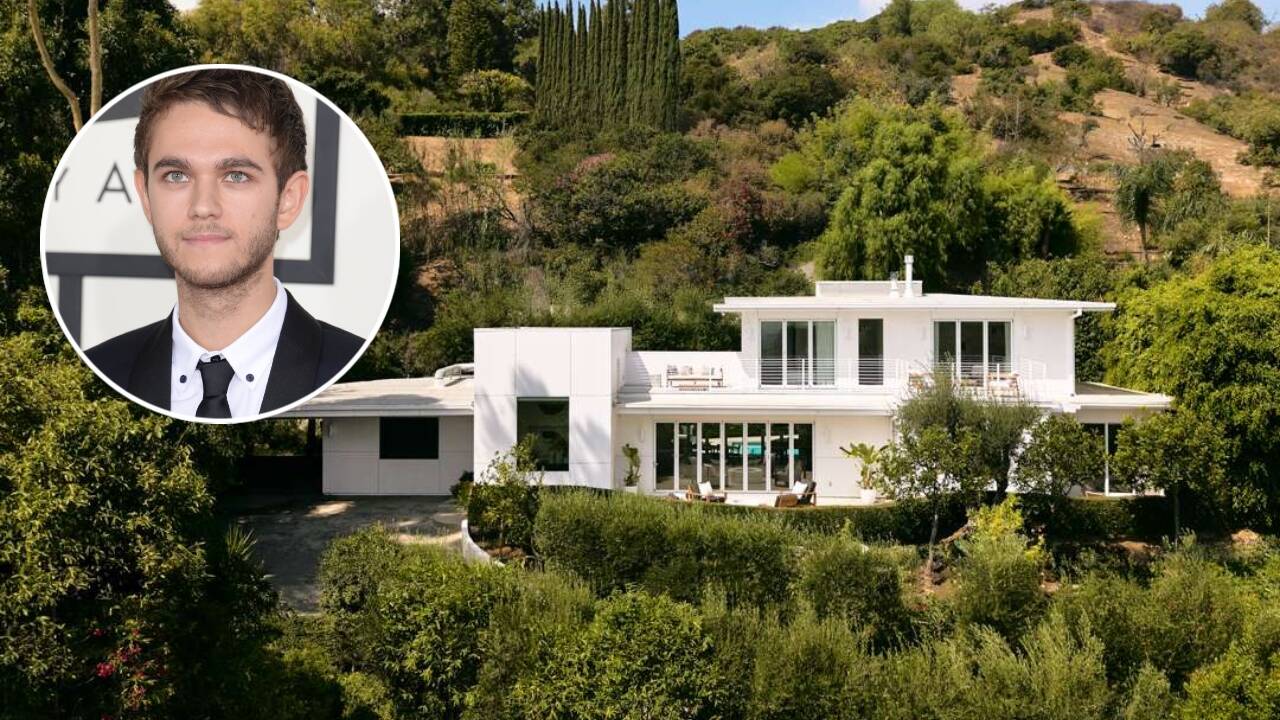
Zedd spent 13 months trying to offload his first Los Angeles home, chopped the asking price by $1.25 million, pulled it off the public market entirely, and still walked away with a pair of die-hard fans holding the keys.
That $4.25 million transaction in November 2026 isn't just a quirky footnote in dance music history. It's a textbook case study in how Los Angeles luxury real estate behaves when a decade-long chapter closes, and why bespoke celebrity upgrades rarely return dollar-for-dollar value on paper even when they're the exact reason a buyer signs the contract.
The Numbers Behind Zedd's Outpost Estates Exit
If you only read the headline, you might assume the Grammy-winning producer made a killing. He didn't. Not after holding the property for roughly 12 years.
Anton Zaslavski—better known globally as Zedd—picked up the gated modernist property at 2635 Carman Crest Drive in Outpost Estates back in 2014. He paid $3.9 million through a trust right after his debut album Clarity turned him from an underground club favorite into a mainstream radio staple. For years, this 3,381-square-foot sanctuary perched on just over a third of an acre served as his home base and creative laboratory.
Fast-forward to October 2025. Zedd listed the four-bedroom, six-bathroom home for roughly $5.5 million ($5,495,000 on the nose).
The market didn't bite.
Over the next year, the listing endured multiple price reductions, dipping down to $4.75 million and eventually landing at $4.499 million before disappearing from active public listings in early October 2026. Then, on November 10, 2026, the house quietly closed off-market for $4.25 million—or roughly $1,257 per square foot.
Do the quick math on that gross spread:
- 2014 Purchase Price: $3.9 million
- 2025 Initial Ask: $5.5 million
- 2026 Final Sale Price: $4.25 million
- Gross Appreciation Over 12 Years: $350,000 (about 9% total)
Once you factor in California closing costs, agent commissions, a decade of property taxes, and the money Zedd poured into renovating the 1950 structure, that $350,000 gross gain evaporates fast. Yet in late-2026 Hollywood Hills real estate, getting out near your basis without taking a bath is actually considered a solid outcome.
Why Fans Bought the House and Immediately Planned to Gut the Studio
Here's the twist that makes this sale genuinely fun. According to buyer's agents Brandon Meneses of The Beverly Hills Estates and Janelle Meneses of The Agency—as originally reported by Mansion Global—the local couple who bought the house are massive Zedd fans.
You'd think superfans buying a producer's longtime home would preserve his studio like a museum. Nope. They're turning it into a home cinema.
Honestly, that makes total sense if you understand how residential recording studios work. Zedd's built-in studio was a major emotional hook for the buyers. Knowing that chart-topping tracks were mixed inside your own walls carries undeniable cool factor. From a practical standpoint, though, acoustic isolation, heavy soundproofing, and zero-window layouts are halfway to a screening room already.
The buyers didn't have to tear down structural walls to make the space fit their lifestyle. They got the acoustic bones of a Grammy winner's studio and simply repurposed the room for movies instead of mastering tracks.
Inside the 1950 Modernist Layout
Built in 1950 and thoughtfully updated during Zedd's ownership, the house avoids the sterile white-box look that plagues half the Hollywood Hills. Warm wide-plank white oak floors run through the interior, balancing out the sharp mid-century lines.
The main living level revolves around an expansive great room flanked by folding glass walls. Open them up, and the indoor space bleeds directly into the canyon views and downtown city lights on one side and the backyard pool terrace on the other.
Other standout details baked into the floor plan include:
- The Kitchen and Bar Setup: A chef's kitchen outfitted with a large center island, bar seating, and a dedicated pass-through window connecting straight to an outdoor poolside bar.
- Entertainment Spaces: Beyond the recording studio, there's a den with a wet bar, a glass-enclosed wine cellar, and Carrara marble accents.
- Primary Retreat: Each of the four bedrooms features en-suite bathrooms and terrace access, while the primary suite adds a fireplace, dual rain showers, a soaking tub, and a generous walk-in closet.
- Privacy and Security: Set at the top of a long gated driveway behind dense greenery, the compound runs on an eight-camera remotely monitored security system.
Why Hollywood Hills Sellers Had to Slash Prices in 2026
If you're wondering why Zedd had to cut his price by nearly 23% from his original $5.5 million ask, look at the broader Outpost Estates and Sunset Strip micro-markets during the 2025–2026 cycle.
Celebrity cachet doesn't override buyer math anymore. Between stubbornly elevated mortgage rates, Los Angeles's Mansion Tax (Measure ULA) dampening upper-tier turnover, and soaring hillside fire insurance premiums, buyers shopping in the $4 million to $7 million bracket became ruthless about price per square foot.
Zedd wasn't the only high-profile seller forced to reset expectations. Around the exact same window in autumn 2026, actor Chris Evans's former Mulholland-area home closed at $5.385 million after originally asking nearly $7 million. Meanwhile, a Sunset Strip-adjacent property at 1350 Belfast Drive dropped from a $6.99 million debut all the way down to a $3.8 million closing price—a staggering 46% haircut.
Notice the pattern across all three deals. Every single one of those homes had to be pulled off the Multiple Listing Service (MLS) before eventually finding a buyer.
When a luxury home sits on the public market for 10 or 12 months, the listing accumulates "days on market" stigma. Buyers assume something is wrong with the foundation, the hillside slope, or the title. By withdrawing the property in early October 2026 at $4.499 million, Zedd's listing team—David Kramer and Andrew Buss of Compass—hit the reset button. Taking it off-market let them negotiate quietly at $4.25 million without broadcasting another public price chop.
How This Fits Into Zedd's Bigger Real Estate Playbook
Selling Outpost Estates wasn't a fire sale. Zedd had already moved on years earlier.
As his touring fees and Las Vegas residencies scaled into the stratosphere, the 3,381-square-foot Hills house became a starter home in hindsight. In 2018, he upgraded to a massive $16 million mansion in Beverly Hills' Benedict Canyon, which he later sold in 2023 for $18.4 million to Black-ish creator Kenya Barris.
Right after cashing out of Beverly Hills in late 2023, Zedd turned around and dropped $18.4 million on "ODIN," a sprawling 17,500-square-foot compound in Encino designed by Jae Omar—setting the all-time residential price record for Encino that year. That estate comes with eight bedrooms, a bowling alley, a junior Olympic pool, and a Norse mythology library.
Compared to a 17,500-square-foot Encino compound, holding onto a four-bedroom house in Outpost Estates made zero practical sense. He reportedly stopped living there full-time around 2023, meaning the property was mostly sitting as a legacy asset while carrying steep California maintenance and insurance bills.
What Smart Buyers and Sellers Should Take From This Deal
Whether you're shopping in Los Angeles or watching luxury real estate trends in your own city, Zedd's exit highlights three rules that hold true in any tight market:
- Overpricing your debut costs you a year. Launching at $5.5 million when true market value sat closer to $4.25 million forced Zedd to chase the market downward for 13 months. Pricing accurately on week one almost always nets more money than chasing buyers with incremental cuts.
- Niche rooms need easy exit strategies. If you build a recording studio, golf simulator, or hyper-specific hobby room, make sure the footprint can easily convert into a standard bedroom, office, or media room. Zedd's studio worked because turning an isolated room into a cinema requires minimal demolition.
- Off-market closings protect leverage. When a public listing goes stale, pulling it off the MLS for 30 days stops the clock on public price history and opens the door for quiet, face-saving negotiations.
If you're eyeing a unique property with custom celebrity or luxury upgrades right now, don't pay a premium for someone else's niche build-out—calculate what it'll cost to adapt that space to your actual daily routine, and use stale days-on-market data to negotiate closer to the seller's true basis.
Watch the full property tour in Zedd's former Beverly Hills estate walkthrough for context on his broader Los Angeles real estate portfolio. This short video highlights the luxury architectural style Zedd moved into after outgrowing his original Outpost Estates home.