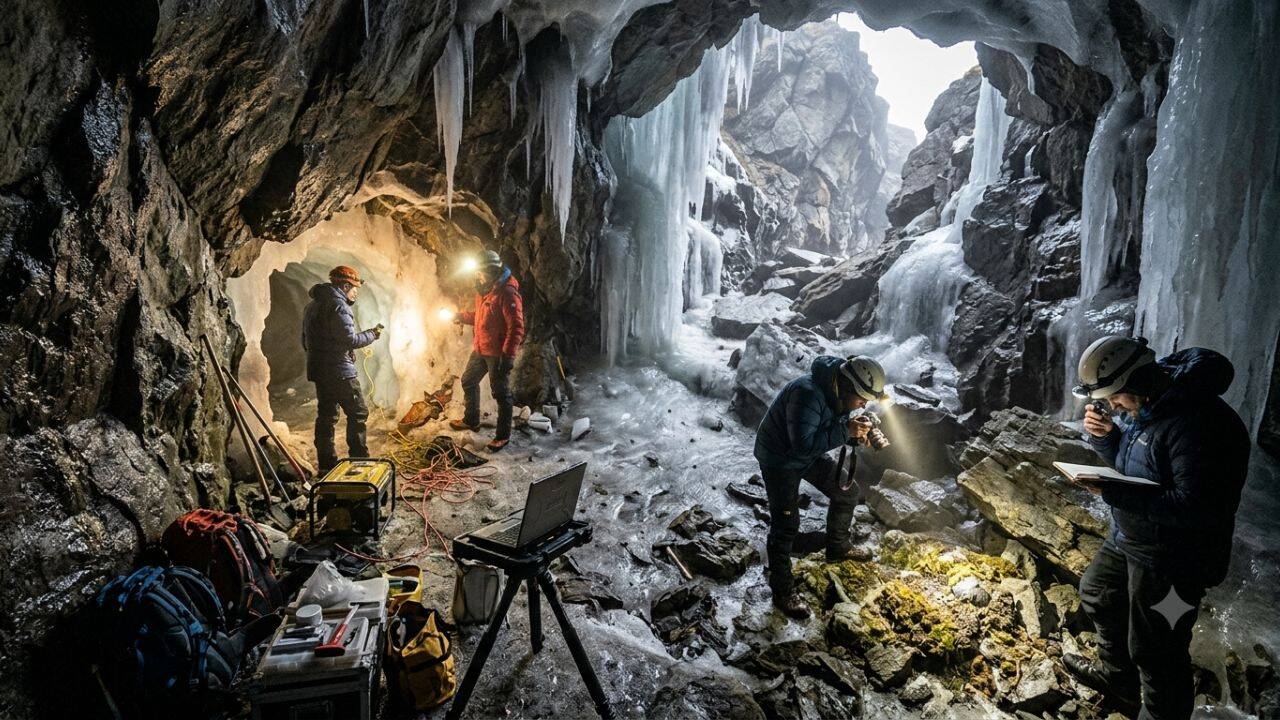
The cold in northern Norway does not just chill your skin. It settles deep into your bones, a heavy, silent weight that feels as old as the earth itself. Standing at the mouth of an unnamed fissure in the limestone cliffs, the wind howling off the Barents Sea slaps your face with microscopic needles of ice. You breathe in, and the air tastes like absolute nothingness. Pure. Empty.
For millennia, this exact stillness held a secret.
While empires rose and crumbled into dust, while humans learned to forge iron and print books and launch satellites into the atmosphere, a perfect capsule of a forgotten world sat undisturbed in total darkness. Seventy-five thousand years ago, the doors to this subterranean vault slammed shut. Now, a team of shivering scientists has cracked it open. What they found inside is not just a collection of ancient dust. It is a mirror reflecting our own fragile future.
The Day the World Froze
To understand the weight of this discovery, we have to travel backward through a span of time that the human brain is barely wired to comprehend. Seventy-five millennia.
Imagine a family. Let us call the matriarch Alva. She belonged to a small band of early humans, or perhaps Neanderthals, navigating an landscape that looked nothing like the Scandinavia we see on travel brochures today. The forests were retreating. The air was sharpening. Alva’s world was entering the peak of the last glacial period, a brutal epoch where survival was a daily calculation of calories and shelter.
One afternoon, Alva might have stood on the very ridge where researchers recently set up their camp. She would have looked out over a valley teeming with life that seems alien to modern Europe.
- Woolly mammoths moving like shaggy mountains across the tundra.
- Steppe bison with horns spanning the width of a small cabin.
- Arctic foxes trailing behind apex predators, waiting for scraps.
Then, the snow came. Not the kind of snow that melts come May, but a relentless, heavy blanket that grew thicker year after year. A massive glacier, a slow-moving wall of solid ice hundreds of meters thick, ground its way across the terrain. It sealed the mouth of a deep limestone cave system, trapping the air, the soil, and the biological remnants of Alva’s world inside.
The lock was turned. The combination was lost to time.
Breaking the Seal
Fast forward to the present day. Dr. Erik Thorsen, a geologist whose hands are permanently calloused from chipping at frozen rock, recalls the moment his team realized they were looking at something unprecedented.
The cave had been flagged during a routine aerial radar survey designed to map underground water channels. The data returned a strange anomaly: a vast, hollow pocket completely isolated from the surrounding permafrost. No modern air had touched it. No surface water had contaminated it.
Getting inside required the precision of a surgeon and the endurance of an astronaut.
The team had to drill through meters of ancient, compacted glacial ice, careful not to introduce modern bacteria or carbon into the pristine environment. The work was grueling. Twelve-hour shifts in sub-zero temperatures, illuminated only by the harsh glare of headlamps. The noise of the drill was deafening, bouncing off the icy walls of the approach trench.
Then, the resistance vanished. The drill bit punched into empty air.
Dr. Thorsen describes the smell that drifted up from the borehole as deeply unsettling. It smelled like old ocean, damp stone, and a faint, sweet musk of decayed organic matter that had been frozen mid-process. It was the scent of a world that died seventy-five thousand years ago, exhaling for the first time.
The Arctic Oasis
When the remote cameras were lowered into the cavern, the images sent back to the surface lab completely upended expectations. Scientists expected a barren, rocky tomb. Instead, they found an impeccably preserved ecosystem.
Because the cave had been sealed so rapidly by the advancing ice sheet, it acted like a natural flash-freezer. The humidity had stabilized instantly. The temperature had hovered at a constant, fractional degree below freezing for seventy-five centuries.
On the floor of the cave lay the intact remains of plants that had long vanished from the northern hemisphere. Delicate mosses, preserved down to their cellular structure, still retained a ghostly, faded green hue. DNA sequencing of the sediment samples revealed a vibrant web of life. The soil was thick with the genetic signatures of ancient lemmings, cave bears, and unique strains of micro-organisms that modern science has never categorized.
This was not a dead space. It was a library.
Consider the complexity of extracting this information. In normal archeological sites, wind, rain, and burrowing animals churn the soil, mixing centuries together like a deck of cards. Here, the layers of dust settled chronologically, a perfect vertical timeline. Each millimeter represented a year of ancient history, waiting to be read like the pages of a monograph.
The Human Element in the Heavy Dust
It is easy to get lost in the numbers. Seventy-five thousand years. Millions of genetic sequences. Petabytes of climate data. But the real significance of this Norwegian cavern lies in how it challenges our understanding of resilience.
As the team excavated deeper into the cave’s mouth, near the point where the ancient blockage had occurred, they found a small hearth. A circle of charred stones. Inside the circle were the blackened remnants of a fire, along with the cracked bones of an Arctic hare.
Alva, or someone exactly like her, had sat there.
They had sought refuge from the encroaching ice, huddling close to a blaze that provided the only warmth for hundreds of miles. They had eaten their meal, looked out at the darkening sky, and slept, completely unaware that the heavy roof of ice was closing in to preserve their temporary campsite for eternity.
Sitting in the modern research tent, drinking bitter coffee out of insulated thermoses, the scientists felt an overwhelming sense of humility. The tools have changed. We have satellite phones, synthetic parkas, and mass spectrometers. But the fundamental human struggle against the elements remains completely unchanged. We are still just fragile beings trying to stay warm against an indifferent climate.
The Warnings Written in Stone
The data pulled from the cave's ancient air pockets is already sending shockwaves through the scientific community. By analyzing the isotopes of carbon and oxygen trapped in the sealed atmosphere, researchers have constructed the most detailed model of ancient climate transition ever created.
The results are startlingly clear. The shift from a temperate Arctic to an ice-shrouded wasteland did not take centuries, as previously assumed. It happened with terrifying speed.
The cave records show that a sudden shift in ocean currents caused regional temperatures to plummet by nearly ten degrees Celsius in the span of less than a decade. Vegetation died off almost instantly. The megafauna migrated or perished. The world changed overnight.
This realization is where the scientific triumph meets a sobering reality. We often view climate change as a slow, linear process that happens across generations, giving us ample time to adapt, innovate, and rebuild. The silent testimony of the Norwegian cave suggests otherwise. Nature does not always move in smooth lines. It moves in fractures. It holds, it bends, and then it snaps.
The Final Echoes
The excavation is now drawing to a close. The strict environmental protocols mean that the cave cannot remain open indefinitely. The heat from human breath and the introduction of modern lighting are already beginning to alter the delicate microclimate inside the cavern.
Within weeks, the entrance will be sealed once more with engineered plugs, isolating the remaining unexplored chambers for future generations of researchers who will possess even more advanced tools.
The wind outside the fissure continues to howl, its pitch rising as the Arctic sun dips below the horizon. The research vessels waiting in the fjord below blink their tiny navigation lights against the vast darkness of the water.
We came to this remote corner of Norway looking for answers about where we came from, seeking a glimpse of a world that existed before history began. Instead, we found a monument to transience. The ancient cave reminds us that the earth is perfectly capable of wiping the slate clean, burying our grandest achievements under a mountain of ice, and waiting in absolute silence for the next explorer to knock on the door.