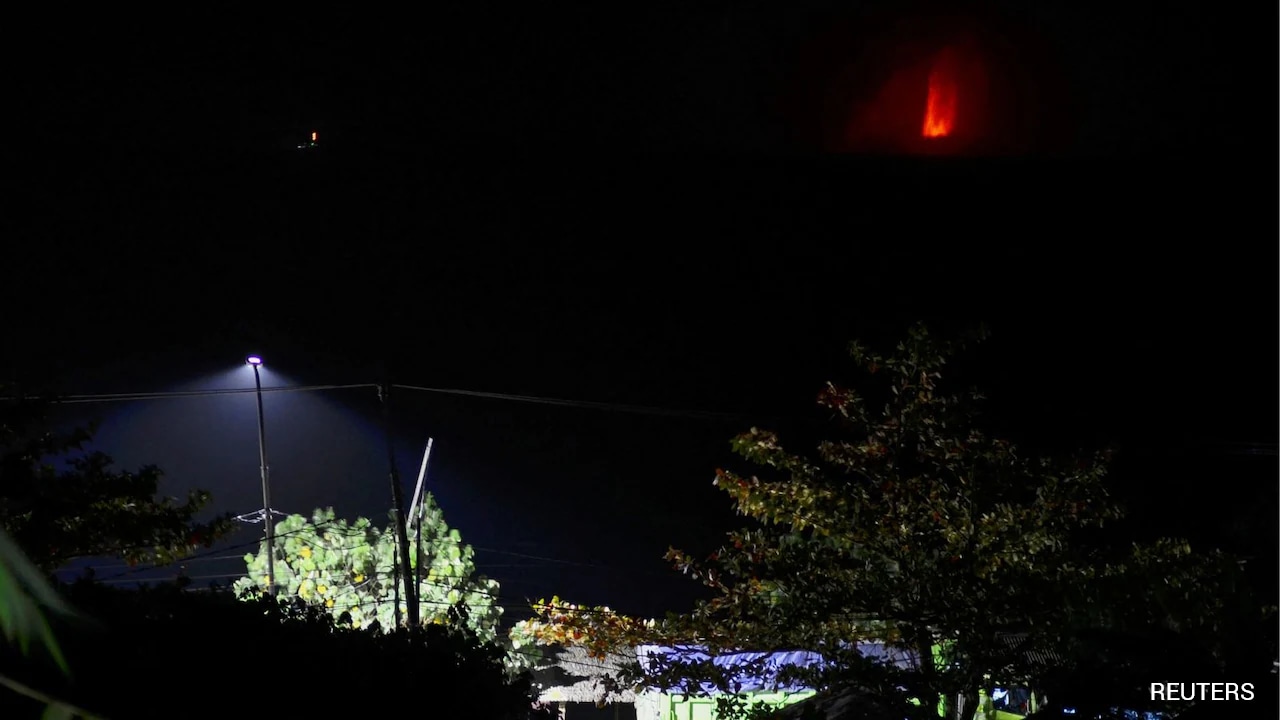
When Mount Anak Krakatoa erupted across the Sunda Strait, expelling plumes of pulverized rock and high-altitude tephra, the immediate consequence was not merely local disruption. It triggered a cascade failure across regional transportation networks that forced the complete suspension of operations at Soekarno-Hatta International Airport, situated more than 150 kilometers away. Standard media accounts register this event as an isolated natural hazard. A rigorous systems-level analysis reveals a predictable operational breakdown driven by atmospheric transport mechanics, aviation safety thresholds, and the cascading fragility of hub-and-spoke scheduling.
The Aerodynamic Cost Function of Silicate Particulates
Volcanic ash is fundamentally distinct from meteorological clouds. Composed of microscopic, jagged shards of glass, crystalline rock, and minerals, these particles possess a melting point ranging between 1100 and 1200 degrees Celsius. Modern commercial turbofan engines operate internally at temperatures exceeding 1400 degrees Celsius. When an aircraft ingests volcanic particulates, the material melts within the combustion chamber, coats the turbine blades, and rapidly solidifies upon reaching cooler downstream stages. This accretion chokes airflow, induces compressor stalls, and triggers total engine flameout.
The physical hazard dictates an absolute operational threshold: zero tolerance for suspended silicate concentrations in active flight corridors. Ground controllers cannot visually assess microscopic ash density during nocturnal or low-visibility conditions. Instead, authorities deploy qualitative verification instruments such as paper tests and spectroscopic atmospheric sampling. When positive concentrations are detected within terminal airspace, regulatory frameworks require immediate suspension. The closure of Soekarno-Hatta International Airport at 01:30 local time demonstrated the deterministic nature of this safety constraint. Once the dispersion model and physical ground samples confirmed particulate presence, continued operations violated baseline airworthiness mandates.
Network Propagation Mechanics and Hub Fragility
A major international aviation hub operates as a tightly coupled node within a global logistics network. When a primary node like Jakarta experiences an unpredicted shutdown, the resulting disruption multiplies across international flight paths, affecting arterial corridors to Singapore, Doha, Sydney, and Kuala Lumpur.
The systemic impact can be broken down into three operational friction points:
- Fleet Displacement: Aircraft scheduled to land in Jakarta are held at origin airports or diverted to alternative regional fields. This breaks outbound turnaround loops, stranding crews and invalidating mandatory rest-period regulations.
- Capacity Saturation: Diverted aircraft consume ramp space and fueling reserves at secondary airports, creating secondary bottlenecks that quickly exceed local infrastructure limits.
- Passenger Inventory Shock: Over 22,000 passengers impacted within the initial operational window overwhelmed terminal holding capacity, forcing carriers to execute complex re-accommodation algorithms across constrained inventory pools.
The propagation velocity of flight cancellations outpaces the physical movement of the ash cloud itself. Because commercial aircraft require continuous utilization schedules to remain economically viable, a four-hour closure extension ripples into a multi-day recovery schedule. Airlines cannot instantly reposition widebody assets or reset crew pairings once a hub goes dark.
Tectonic Determinism Along the Sunda Arc
The eruption of Anak Krakatoa is a direct product of subduction zone dynamics along the Pacific Ring of Fire. The Indo-Australian tectonic plate grinds northward beneath the Eurasian plate at a convergence rate averaging approximately 60 to 70 millimeters per year. This sustained mechanical stress melts crustal material, generating high-pressure magma chambers beneath the Sunda Strait.
Unlike effusive shield volcanoes characterized by fluid basaltic flows, stratovolcanoes along this arc produce viscous, gas-rich andesitic and dacitic magma. The pressure differential between deep chambers and surface vents results in explosive fragmentation. When the volatile gases expand rapidly upon ascent, they shatter the surrounding magma into microscopic ash particles, which prevailing tropospheric winds then transport across provincial boundaries into urban airspace over Java and Sumatra.
Strategic Asset Management During Ash Dispersal Events
Mitigating the economic and operational damage of an urban-adjacent volcanic eruption requires a shift from reactive schedule adjustments to predictive asset protection. Airport authorities and commercial carriers must implement dynamic airspace containment protocols that isolate terminal approaches before particulate concentrations cross critical safety thresholds.
To maintain operational integrity during sustained seismic events, logistics planners must decouple regional hub dependency by establishing pre-approved secondary diversion corridors and decentralized maintenance staging zones. This structural separation prevents localized geological hazards from inducing systemic network collapse.