France is experiencing an acute institutional breakdown where street-level containment tactics are directly colliding with sovereign debt constraints. While conventional reporting frames the autumn 2026 demonstrations as a localized clash between youth protesters, black-bloc agitators, and Interior Ministry riot police, the crisis is driven by a structural trilemma: a minority government attempting to pass a contractionary 2027 budget, a sovereign debt load approaching 119% of GDP, and a polarized electorate six months ahead of a presidential election. Kinetic policing—curfews, face-covering bans, and school closures—can suppress immediate property destruction, but it cannot resolve the underlying fiscal insolvency or political illegitimacy that fuels continuous mobilization.
The Structural Architecture of the Crisis
Standard narratives treat the unrest that began in late September 2026 as a spontaneous reaction to deteriorating conditions in public high schools (lycées) and rising living costs. In reality, the mobilization is the convergence of three distinct operational layers, each governed by different incentives and escalation thresholds.
Layer 1: The Institutional Grievance Base
The initial spark originated in the public education sector, where roughly 400 of France's 3,700 lycées experienced blockades or closures by late September. Students and educators mobilized over chronic staff shortages, decaying infrastructure, and the structural bottlenecks of the Parcoursup university admissions system. Because this cohort consists largely of minors and public-sector union members, heavy-handed policing carries a severe political penalty. Polling following the October 17 escalation indicated that 81% of respondents blamed the government rather than the demonstrators for the violence, demonstrating that state force deployed against legitimate institutional grievances actively degrades executive authority.
Layer 2: The Asymmetric Disruption Layer
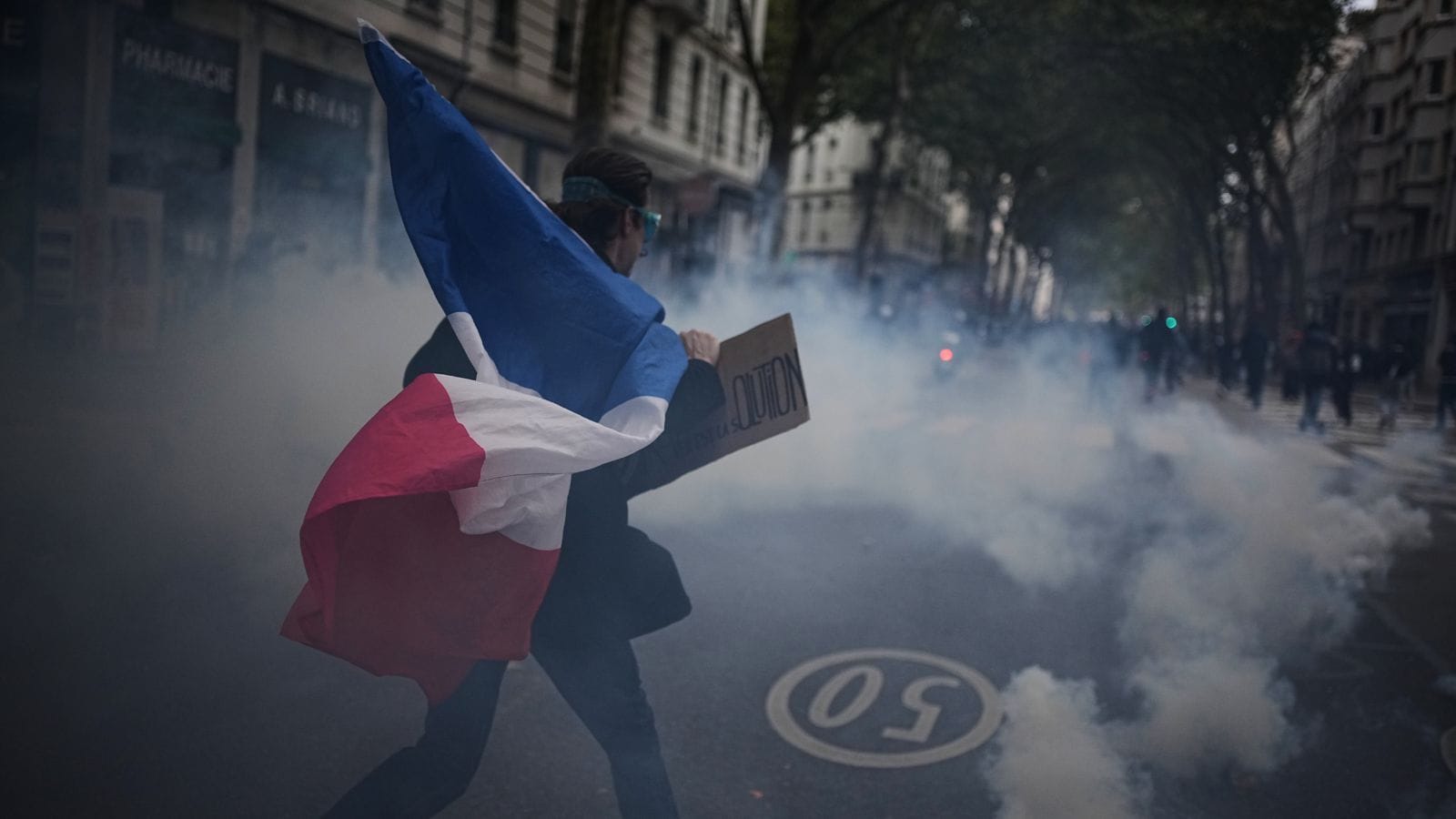
Operating on the periphery of peaceful marches are decentralized, tactical groups—often utilizing black-bloc formations and encrypted or ultra-left online coordination. Their objective is not policy negotiation, which Prime Minister Sébastien Lecornu attempted via accelerated minimum-wage hikes and promises to phase out Parcoursup by 2028. Their objective is systemic friction: provoking disproportionate police responses to generate viral imagery of state repression, thereby radicalizing moderate bystanders. When rumors of a demonstrator's death circulated online during the October 17 clashes—despite later proving unfounded—looting rapidly expanded to roughly 3,000 businesses within a 24-hour window.
Layer 3: The Sovereign Fiscal Constraint
Unlike the 2018–2019 Gilets Jaunes crisis or the 2023 pension protests, the French state in late 2026 lacks the fiscal buffer required to buy social peace. With public debt nearing 119% of GDP, the fourth-highest deficit in the eurozone, and an active European Commission excessive deficit procedure since 2024, Paris cannot issue unfunded subsidies to appease unions or students. Every concession offered to halt strikes directly widens bond spreads, triggering sell-offs in French sovereign debt and increasing borrowing costs.
The Containment Cost Function
Interior Minister Laurent Nuñez and Paris Police Prefect Patrice Faure have relied on a doctrine of preemptive spatial denial. This approach utilizes localized curfews, bans on gatherings outside closed schools, enforcement of anti-mask statutes, and legislative proposals that increase liability for protest organizers. Evaluating this strategy requires analyzing its direct economic and operational trade-offs.
- Direct Property and Commercial Attrition: Riot damage estimates have surpassed €1.2 billion. When urban commercial corridors—such as Rue Beaurepaire or major luxury retail boulevards in Paris—are forced to board up storefronts and operate under curfews, municipal tax receipts contract while retail revenue evaporates.
- The Insurance Transfer Mechanism: A planned 2027 riot insurance restructuring threatens to shift the financial burden of public disorder onto small business owners through elevated premiums. This creates a secondary political failure: the state fails to guarantee physical security for commercial operators, then penalizes those same operators financially to recapitalize the insurance pool.
- Law Enforcement Exhaustion: Deploying thousands of officers across simultaneous urban flashpoints—from Paris to Lyon and Limoges—produces acute operational fatigue. Over 1,000 police officers were injured during the October 17 peak alone. Sustained high-tempo crowd control degrades unit discipline, increasing the probability of tactical errors that reignite public outrage.
- Calendar Multipliers: Seasonal variables, such as Halloween night coinciding with scheduled marches, degrade standard intelligence and surveillance capabilities. When civilian populations naturally wear masks and congregate in urban centers after dark, distinguishing between routine holiday foot traffic and coordinated agitators becomes operationally impossible without imposing blanket lockdowns that paralyze urban economies.
Information Warfare and Algorithmic Amplification
A critical failure in traditional state containment is treating physical street control as separate from digital information velocity. During civil unrest, social media platforms function as real-time command-and-control networks as well as emotional accelerants.
- Latency vs. Verification: False or unverified claims—such as reports of fatal police brutality—propagate across short-form video platforms in minutes, whereas official Interior Ministry or watchdog investigations require days or weeks to verify facts. By the time an official correction is issued, the physical looting and arson triggered by the initial rumor have already occurred.
- The Censorship Paradox: Proposals by political figures such as former Prime Minister Gabriel Attal to temporarily restrict social media platforms during riots attempt to sever this amplification loop. However, shutting down mainstream communication channels during an active crisis drives users onto decentralized, unmonitored messaging applications while validating extremist narratives of authoritarian state overreach.
- Cross-Border Contagion: The unrest in France does not exist in isolation; youth-led demonstrations over economic stagnation and declining social mobility have simultaneously surfaced in Germany and Italy. This regional synchronization reflects a broader European structural dilemma: an aging demographic model colliding with stagnant real wage growth and automation-driven labor anxiety, which lowers the opportunity cost of street protest for younger cohorts.
Political Game Theory Ahead of the 2027 Election
Because President Emmanuel Macron's minority government lacks an absolute parliamentary majority following the 2024 snap election, legislative gridlock prevents structural reform. In this environment, every stakeholder is optimizing for the spring 2027 presidential contest rather than immediate stabilization.
- The Executive Dilemma: The administration must pass a 2027 budget that satisfies European Union fiscal rules without triggering a no-confidence vote that collapses the cabinet. Relying on strict law-and-order rhetoric projects authority to center-right voters, yet visible street chaos undermines the government's core competence claim.
- Asymmetric Opposition Gains: Both ends of the political spectrum extract electoral value from prolonged instability. On the far left, La France Insoumise (LFI) frames police crackdowns as systemic state violence, consolidating youth and urban working-class support—evidenced by Jean-Luc Mélenchon rising to second place in post-October 17 polling at 17%. On the far right, Marine Le Pen maintains a polling lead exceeding 30% by using images of burning city halls and looted shops to argue that the ruling establishment has lost sovereign control over the national territory.
Limitations of Legislative and Kinetic Escalation
The French Parliament's consideration of sweeping anti-riot legislation—introducing heavier penalties and collective liability mechanisms that human rights organizations warn will deter peaceful assembly—illustrates the diminishing returns of legal escalation.
- Deterrence Failure Against Non-Rational Actors: Strict liability laws and higher fines deter middle-class, peaceful participants who have assets and careers to protect. They do not deter radicalized youth or black-bloc operatives who already operate outside legal norms and conceal their identities.
- Hollowing Out Moderate Mediation: When peaceful protesters withdraw due to fear of legal entanglement or physical injury, the remaining crowd composition shifts entirely toward confrontation. Trade unions and student organizers lose their ability to police their own marches, leaving riot police facing an unfiltered adversary.
Strategic Forecast and Operational Imperatives
France will not achieve durable civil stabilization prior to the 2027 presidential election. Tactical policing, curfews, and localized bans will periodically suppress peak violence on specific weekends, creating the illusion of restored order, only for mobilization to reignite around subsequent budget votes, public-sector strikes, or viral policing incidents.
For institutional risk managers, commercial operators, and policymakers operating within the French market over the next six months, strategy must shift from reactive crowd avoidance to structural insulation:
- Commercial and Supply Chain Operations: Enterprises with physical footprints in major French urban centers must budget for recurring, 48-to-72-hour transit and retail interruptions tied to union strike calendars and weekend demonstrations. Inventory must be decentralized away from high-visibility downtown corridors, and commercial property coverage must be audited immediately ahead of the 2027 riot insurance premium repricing.
- Sovereign and Fixed-Income Exposure: Investors should price in persistent volatility in French government bonds (OATs). Because the minority government cannot simultaneously enforce EU-mandated deficit reductions and fund social pacification, fiscal slippage or sudden cabinet collapse via no-confidence motions remains the baseline scenario through spring 2027.
- State De-escalation Doctrine: For French authorities, breaking the escalation cycle requires decoupling legitimate sectoral negotiations from street policing. Concessions on education staffing and Parcoursup restructuring must be implemented visibly at the local lycée level before weekend marches occur, stripping radical agitators of the institutional cover provided by mass student and union grievances. Without removing the moderate mass from the streets, kinetic containment will remain a costly, losing battle of attrition.