Fatal general aviation accidents occurring inside high-security airspace corridors expose the structural friction between restricted flight zones, high-density terminal radar environments, and the operational margins of private jet transport. When a nine-fatality crash occurs near Palm Beach International Airport (PBI) and the adjacent Mar-a-Lago estate, immediate public coverage fixates on geographic proximity to a political landmark. A rigorous operational analysis requires stripping away geopolitical coincidence to examine the actual mechanics of the event: airspace geometry, Part 91 versus Part 135 regulatory baselines, terminal approach vectors, and the National Transportation Safety Board (NTSB) forensic reconstruction pipeline.
Because the competitor reference provides only a headline—"Nine dead after private jet crashes near Trump’s Mar-a-Lago (VIDEOS)"—with no underlying body text or verified flight telemetry, an intellectually honest breakdown cannot invent tail numbers, aircraft models, weather conditions, or crew credentials. Instead, this analysis establishes the exact operational and regulatory frameworks that govern any fatal private jet accident in the Palm Beach terminal area, separating verifiable structural constraints from unconfirmed variables.
The Geography of Proximity vs. Operational Causality
In aviation incident reporting, proximity to a high-profile landmark frequently distorts causal reasoning. Palm Beach International Airport sits roughly two miles west of the Atlantic coastline and directly adjacent to the town of Palm Beach, where Mar-a-Lago occupies a narrow barrier island strip between the Intracoastal Waterway and the ocean.
This geography creates an unavoidable spatial overlap. Standard instrument approach procedures (SIAPs) and visual arrival corridors for PBI’s primary east-west runways (Runways 10L/28R and 10R/28L) route aircraft directly over or immediately parallel to the barrier island. Any aircraft executing a final approach to Runway 28R from the east, or departing Runway 10L toward the east, operates within a 1.5-to-3-nautical-mile radius of the estate during its lowest-altitude, highest-workload flight phases.
To evaluate the incident accurately, analysts must separate spatial coincidence from airspace-induced causality:
- Spatial Coincidence: An aircraft experiencing an uncontained engine failure, asymmetric thrust, or flight control malfunction on short final to Runway 28R will naturally descend within the immediate footprint of Palm Beach Island. The landmark's presence is a geographic constant, not an operational trigger.
- Airspace-Induced Causality: The Federal Aviation Administration (FAA) enforces Temporary Flight Restrictions (TFRs) under 14 CFR § 91.141 whenever a current or former president with Secret Service protection is in residence. A Palm Beach TFR typically establishes an inner core (usually a 10-nautical-mile radius) banning non-approved general aviation traffic and an outer ring (out to 30 nautical miles) requiring discrete transponder codes, two-way radio communication, and active flight plans. Even when a TFR is inactive, PBI operates as a busy Class C terminal airspace beneath the Miami Air Route Traffic Control Center (ZMA) sector. Navigating compressed vectoring, rapid altitude step-downs, and wake turbulence separation behind commercial heavy jets increases cockpit workload.
Without confirmed radar tracks or FAA Notice to Air Missions (NOTAM) timestamps from the exact hour of the crash, assuming the TFR caused the accident is a logical fallacy. Conversely, ignoring how TFR vectoring compresses arrival corridors into narrow, low-altitude funnels misses a critical systemic stressor on flight crews.
Aircraft Class and the Nine-Fatality Capacity Threshold
The headline’s single hard data point—nine fatalities—immediately narrows the probable aircraft categories. Business aviation platforms do not scale uniformly; seating capacity dictates aircraft weight class, certification standards, and crew requirements.
A nine-fatality count (typically comprising two flight crew members and seven passengers, or a single pilot and eight passengers) places the airframe in one of three specific operational tiers:
- Light to Super-Light Business Jets: Platforms such as the Cessna Citation CJ4, Embraer Phenom 300, or Learjet 45/75. These aircraft routinely operate with a maximum certified capacity of 8 to 10 occupants. Crucially, several variants in this class are certified for single-pilot operations under Part 91, meaning an operator can legally fly up to eight passengers without a second qualified pilot in the right seat.
- Midsize Business Jets: Airframes like the Hawker 800XP, Citation XLS+, or Gulfstream G150. These require a two-pilot crew by type certificate and comfortably accommodate seven to nine passengers in standard club configurations.
- Heavy Turboprops: High-performance twin-turboprops such as the Beechcraft King Air 350i, which frequently carry nine occupants on short-to-medium regional hops into South Florida.
Identifying the exact airframe matters because the regulatory safety margin shifts dramatically depending on how the flight was operated.
The Part 91 vs. Part 135 Divergence
In United States civil aviation, two identically equipped private jets flying the exact same route into Palm Beach operate under fundamentally different legal and safety regimes:
- 14 CFR Part 91 (Private/Corporate Operations): Governs aircraft flown by owners, corporations, or non-commercial entities. Part 91 imposes no mandatory flight-and-duty-time rest limits on pilots, permits single-pilot operations in eligible jets regardless of weather complexity, and requires less frequent simulator-based recurrent proficiency checks.
- 14 CFR Part 135 (On-Demand Charter Operations): Governs commercial air carriers offering charter flights to the public. Part 135 enforces strict crew rest minimums, mandatory two-pilot crews for most passenger-carrying turbojet operations, tighter runway length landing margins (requiring aircraft to stop within 60% of the available runway length under dry conditions, compared to less restrictive operational planning under Part 91), and rigorous FAA operational specifications (OpSpecs) oversight.
When an incident results in nine fatalities, the first structural question for safety analysts is whether the flight was a commercial Part 135 charter or a private Part 91 flight. Statistically, commercial Part 135 turbojet accident rates track significantly lower than non-commercial Part 91 corporate and owner-flown jet operations, largely due to standardized crew resource management (CRM) and mandatory rest cycles.
The Four Phases of Terminal Approach Failure
Because the crash occurred near the airport perimeter rather than at cruise altitude, the failure sequence almost certainly unfolded within the terminal maneuvering or approach-and-landing phase. According to global commercial and business aviation safety data compiled by organizations like the Flight Safety Foundation, approach and landing account for roughly 15% of total flight time yet generate over 50% of all fatal accidents.
In the Palm Beach coastal environment, four primary failure mechanisms dominate terminal-phase investigations:
1. Loss of Control In-Flight (LOC-I) During Maneuvering
LOC-I remains the leading cause of fatal accidents in business aviation. In a coastal terminal environment like PBI, air traffic control frequently issues last-minute runway changes or tight base-to-final turns to sequence private jets between commercial airliners. If a crew overshoots the extended runway centerline and attempts to tighten the turn using excessive bank angle at low airspeed—while configured with approach flaps and landing gear extended—the aircraft’s stall speed increases exponentially with load factor. At altitudes below 1,000 feet above ground level (AGL), an aerodynamic stall or asymmetric wing drop leaves insufficient vertical distance for recovery.
2. Uncontained Powerplant Failure and Asymmetric Thrust
Twin-engine business jets are certified to climb out safely on a single engine following an engine failure at or above takeoff decision speed ($V_1$). However, surviving an engine failure during a low-altitude go-around or final approach requires immediate, precise pilot inputs: applying full thrust on the operating engine, arresting yaw with rudder input, pitching to the single-engine climb attitude, and retracting flaps and gear on schedule. Delayed recognition or improper rudder trim during a go-around near PBI can induce a $V_{mc}$ (minimum control speed) rollover, inverting the aircraft within seconds.
3. Coastal Micro-Weather and Wind Shear
South Florida’s coastal boundary generates rapid, localized convective activity and sea-breeze convergence zones. Unlike wide-area frontal systems, coastal microbursts or sudden wind shear events can produce a 20-to-30-knot headwind-to-tailwind reversal over a distance of less than one nautical mile. An aircraft stabilized on a 3-degree glide path experiencing sudden tailwind shear suffers an immediate loss of indicated airspeed and lift, causing a high sink rate close to terrain or water.
4. Bird Strike Ingestion
Palm Beach sits directly along the Atlantic Flyway, and the proximity of the Intracoastal Waterway, Lake Worth Lagoon, and coastal wetlands creates high concentrations of large wading birds, pelicans, and gulls. High-bypass turbofan engines ingesting multiple large birds at low altitude during initial climb or final approach can suffer simultaneous dual-engine thrust loss, forcing an immediate off-field landing in a densely populated urban corridor.
Limitations of Early Eyewitness Video Evidence
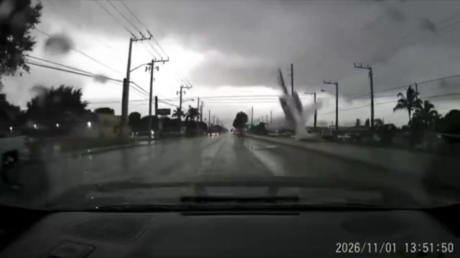
The competitor headline highlights "(VIDEOS)" as a primary value driver. In modern aviation reporting, bystander smartphone footage is ubiquitous within minutes of an impact, yet it introduces severe analytical distortion if treated as primary forensic evidence.
Eyewitness videos suffer from three inherent technical limitations:
- Frame-Rate Aliasing and Acoustic Lag: Consumer smartphone cameras capture video at 30 or 60 frames per second with rolling shutters, distorting propeller/fan blade appearances and obscuring high-frequency structural vibrations. Furthermore, at a distance of one mile, sound travels roughly five seconds behind visual events. Viewers routinely misinterpret post-impact ground explosions or acoustic echoes off coastal high-rises as mid-air engine detonations.
- Perspective Foreshortening: Ground-based cameras lack depth perception cues against an overcast or bright coastal sky. An aircraft executing a steep, bank-angle turn toward the camera appears to be falling vertically, leading untrained observers to report that the aircraft "dropped straight out of the sky" when radar telemetry later confirms a controlled, albeit steep, descent angle.
- Absence of Pre-Trigger Context: Bystanders almost never begin recording until an anomaly is already audible or visible—such as trailing smoke, an abnormal engine pitch, or an unusually low altitude. Consequently, video captures the terminal consequence (the final 3 to 8 seconds) while missing the initiating mechanical or human factors trigger that occurred 60 to 180 seconds earlier.
The Forensic Reconstruction Pipeline
To move from raw headline reporting to verified root cause, investigators follow a strict evidentiary hierarchy governed by International Civil Aviation Organization (ICAO) Annex 13 protocols and NTSB investigative procedures.
[Initial Emergency Response & Site Security]
                     │
                     ▼
[Perishable Evidence Recovery: FDR, CVR, ADS-B Logs]
                     │
                     ▼
[Wreckage Diagramming & Powerplant Teardown]
                     │
                     ▼
[Human Factors & Maintenance Log Audit]
                     │
                     ▼
[NTSB Preliminary Report (10–14 Days) -> Final Report (12–24 Months)]
- ADS-B and Primary Radar Extraction: Within hours of the crash, investigators pull Automatic Dependent Surveillance-Broadcast (ADS-B) telemetry and FAA Airport Surveillance Radar (ASR-9) data. This establishes exact groundspeed, geometric altitude, vertical rate of descent, and heading changes at one-second intervals, immediately confirming or refuting eyewitness claims of mid-air breakup or erratic maneuvering.
- Flight Data Recorder (FDR) and Cockpit Voice Recorder (CVR) Interrogation: Not all private jets carry both recorders. Under FAA rules, turbine-powered aircraft with fewer than 10 passenger seats are generally not required to carry a Flight Data Recorder, though multi-engine turbine aircraft with six or more passenger seats requiring two pilots must carry a Cockpit Voice Recorder. If the aircraft was a 9-seat light jet operated single-pilot under Part 91, investigators might find neither a CVR nor an FDR, forcing reliance on non-volatile memory chips inside avionics units (such as Garmin G1000/G3000 or Honeywell Primus flight management systems) to extract engine parameters and flight control positions.
- Powerplant and Actuator Teardown: Metallurgists examine turbine blades and compressor stages. Blades bent opposite the direction of rotation indicate the engine was producing high power at the moment of impact—ruling out total engine failure and shifting focus toward aerodynamic stall, spatial disorientation, or flight control failure. Conversely, straight or minimally deformed blades point toward an unpowered impact.
Strategic Framework for Evaluating Breaking Aviation Incidents
When analyzing high-visibility private aviation crashes near sensitive infrastructure, observers, risk analysts, and media editors must resist narrative speculation and execute a disciplined verification sequence:
- Verify the Registration and Regulatory Part: Cross-reference the aircraft's N-number against the FAA Registry to determine the exact airframe make, model, year of manufacture, and registered owner. Immediately cross-check the operator against the FAA Part 135 Air Carrier database to establish whether commercial charter safety standards or private Part 91 rules applied.
- Audit Active Airspace Restrictions: Pull historical NOTAM archives for the destination airport at the exact Zulu (UTC) timestamp of the accident to confirm whether a Presidential TFR was active, and identify which runways and instrument approach procedures were in use based on archived METAR surface weather observations.
- Anchor Analysis to Telemetry Over Video: Treat bystander footage strictly as corroborative evidence for post-impact fire, weather visibility, and surface wind direction. Base all flight-path and structural integrity assessments exclusively on verified ADS-B tracks, ATC audio recordings, and official NTSB preliminary factual releases.