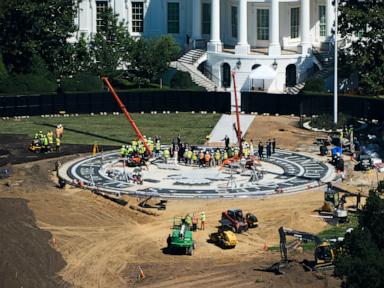
Capital asset projects commissioned by sitting executives frequently blur the boundary between state function and personal legacy. When Donald Trump led reporters onto the South Lawn to inspect ongoing construction of a heavy-duty granite helipad and a multi-hundred-million-dollar ballroom, the event served as a case study in executive project management intersecting with public administration. Beyond the immediate media narrative of an unconventional press briefing, these simultaneous developments—the South Lawn helicopter landing zone and the expansive ballroom structure—represent a specific intersection of engineering constraints, procurement strategy, and political signaling.
The Structural Mechanics of Executive Infrastructure
The decision to replace traditional asphalt and standard concrete with white granite on the South Lawn is framed by the administration as a matter of structural longevity and material superiority. From an engineering standpoint, material specification dictates lifecycle maintenance costs.
- Compressive Strength Profiles: The administration emphasized a material specification rated for thirty-five thousand pounds per square inch of pressure. Standard commercial concrete operates at lower baseline thresholds, meaning heavy transport and recurring rotor downwash create cumulative fatigue that degrades softer aggregate over time.
- Thermal and Mechanical Durability: Asphalt exhibits plastic deformation under high ambient summer temperatures and concentrated static loads. Replacing transitional pathways and landing surfaces with dense igneous stone eliminates the rutting and thermal softening associated with petroleum-based binders.
- Operational Geometry: Adjusting the grading of the helipad to ensure a flat landing plane addresses pilot ergonomics and safety margins during vertical flight operations, particularly given the increased weight class of modern Marine One aircraft variants.
These technical choices reflect a developer's mentality applied to federal real estate. However, public infrastructure projects within the Washington monumental core must navigate variables distinct from private commercial development, including federal review boards, historic preservation constraints, and judicial intervention.
The Cost Function and Regulatory Friction of the Executive Ballroom
The construction of the $400 million executive ballroom introduces a different set of administrative friction points. Large-scale capital outlays on federal property typically require explicit congressional appropriations. When executive projects proceed in the face of legal challenges and pending judicial reviews—such as scrutiny from appellate and supreme courts regarding authorization and funding mechanisms—they generate distinct operational risks.
- Capital Allocation Pathways: Attempting to secure funding through alternative military and security justifications—including proposals integrating anti-drone architecture into the ballroom complex—illustrates how project sponsors reframe civilian entertainment spaces as national security assets to bypass budgetary bottlenecks.
- Timeline Compression: Rushing construction phases to meet hard deadlines, such as an impending state visit by Chinese President Xi Jinping, introduces execution risk. Accelerated project schedules compress curing times, quality assurance inspections, and administrative sign-offs.
- Jurisdictional Conflicts: The ongoing friction between judicial injunctions and continuous construction activity highlights a breakdown in traditional administrative oversight, where executive momentum tests the limits of judicial enforcement on federal grounds.
Signaling Value and Diplomatic Stagecraft
Infrastructure projects executed within the executive mansion function simultaneously as physical utilities and diplomatic signaling devices. The timing of the South Lawn improvements, explicitly slated for completion ahead of high-level foreign engagements, serves an instrumental purpose in international statecraft.
Physical scale and material permanence project state capacity. By showcasing heavy granite installations and permanent architectural additions to visiting heads of state, the administration utilizes the built environment to communicate permanence, economic capability, and executive agency. This strategy relies on tangible, highly visible capital improvements to anchor political narratives in physical reality rather than abstract policy metrics.
Prioritize procurement strategies that decouple executive legacy projects from accelerated political timetables to minimize structural compromise and legal exposure.