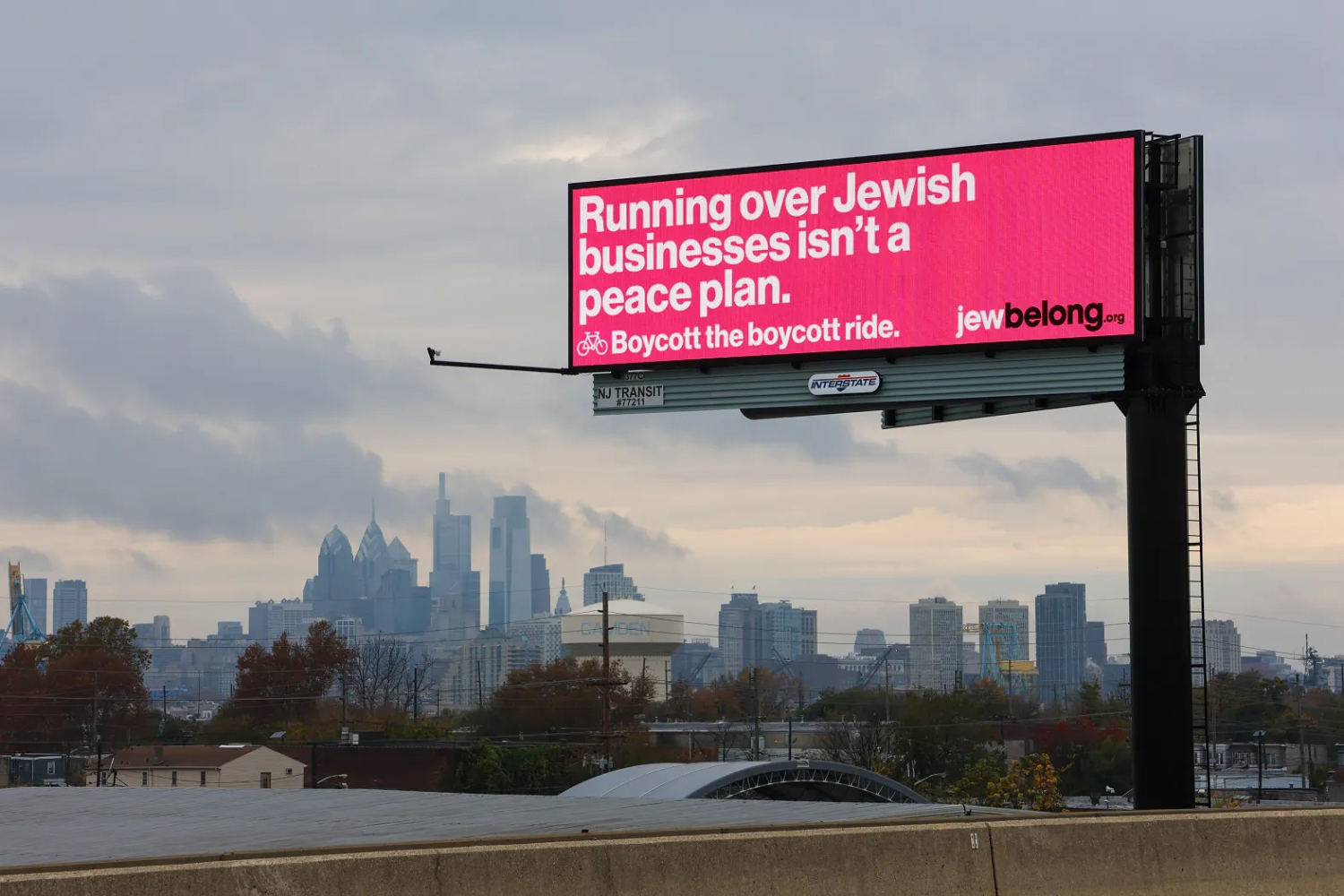
Walk down a busy highway corridor in almost any major metro area right now, and you'll notice something unusual towering above traffic. Instead of the usual personal injury lawyers or fast-food combos, massive digital billboards are urging drivers to "boycott the boycott" of Jewish-owned businesses.
It's a sharp pivot in how advocacy groups fight economic pressure. For years, grassroots campaigns and online lists have targeted local bakeries, bookstores, cafes, and tech startups simply because their owners are Jewish or maintain ties to Israel. Now, counter-campaigns are taking that fight offline and putting it in 40-foot letters along commuter routes.
Honestly, this isn't just about advertising. It's a direct collision between digital cancel culture, local small-business survival, and how communities push back against economic discrimination in the real world.
What Sparked the Boycott the Boycott Billboard Push
You don't spend tens of thousands of dollars on out-of-home advertising unless digital channels are failing you. That's basically what happened here.
Over the past couple of years, neighborhood storefronts across North America and Europe have faced coordinated online review-bombing, sidewalk protests, and viral spreadsheet lists telling consumers where not to shop. Many of these targeted businesses aren't multinational corporations shaping foreign policy. They're family-owned delis, independent clothing boutiques, and local service providers run by Jewish entrepreneurs.
When small businesses get hit with coordinated boycotts, social media algorithms rarely help them recover. Outrage travels faster than nuance. A single viral post accusing a local cafe owner of political ties can tank weekend foot traffic overnight, even when the claims are completely false.
Advocacy organizations, business coalitions, and individual donors realized that fighting back on X, TikTok, or Instagram meant playing on a tilted field. So they bypassed the algorithms entirely. By buying physical billboard space in high-traffic urban neighborhoods, these campaigns force a simple, unavoidable message into the daily commute of hundreds of thousands of residents who might never see a counter-post online.
Why Physical Billboards Work Better Than Online Counter-Campaigns
If you've ever managed local marketing or grassroots outreach, you know how easy it is to scroll past a sponsored post. Your thumb moves in half a second.
Billboards don't have a mute button.
According to data consistently cited by the Out of Home Advertising Association of America (OAAA), physical billboards reach commuters repeatedly along predictable daily routes, building familiarity through sheer physical presence rather than algorithmic targeting. When someone drives past a sign urging them to support local Jewish-owned businesses five days a week on their way to work, the message sticks differently than an angry thread online.
There's also a psychological shift happening here. Boycotts rely heavily on social pressure—making shoppers feel guilty or nervous about walking through a store's front door. A massive public billboard flips that script. It signals to everyday shoppers that supporting these businesses isn't fringe or controversial; it's mainstream community solidarity.
Think about what happens to a small business owner watching protesters outside their window. Seeing a billboard two blocks away actively defending their right to do business changes their calculus. It tells them they aren't isolated.
The Difference Between Political Boycotts and Targeting Local Storefronts
This is where things get messy, and we shouldn't pretend otherwise. Economic boycotts have a long, complicated history in democracies. Under U.S. law, peaceful consumer boycotts are generally protected as political expression under the First Amendment, a principle affirmed by the U.S. Supreme Court in landmark cases like NAACP v. Claiborne Hardware Co.
Nobody is arguing that consumers don't have the right to choose where they spend their money. You can boycott a brand over its labor practices, environmental record, or corporate political donations. That happens every single day.
The friction starts when boycotts stop targeting corporate policies and start targeting individuals based on ethno-religious identity. When activists circulate lists of "Jewish-owned businesses to avoid" in a local city—regardless of whether those businesses have anything to do with Middle East politics—the line between political protest and identity-based discrimination blurs fast.
Organizations like the Anti-Defamation League (ADL) and local Jewish federations have documented numerous instances where neighborhood businesses with zero connection to foreign governments were vandalized, harassed, or boycotted purely because of the owner's heritage or synagogue affiliation.
That distinction explains why the "boycott the boycott" messaging resonates beyond just one demographic. Even people who disagree sharply on international politics tend to recoil at the idea of blacklisting a local neighborhood bakery because of the owner's background.
How Buycotts Actually Impact Small Business Revenue
In economics, the opposite of a boycott is a "buycott"—deliberately spending money at a business to support it or counteract a protest.
Do buycotts actually save struggling storefronts? Yes, in the short term, though they come with real limitations.
When a community rallies around a targeted shop after seeing a billboard or local campaign, sales often spike dramatically for two to four weeks. Lines wrap around the block. Gift card purchases surge. Regulars bring friends who have never visited before. For a small restaurant operating on razor-thin 5% to 8% profit margins, a sudden wave of community cash can cover payroll and rent that might otherwise have been missed.
Here's the catch that anyone who's worked with small businesses knows well: hype fades.
A billboard can drive someone through the door once. It can't make them come back six months later if the coffee is lukewarm or the service is slow. The most successful counter-boycott campaigns understand this. They don't just ask people to make a one-time protest purchase; they push residents to discover genuinely great local businesses and turn them into permanent neighborhood habits.
What Critics and Skeptics Say About the Campaign
Not everyone thinks "boycott the boycott" billboards are a smart strategy. Even within Jewish communities and among free-speech advocates, there's real debate over whether this approach helps or backfires.
First, critics point out that billboards can inadvertently amplify the original boycott. If a neighborhood protest only had fifteen people standing on a corner, putting up a giant highway billboard tells half a million commuters that a boycott is underway. Some shoppers who never knew the business was targeted might suddenly view the storefront as a political battleground—and decide to avoid the drama altogether by shopping somewhere neutral.
Second, there's the cost factor. Prime digital billboard space in cities like New York, Los Angeles, Chicago, or Toronto can easily run from several thousand dollars to tens of thousands per month depending on impressions and location. Skeptics argue that pouring six figures into outdoor advertising delivers fewer tangible benefits than putting that exact same money directly into security grants, legal defense funds, or direct micro-grants for harassed business owners.
Third, some activists argue that framing the issue as "boycotting a boycott" gets bogged down in semantic cleverness rather than addressing the underlying hostility. If someone genuinely harbors prejudice, a catchy slogan on an interstate won't change their worldview.
Those are fair points. Advertising isn't a magic wand, and it doesn't solve deep ideological divisions. Still, ignoring public narrative battles has rarely worked well for vulnerable minority-owned businesses either.
How You Can Support Targeted Local Businesses Without the Performative Noise
If you drive past one of these billboards and want to do something that actually matters to a local business owner, skip the viral social media post and focus on actions that directly affect their bottom line and daily operations.
- Show up on a Tuesday afternoon, not just during viral surges. Weekend solidarity crowds are great, but predictable mid-week revenue is what keeps small retailers alive when the news cycle moves on.
- Leave detailed, authentic reviews on Google and Yelp. If a local shop has been hit with fake one-star review bombs, platforms often take weeks to remove them. Specific, honest reviews mentioning what you actually bought help bury coordinated spam and restore their search visibility.
- Buy directly instead of through third-party delivery apps. Delivery platforms take up to 30% in commission fees. Ordering in person or through the shop's own website ensures the owner actually keeps the revenue you're trying to give them.
- Recommend them for corporate catering or group orders. One $800 office lunch order does more for a local deli's monthly balance sheet than forty individual coffee purchases.
- Check in privately with the owners if you're a regular. Ask how they're holding up without demanding they perform their trauma for your social media feed.
Billboards are loud by design, meant to break through the noise of a crowded highway and force a moment of clarity. Whether the "boycott the boycott" campaign becomes a lasting model for local advocacy or remains a snapshot of a polarized moment, its real test won't happen on the side of an interstate—it'll happen at the cash registers of neighborhood shops long after the ads come down.