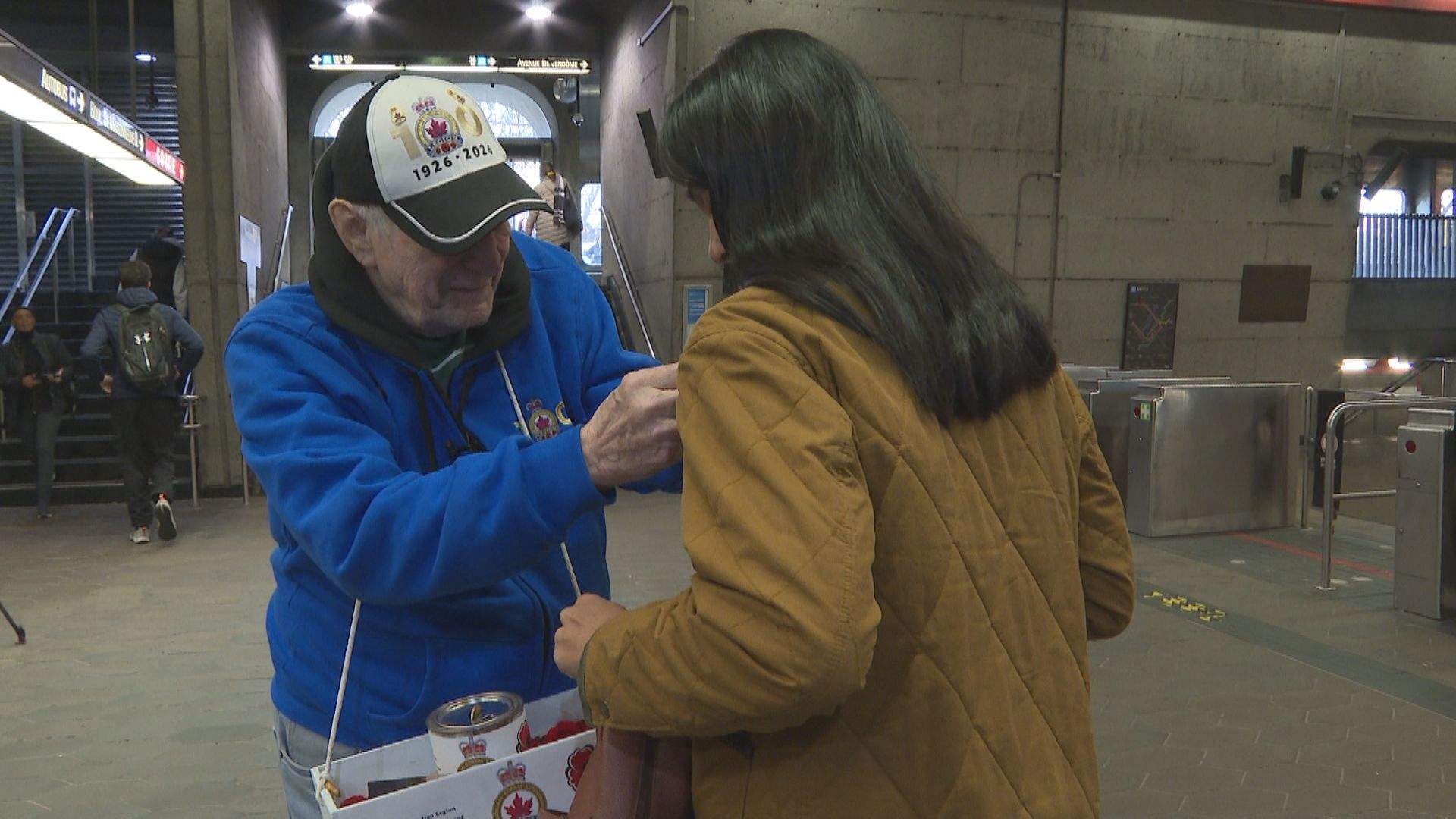
Every November, a quiet, red-felt ritual unfolds across Canadian transit hubs, shopping centers, and street corners. Yet when a 90-year-old military veteran distributing Remembrance Day poppies in a Montreal metro station reported being harassed by transit security, the resulting public outrage exposed a much deeper, systemic friction. The incident was not merely a misunderstanding between an elderly volunteer and an overzealous guard. It was the inevitable collision between rigid, liability-driven transit bylaws and a decades-old civic tradition that relies entirely on informal public goodwill.
To understand how an act of remembrance turns into a security confrontation, you have to look past the immediate emotional reaction and examine the mechanics of modern urban transit governance. Transit authorities operate under strict administrative frameworks designed to keep millions of commuters moving safely while insulating the agency from legal and financial liability. When those frameworks meet traditions that predate modern risk-management manuals, friction is guaranteed.
The Anatomy of a Public Relations Crisis
Transit security personnel do not wake up hoping to confront nonagenarians. They operate within a chain of command governed by standard operating procedures, municipal bylaws, and private-sector security contracts. In major metropolitan transit systems like the Société de transport de Montréal (STM), stations are technically public spaces, yet they are regulated as controlled environments.
Solicitation, fundraising, and the distribution of materials inside stations are heavily restricted. On paper, these rules exist for clear operational reasons. Unregulated solicitation creates bottlenecks near fare gates, increases the risk of crowd crush during peak commuting hours, and opens the door to aggressive panhandling or fraudulent charity drives. If an agency allows one group to set up a table or stand near a turnstile without formal clearance, it immediately faces legal challenges from other political, religious, or commercial groups demanding the exact same access.
This is the administrative trap. Bylaw enforcement relies on uniform application. The moment a security officer exercises personal discretion to waive a rule for a sympathetic figure, that officer risks disciplinary action from supervisors who audit compliance through CCTV footage and incident reports.
From the perspective of the veteran and the public, however, the enforcement looks entirely different. The Royal Canadian Legion's Poppy Campaign is not a commercial enterprise or a fringe political movement. For generations, veterans and cadets have stood in transit stations with trays of poppies, operating on an unspoken social contract. When an enforcement officer treats a 90-year-old veteran like an unauthorized vendor, the public perceives it as a profound failure of basic common sense and institutional respect.
Why Formal Permits Fail Informal Traditions
When controversies like this erupt, transit spokespeople almost always fall back on the same explanation. They state that the organization supports the cause, regrets any distress caused, and encourages volunteers to coordinate with station management in advance.
That response sounds reasonable in a press release, yet it misunderstands how grassroots volunteer drives actually function on the ground.
Consider a hypothetical scenario involving a local Legion branch organizing volunteers for the two weeks leading up to November 11. The branch coordinator is often an unpaid volunteer themselves, managing dozens of elderly members whose health, mobility, and weather tolerance dictate where and when they can stand on any given morning.
If a volunteer's usual outdoor post is sleeting or freezing, moving ten feet inside the glass doors of a metro entrance is a matter of physical safety, not a calculated breach of municipal code. Requiring a pre-approved, site-specific permit for every shifting micro-location assumes a level of corporate logistics that volunteer chapters simply do not possess.
Furthermore, large transit networks often suffer from internal communication breakdowns between executive leadership and frontline enforcement. Upper management may issue a broad directive welcoming Poppy Campaign volunteers across the network, while failing to ensure that shift supervisors, third-party security contractors, and newly hired constables actually read the memo before their morning patrol. The result is uneven enforcement. A veteran might stand unbothered at one station on Tuesday, only to be told to pack up and leave by a different officer at an adjacent station on Wednesday.
The Privatization and Militarization of Transit Security
Over the past two decades, the nature of security inside North American transit systems has shifted dramatically. Where stations were once patrolled primarily by career transit employees who knew their regular commuters by name, enforcement is now frequently split between sworn special constables with police-like powers and contracted private security guards.
This split creates two distinct behavioral problems during sensitive public interactions.
First, contracted security personnel often receive minimal training in de-escalation and discretionary judgment. Paid modest wages and instructed to follow strict post orders to the letter, they are conditioned to view any deviation from station rules as a binary infraction. To a guard whose primary metric for job performance is rule enforcement, a person standing near a stairwell without a visible lanyard or permit represents a compliance failure that must be cleared.
Second, sworn transit constables increasingly operate within a policing culture focused on threat assessment and rapid intervention. Transit systems in major cities have grappled with rising rates of visible homelessness, substance use, and unpredictable behavior in underground corridors. Officers spend entire shifts dealing with acute social crises, verbal abuse, and genuine safety threats.
When officers are conditioned to operate in a high-alert defensive posture for ten hours a day, switching gears to handle a benign, low-stakes situation requires deliberate cognitive restraint. Without explicit, ongoing training in community-oriented discretion, the default institutional response to any unscheduled activity becomes containment and removal.
The Myth of Neutral Enforcement
Transit agencies routinely defend strict bylaw enforcement by claiming they must remain neutral arbiters of public space. If they allow poppy distribution without a permit, what happens when an activist group wants to hand out flyers, or a local charity wants to collect cash donations?
This argument collapses under scrutiny because public institutions already make value judgments every single day. Transit networks routinely wrap buses in promotional campaigns, host sanctioned cultural events in major hubs, and partner with specific civic initiatives. Neutrality is not an absolute law of physics; it is a policy choice.
More importantly, the law itself recognizes the concept of de minimis—the principle that the law does not concern itself with trifles. A 90-year-old veteran standing quietly out of the flow of foot traffic, offering poppies by donation, poses zero threat to transit operations, passenger safety, or infrastructure integrity. Treating a trivial technical violation with the same procedural rigidity as an actual safety hazard destroys institutional credibility.
When an agency insists that its hands were tied by the rules, it is admitting that its rules are poorly written. Good governance builds explicit exemptions into operational manuals for predictable, annual civic traditions. It does not leave frontline workers guessing whether a widely recognized national symbol of remembrance constitutes illegal solicitation.
What Real Accountability Looks Like
Whenever a story about a mistreated veteran hits the local news cycle, the institutional playbook is entirely predictable. Within hours, the transit agency issues an apology. A senior official calls the veteran to express regret. The agency promises to review its protocols and remind staff of its commitment to supporting veterans.
Then, eleven months pass, and the exact same breakdown happens in another city, or at another station.
Apologies do not fix structural blind spots. If transit authorities want to prevent frontline personnel from humiliating elderly volunteers, they have to change the operational mechanics before November arrives.
- Blanket Network Authorization: Transit executives must issue a standing, system-wide operational directive every October that explicitly authorizes recognized Poppy Campaign volunteers across all stations, without requiring individual site permits or advance registration for shifting posts.
- Clear Spatial Guidelines Instead of Bans: Rather than banning volunteers from undesignated zones, station staff should be trained to assist them. If a veteran is standing in a spot that blocks a fare gate or fire exit, the officer's job is not to demand a permit or tell them to leave, but to help them move five feet to a safer, unobstructed alcove.
- Briefing Verification for Contractors: Any directive regarding civic traditions must be mandatory reading during daily roll call for both internal constables and external private security contractors, with supervisors held directly accountable if a frontline guard claims ignorance of the policy.
- Empowering Frontline Discretion: Management must explicitly protect officers from disciplinary blowback when they exercise common-sense leniency in non-hazardous situations. People follow incentives; if guards are only penalized for failing to enforce rules and never rewarded for sound judgment, rigid over-enforcement will always win.
Public trust in municipal institutions is fragile, built slowly through competence and lost instantly through arrogance. A transit system exists to serve the community that funds it, and part of that service is recognizing the cultural and historical fabric of the city itself. When a security apparatus becomes so obsessed with technical compliance that it cannot distinguish between a public nuisance and a 90-year-old veteran honoring his fallen peers, the problem is not the person holding the tray of poppies—it is a system that has forgotten who it works for.