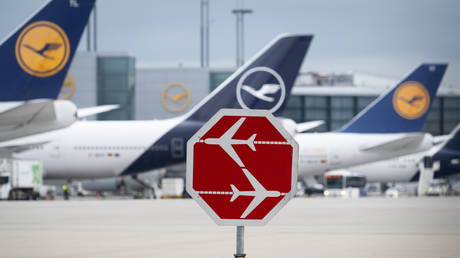
A single bomb threat in European airspace does not isolate an airport; it triggers a systemic contagion across an interconnected network operating near maximum capacity. When security protocols force an emergency diversion or terminal evacuation, the operational cost compounds exponentially through missed slot allocations, crew duty-time expirations, and aircraft misalignments that persist for days after the initial threat is cleared.
Understanding these events requires stripping away sensational reporting and examining the underlying architecture of European civil aviation. Standard news coverage focuses on immediate passenger delays and police cordons. Operational reality centers on network fragility, regulatory rigidity, and the asymmetric economics of threat response.
The Anatomy of a Network Contagion
European airspace is one of the most congested and fragmented transport grids in the world. Unlike the unified domestic airspace of the United States, European air traffic management spans dozens of national Air Navigation Service Providers (ANSPs) coordinated centrally by Eurocontrol. Within this structure, commercial airlines utilize tight turnaround schedules—often 25 to 45 minutes for short-haul carriers—to maximize aircraft utilization.
When a bomb scare occurs, the disruption follows a predictable four-stage operational cascade:
- Immediate Containment and Airspace Sterilization: Upon receiving a credible or unverified threat—whether via electronic communication, physical discovery, or crew report—authorities initiate mandatory containment. An airborne aircraft is diverted to the nearest designated security airport, often escorted by military interceptors to enforce compliance and monitor flight paths. On the ground, terminals are evacuated, establishing a sterile perimeter that halts all ramp operations, refueling, and baggage handling.
- Slot Forfeiture and Holding Patterns: European airports operate under strict slot coordination governed by EU Regulation 95/93. When a hub locks down, inbound flights enter holding patterns until fuel reserves dictate diversion to secondary airports. Outbound flights miss their Calculated Take-Off Times (CTOT). Because airspace sectors are metered to prevent controller overload, a missed slot pushes an aircraft to the back of the flow-management queue.
- Crew Duty-Time Expirations: Flight and cabin crews are bound by strict Flight Time Limitations (FTL) enforced by the European Union Aviation Safety Agency (EASA). A two-hour security lockdown frequently pushes a crew past their legal duty window. Even after security forces declare an all-clear, the aircraft remains grounded because the operating crew is legally barred from flying, and reserve crews are rarely positioned at secondary diversion airports.
- Asset Misalignment: Commercial airline schedules rely on specific tail numbers executing four to six legs per day. When Aircraft A is stranded in Lyon due to a threat, the subsequent flights scheduled for that specific airframe out of Frankfurt, Madrid, and Rome are canceled or severely delayed. The network loses structural integrity.
Threat Verification Protocols and the Asymmetric Cost Function
Security agencies operate under a zero-tolerance mandate regarding aviation explosives. This creates a severe economic asymmetry: an anonymous actor can deploy a hoax at near-zero financial and technical cost, forcing airlines, airport operators, and state security apparatus to absorb millions of euros in direct and indirect losses.
Security protocols do not allow authorities to dismiss threats based on statistical probability alone. Instead, threat assessment teams evaluate the specificity of the claim, the communication vector, and current intelligence baselines. However, until an aircraft is physically searched and every piece of cargo is re-screened, the threat must be treated as active.
The physical clearing process is governed by rigid procedures:
- Passenger and Carry-On Separation: Passengers are disembarked via mobile stairs at remote stands away from main terminals. They are screened individually before being bused to sterile holding areas.
- Hold Baggage Reconciliation: Under international aviation law (ICAO Annex 17), no bag may travel without its corresponding passenger unless subjected to advanced explosive detection screening. During a bomb scare, every container is offloaded, laid out on the tarmac, and physically matched to a manifest before canine units and explosive ordnance disposal (EOD) technicians inspect the items.
- Airframe Inspection: Specialized teams search the cabin, avionics bays, cargo holds, and wheel wells. Depending on the aircraft size—such as a narrow-body Airbus A320 versus a wide-body Boeing 777—a thorough sweep takes between three and six hours.
The distinction between a verified device and a hoax only alters the post-incident investigation. During the operational window, the resource drain and network paralysis are identical.
Known Facts Versus Operational Hypotheses in Developing Incidents
During the initial hours of a widespread European flight disruption, public information is fragmented. Separating verified operational parameters from analytical hypotheses is essential for assessing the true scope of the event.
Verified Operational Realities:
- Protocol Uniformity: Security lockdowns across Schengen and non-Schengen European hubs follow standardized EU and ICAO mandates. Simultaneous evacuations at multiple airports indicate either a coordinated threat campaign or a shared intelligence trigger distributed via Europol and national aviation authorities.
- Secondary Ripple Effects: Delays reported at unaffected airports are direct mathematical consequences of Eurocontrol flow restrictions and aircraft rotation failures, not necessarily indicators of localized threats at those secondary hubs.
- Financial Liability: Under EU Regulation 261/2004, security emergencies and bomb threats are classified as "extraordinary circumstances." Airlines are legally exempt from paying fixed cash compensation to passengers for delays or cancellations resulting from these events, though they remain obligated to provide duty-of-care essentials such as meals and hotel accommodation.
Analytical Hypotheses Requiring Verification:
- Threat Origin and Attribution: Early reports rarely confirm whether multi-airport threats stem from state-sponsored hybrid warfare, organized cyber-extortion groups, or isolated copycat actors. Attribution requires forensic tracing of communication metadata, which takes days or weeks.
- Systemic Vulnerability Exploits: While immediate disruptions appear random, attackers frequently target specific choke points—such as major transfer hubs during peak morning or evening banks—to maximize network friction. Confirming whether an incident represents targeted network warfare requires mapping the exact timestamps of the threats against airline wave schedules.
The Structural Limitations of Current Aviation Resilience
Airlines and airport operators attempt to mitigate these disruptions through operational buffers, yet fundamental structural constraints limit their effectiveness.
First, financial margins in European aviation prohibit maintaining large fleets of idle spare aircraft or excess standby crews at outstations. Capital efficiency demands high utilization. Building enough slack into a schedule to absorb a major hub shutdown without cascading cancellations would render routes unprofitable under normal operating conditions.
Second, physical airport infrastructure cannot easily expand sterile processing capacity. Remote stands, bus fleets, and EOD teams are sized for baseline traffic plus minor contingencies. When multiple wide-body aircraft divert simultaneously to a regional airport, ground handling capabilities saturate immediately, extending turnaround times from hours to days.
Third, digital threat vectors have outpaced legacy verification protocols. As anonymous email services, encrypted messaging, and spoofed telephony become ubiquitous, the barrier to issuing mass hoaxes drops. Aviation security frameworks were designed primarily to stop physical infiltration of airports and aircraft, leaving the system exposed to information-based denial-of-service attacks that weaponize the safety protocols themselves.
Strategic Execution for Network Operators and Corporate Travel
Organizations managing aviation logistics or corporate mobility cannot prevent external security threats, nor can they alter state-mandated lockdown protocols. Resilience depends entirely on pre-positioning decision-making frameworks before a disruption locks down communication channels.
For airline operations control centers, recovery speed hinges on immediate schedule pruning rather than attempting to salvage delayed rotations. Canceling select round-trip frequencies early frees up airframes and legal crew hours to protect core trunk routes, preventing a single-day security event from bleeding into a multi-day operational collapse.
For enterprise travel managers and logistics coordinators, mitigating exposure requires decoupling critical itineraries from single-hub dependencies. Booking point-to-point routes on carriers with decentralized crew bases, avoiding tight minimum connection times at major Schengen transfer hubs, and establishing pre-approved rail alternatives for intra-European corridors under 600 kilometers provide the only reliable insulation against the cascading paralysis of an airspace security shutdown.