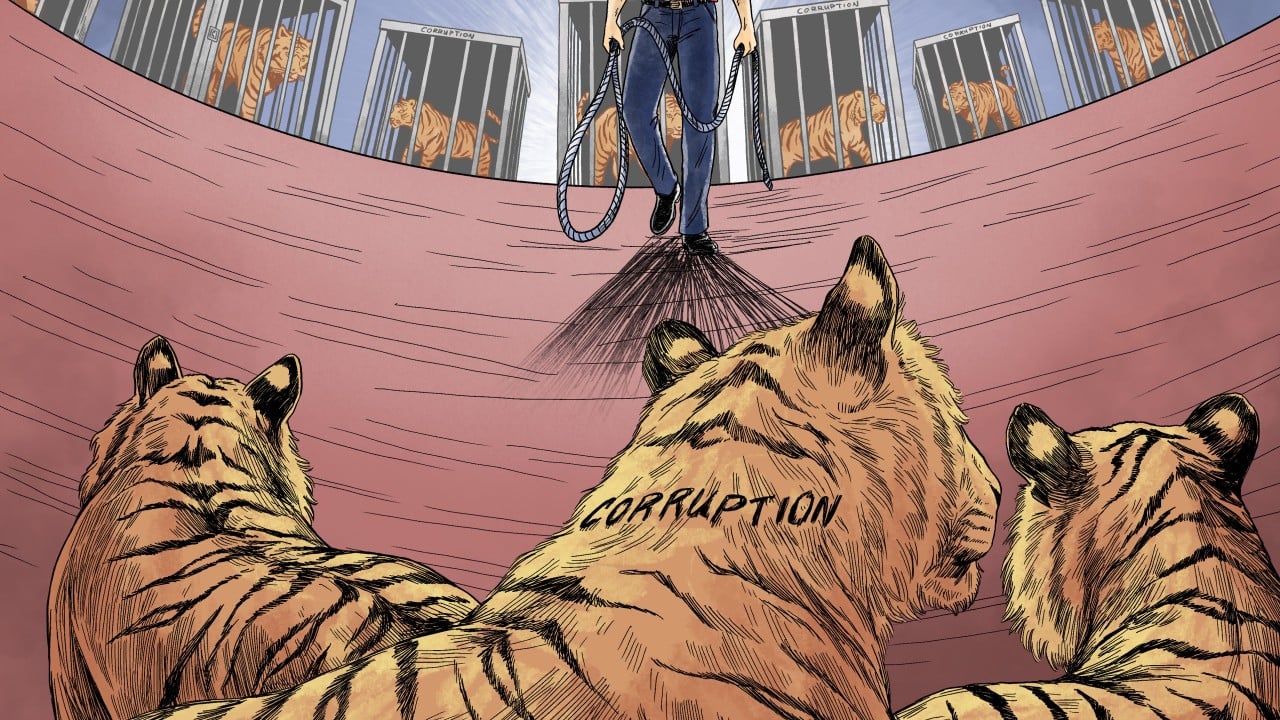
Western analysts have spent the last decade staring at China’s anti-graft campaign through a keyhole, obsessed with the "purge" narrative. They see a political theater of "tigers and flies"—the dramatic downfall of Politburo members and low-level bureaucrats alike—and conclude it’s merely a consolidation of power. They are wrong. They are missing the structural engineering beneath the political drama.
The "lazy consensus" suggests that Xi Jinping’s war on corruption is a drag on the economy, a wet blanket on the "animal spirits" of the private sector that has turned Chinese officials into paralyzed statues too scared to sign a permit. That view isn't just shallow; it’s economically illiterate.
If you want to understand the modern Chinese economy, stop reading political tea leaves and start looking at it as a massive, state-wide cleanup of a cap table. This isn't just a moral crusade. It is a ruthless, high-stakes recapitalization of the entire Chinese system.
The Rent-Seeking Tax You Never Calculated
For thirty years, the Chinese "miracle" carried a hidden, massive operational tax: the cost of informal networks. In the early 2000s, doing business in a Tier 2 city wasn’t about who had the best product. It was about who could satisfy the "rent-seeking" requirements of the local party boss.
Economists call this Transaction Cost. I call it a structural parasite.
When a local official takes a 10% "consulting fee" to approve a factory, that capital doesn't go into R&D. It goes into high-end Vancouver real estate or Swiss watches. It is capital flight disguised as a business expense. By aggressively dismantling these networks, the central government isn't just "punishing" people; it is forcibly lowering the cost of doing business for the firms it actually wants to succeed—the high-tech, strategic champions.
The "paralysis" critics complain about is actually the sound of a system being forced to migrate from Guanxi-based capitalism to Rule-based state capitalism. Yes, the transition is painful. Yes, bureaucrats are terrified. But a terrified bureaucrat is cheaper for a CEO than a greedy one.
The Myth of the "Chilled" Private Sector
The most common refrain in the Financial Times or The Economist is that the crackdown has "chilled" investment. This ignores the Darwinian reality of what is actually happening.
The state is no longer interested in subsidizing real estate speculators or "shadow banking" wizards who grew fat on cheap credit and political connections. The "chilling" effect is targeted. If you are building a 40th empty skyscraper in a third-tier city, the state wants you to feel a deep, existential frost. But if you are working on lithography, EV battery density, or synthetic biology, the state is your most aggressive angel investor.
I’ve talked to founders in Shenzhen who are relieved the old guard is gone. Under the old system, a startup could be hijacked by a local official’s son-in-law the moment it hit $50 million in revenue. Today, that risk has plummeted. The "predatory" nature of local government has been curtailed by the fear of a central inspection team showing up at 4:00 AM.
Efficiency Through Absolute Fear
Let’s be brutally honest about the mechanism: fear works. In a massive, sprawling bureaucracy, "soft" incentives fail. You cannot "foster" (to use a banned word) a culture of integrity in a system that has been lubricated by kickbacks for forty years. You have to break the machine and rebuild it.
The CCDI (Central Commission for Discipline Inspection) functions as the ultimate auditor. In any Western multinational, if an internal audit found that 20% of the regional VPs were skimming off the top, the CEO would be praised for firing them. When China does it, it’s called a "purge." This is a double standard that ignores the organizational necessity of the move.
The crackdown has effectively centralized the "take." Instead of thousands of small-scale "taxes" collected by local warlords, the state now dictates where the surplus value goes. It goes into the "Big Fund" for semiconductors. It goes into the high-speed rail network. It goes into the blue-water navy.
The Downside: The Competence Trap
There is a legitimate danger here, but it isn't what the Western media thinks it is. The risk isn't "stability"; it's competence.
When you remove the "incentive" of corruption, you find out very quickly who was a genius and who was just a well-connected bagman. The Chinese system is currently undergoing a massive talent audit. The "slackers" are keeping their heads down to avoid the CCDI's glare.
Imagine a scenario where a provincial governor has $5 billion to spend on infrastructure. In 2010, he’d spend it immediately because he’d get a 2% cut. In 2026, he’s terrified that if the project fails or if his chosen contractor has "issues," he’ll end up in a cell. So, he does nothing. This "nothingness" is the true threat to Chinese GDP, not the lack of "democracy."
But the central government knows this. That is why they are shifting the KPI (Key Performance Indicator) for officials. It is no longer just "GDP growth at all costs." It is now "High-Quality Growth" and "Technology Self-Reliance." They are replacing the "bribe" incentive with the "promotion" incentive, tied to specific, measurable technological milestones.
Why the "End of the Beginning" Narrative is Wrong
The competitor article asks if this is the "end of the beginning." That’s the wrong question. It assumes this is a temporary phase that will eventually conclude, returning China to some "normal" state.
It won't. This is the Permanent Revolution of Compliance.
The goal isn't to "fix" corruption and then stop. The goal is to build a digital, panoptic state where corruption is mathematically impossible. With the rollout of the Digital Yuan (e-CNY), every transaction becomes traceable. The "war on corruption" was the manual precursor to an automated, algorithmic governance system.
If you can track every penny in real-time, you don't need to send in the CCDI. You just flag the anomaly and freeze the account. This is the endgame. It’s not about morality; it’s about the ultimate optimization of state resources.
The Actionable Truth for Investors
If you are waiting for the "crackdown" to end so you can go back to the "good old days" of 2005, you will lose your shirt. Those days are dead.
The smart money isn't betting on the "thaw." The smart money is following the state's redirected capital.
- Stop looking at consumer tech that relies on bypassing regulations (the Didi/Ant Group model).
- Start looking at "Hard Tech" (semiconductors, material science, biotech).
- Understand the "Red Supply Chain." The companies succeeding now are those that have aligned their internal compliance with the state's audit-heavy reality.
The "corruption war" has effectively killed the middlemen. If your business model relied on a "fixer" in Beijing, you don't have a business; you have a liability. The new China is a place where you must be useful to the state’s strategic goals, or you are irrelevant.
The Western world keeps waiting for the Chinese economy to collapse under the weight of this "authoritarian" pressure. Instead, they should be worried about what happens when the world’s second-largest economy finishes its "recapitalization" and emerges with the leanest, most disciplined, and most strategically aligned corporate-state apparatus in human history.
The "tigers and flies" were just the noise. The signal is a state that has successfully reclaimed its own balance sheet.
Stop looking for the end of the war. Start looking at who won.
Identify the firms that thrived while their competitors were being hauled off to Qincheng Prison. Those are the ones that actually know how to build value without the crutch of a bribe. They are leaner, meaner, and coming for your market share.
Would you like me to analyze the specific sectors where the "Red Supply Chain" has gained the most ground since the 2023 CCDI expansion?