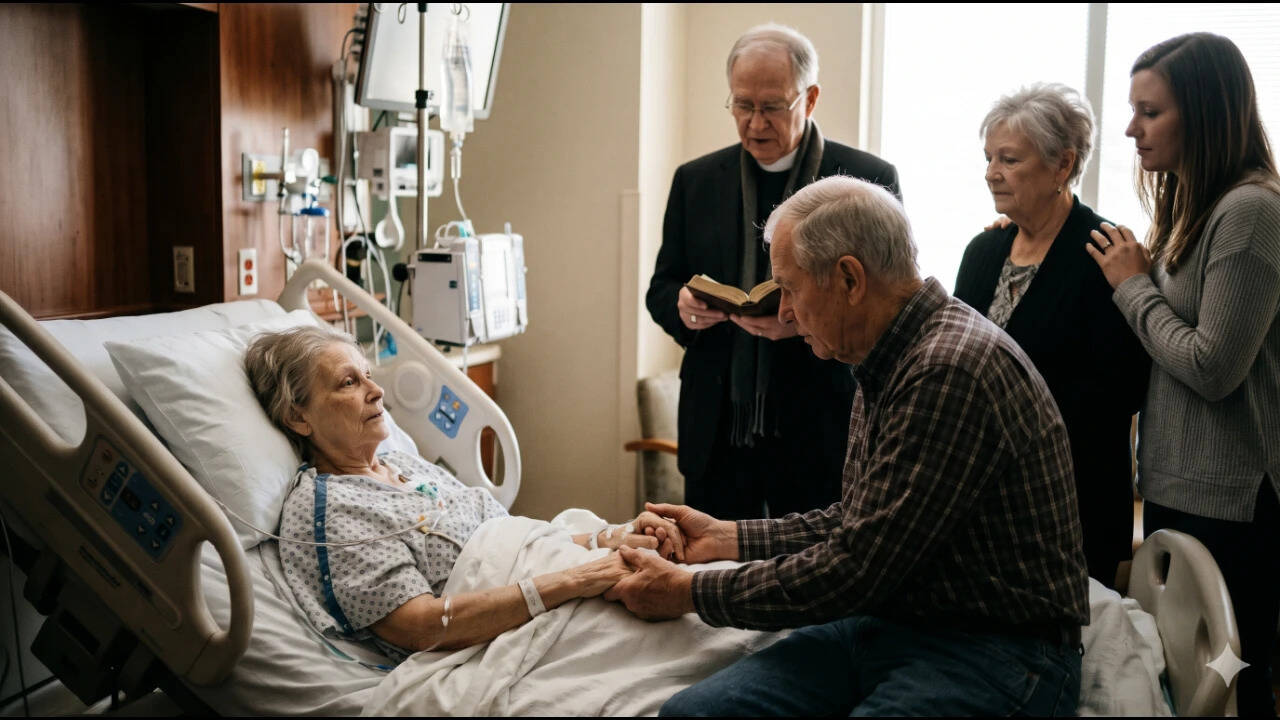
Everyone loves a tearjerker. A man rushes to a hospital bedside, slips a ring onto the finger of his dying partner, and beats the clock before the flatline. Months later, a cold, heartless probate judge voids the union, only for an appellate court to swoop in, reverse the ruling, and restore faith in humanity.
That is the lazy, Hallmark-card narrative media outlets peddle every time a deathbed marriage case hits the news wire. They frame it as a triumph of true love over bureaucratic red tape. They paint the lower court judges as villains lacking basic empathy and the surviving spouse as a romantic hero. Meanwhile, you can explore similar developments here: The Electoral Calendar Tug-of-War Behind Alberta's 2027 Election Debate.
They are completely missing the point.
When an appellate court validates a deathbed marriage, it isn't a victory for romance. It is an open invitation for probate litigation, elder financial abuse, and catastrophic estate battles that tear families apart for decades. If you think getting married in an intensive care unit is a noble gesture, you have never sat across the table from a forensic psychiatrist and three estate litigators billing $800 an hour while a grieving family dismantles itself over a 401(k). To understand the full picture, we recommend the excellent analysis by BBC News.
The Romantic Delusion vs. Statutory Reality
The competitor coverage of this appellate reversal treats marriage as a purely emotional covenant that the state merely rubber-stamps. That is legally illiterate.
Marriage, in the eyes of every jurisdiction in the United States, is a bilateral civil contract that instantly alters the distribution of property, overrides existing wills, triggers federal tax consequences, and rewrites survivor benefits. When you sign a marriage license, you are executing one of the most powerful financial instruments available to a private citizen.
In most states, a surviving spouse is automatically entitled to an "elective share" of the deceased’s estate—often between 30% and 50% of all assets—regardless of what the deceased wrote in their will ten years prior. If the deceased died intestate (without a will), the new spouse frequently inherits everything, completely disinheriting children from previous relationships, aging parents, or siblings who actually paid for the deceased’s medical care.
I have watched families lose generational homes because a grieving relative thought a last-minute hospital ceremony was "the right thing to do" without realizing they had just detonated a carefully structured estate plan. The lower court judge who originally voided that hospital marriage wasn't being cruel. That judge was looking at the statutory requirements of contractual capacity and statutory formalities—the exact guardrails designed to prevent someone from hijacking an estate while the owner is pumped full of fentanyl and morphine.
Why Appellate Reversals Create Dangerous Precedent
Let’s look at why the lower court voided the marriage in the first place, and why the appellate reversal is a double-edged sword.
To enter into a valid marriage, both parties must possess testamentary and contractual capacity. Under established legal standards—and clinical frameworks outlined by the American Bar Association and the American Psychological Association in their joint handbook on assessing diminished capacity—a person must understand the nature of the marriage contract, the duties and responsibilities it creates, and its effect on their property and existing relationships.
Now, picture an intensive care unit.
The patient is hypoxic. Their kidneys are failing, causing uremic encephalopathy. They are on high-dose opioids for pain management, or benzodiazepines to quell terminal agitation. Even if they appear lucid for a three-minute window, their executive functioning is severely compromised.
When a lower court voids a marriage performed under these conditions, it is applying strict scrutiny to protect a vulnerable adult. When an appellate court reverses that decision—often citing the "presumption of validity" that courts historically attach to ceremonial marriages—it lowers the evidentiary bar for everyone else.
Here is the nuance the feel-good news stories ignore: The law does not distinguish between a devoted partner of twenty years and a predatory caregiver who met the patient six weeks ago.
If the appellate standard says that a whispered "yes" between bouts of sedation is sufficient to overcome a lack of strict statutory compliance or questionable cognitive clarity, predatory opportunists will use that exact same precedent to validate sham marriages with wealthy, dying seniors. You cannot create a legal loophole exclusively for true love. Once the loophole exists, every con artist with a notary public and a hospital visitor badge will drive a truck through it.
Dismantling the "People Also Ask" Myths About Hospital Weddings
Whenever these stories go viral, search engines light up with questions from people wondering how they can pull off a last-minute ceremony if tragedy strikes. Most of the advice floating around online is dangerously wrong.
Can you get married in a hospital without a waiting period?
People assume hospitals have some kind of magical override switch for state marriage laws. They don't. Every state sets its own statutory waiting period between the issuance of a marriage license and the solemnization of the ceremony—ranging from zero days in states like Nevada and Texas to three days in states like Massachusetts and Pennsylvania.
While many jurisdictions allow a judge to waive the waiting period for "good cause" (such as terminal illness), you still have to get a judge to sign the waiver, obtain the physical license from a county clerk, and have an authorized officiant perform the ceremony while the patient is legally competent. Skipping any of these steps renders the marriage either void (never existed legally) or voidable (valid until successfully challenged in court). Relying on an appellate court to bail you out years later because you skipped a statutory step is a terrible legal strategy.
Does a deathbed marriage automatically override an old will?
In the vast majority of states, yes, functionally it does. Even if the deceased’s will leaves 100% of their assets to their children or a charity, a valid marriage after the execution of that will triggers "omitted spouse" statutes or elective share rights. The new spouse gets a massive cut off the top before the will is even probated.
If the dying partner genuinely wanted to provide for their partner, marriage is the clumsiest, slowest, and most litigation-prone tool they could possibly use. A simple Transfer-on-Death (TOD) deed, a payable-on-death bank beneficiary designation, or a properly witnessed codicil to a will takes ten minutes, requires zero county clerk involvement, and carries far less friction than trying to prove marital capacity in an ICU.
Is a deathbed marriage valid if the person dies hours later?
Legally, duration does not invalidate a marriage. A marriage lasting four minutes carries the exact same legal weight as a marriage lasting forty years, provided the formalities were met and both parties had capacity at the exact moment of consent.
Practically, however, a marriage that ends in death hours later guarantees a lawsuit. If there is a pension, a life insurance policy, a wrongful death claim, or real estate on the table, the deceased's blood relatives—or the pension administrator—will almost certainly sue to annul the marriage on the grounds of lack of capacity or undue influence. You aren't buying peace of mind; you are buying a three-year ticket to probate court.
The Invisible Victims: Pensions, Wrongful Death, and ERISA
To understand why these cases end up in appellate courts in the first place, you have to follow the money. Nobody spends $150,000 fighting an appeal over a sentiment. They fight over survivor benefits and wrongful death standing.
Under the Employee Retirement Income Security Act (ERISA), private-sector pensions and 401(k) plans are heavily regulated. Many defined-benefit pension plans have a strict "one-year marriage rule"—meaning you must be married for at least twelve months prior to the participant's death to qualify for survivor annuity benefits. A deathbed marriage does nothing to unlock those funds; it just creates false hope and massive legal bills when the plan administrator rightfully denies the claim.
On the flip side, look at wrongful death statutes. In almost every state, an unmarried partner—even one who lived with the deceased for thirty years and raised children together—has zero legal standing to sue for wrongful death if their partner is killed by medical malpractice or a drunk driver. Only a legal spouse, child, or parent can bring that claim.
This is the one scenario where a hospital marriage actually makes cold, hard tactical sense. If a partner is dying due to hospital negligence, marrying them before they pass transfers the legal standing to sue the hospital directly to the surviving partner.
Even then, doing it in the hospital bed puts a massive target on your back. The hospital’s defense attorneys will immediately subpoena every single medical chart, nursing note, and toxicology screen from the day of the wedding. They will hire neurologists to testify that the patient's Glasgow Coma Scale score made informed consent impossible. If they invalidate the marriage, the wrongful death lawsuit evaporates instantly.
The Brutal Truth About My Own Contrarian Stance
I am arguing against deathbed marriages, and I will be the first to admit the glaring flaw in my position: the law fails unmarried couples miserably.
If you spend twenty years building a life with someone without a marriage certificate, the state treats you like legal strangers. You don't get Social Security survivor benefits. You don't get the unlimited marital deduction for estate taxes. You don't get automatic medical decision-making power without a healthcare proxy. When tragedy hits, a hospital wedding feels like the only lever left to pull to fix decades of legal procrastination.
And sometimes, as this appellate ruling shows, it works. The surviving partner gets the legal recognition they deserved all along, and the court honors the obvious intent of two people who loved each other.
But winning an appeal is not a strategy. It is surviving a plane crash.
If you have to rely on three appellate judges reversing a trial court years after your partner’s funeral just to prove you were married, the system has already chewed you up, drained your savings, and turned your grief into public record.
What You Should Actually Do Before an Emergency Hits
Stop romanticizing eleventh-hour legal miracles and start treating your relationship like an enterprise that needs protection. If you are unmarried and committed to your partner, do not wait for a diagnosis to handle your paperwork.
- Execute Durable Powers of Attorney Immediately. You need both a Financial Power of Attorney and a Healthcare Proxy (Advance Directive). Without these, if your partner goes into a coma tomorrow, you won't even be allowed to talk to their doctors, let alone marry them.
- Audit Your Beneficiary Designations. Beneficiary forms on 401(k)s, IRAs, and life insurance policies supersede wills and marriage certificates in most circumstances. Make sure your partner is listed as the primary beneficiary today. It takes five minutes online and is nearly impossible to overturn in probate court.
- Use Transfer-on-Death (TOD) Titles. If you own property or vehicles together, check your state's laws on Joint Tenancy with Right of Survivorship (JTWROS) or TOD deeds. This moves assets outside of probate entirely upon death, bypassing the need for a marriage certificate to prove inheritance rights.
- If You Want the Legal Protections of Marriage, Get Married Healthy. Go to the courthouse on a random Tuesday while both of you have full cognitive capacity, zero opioids in your bloodstream, and plenty of time to sign a prenuptial agreement if you have children from prior relationships.
Leave the hospital rooms for doctors, nurses, and quiet goodbyes. If you bring a marriage license into an ICU, you aren't sealing a love story—you are filing the opening brief for a lawsuit.