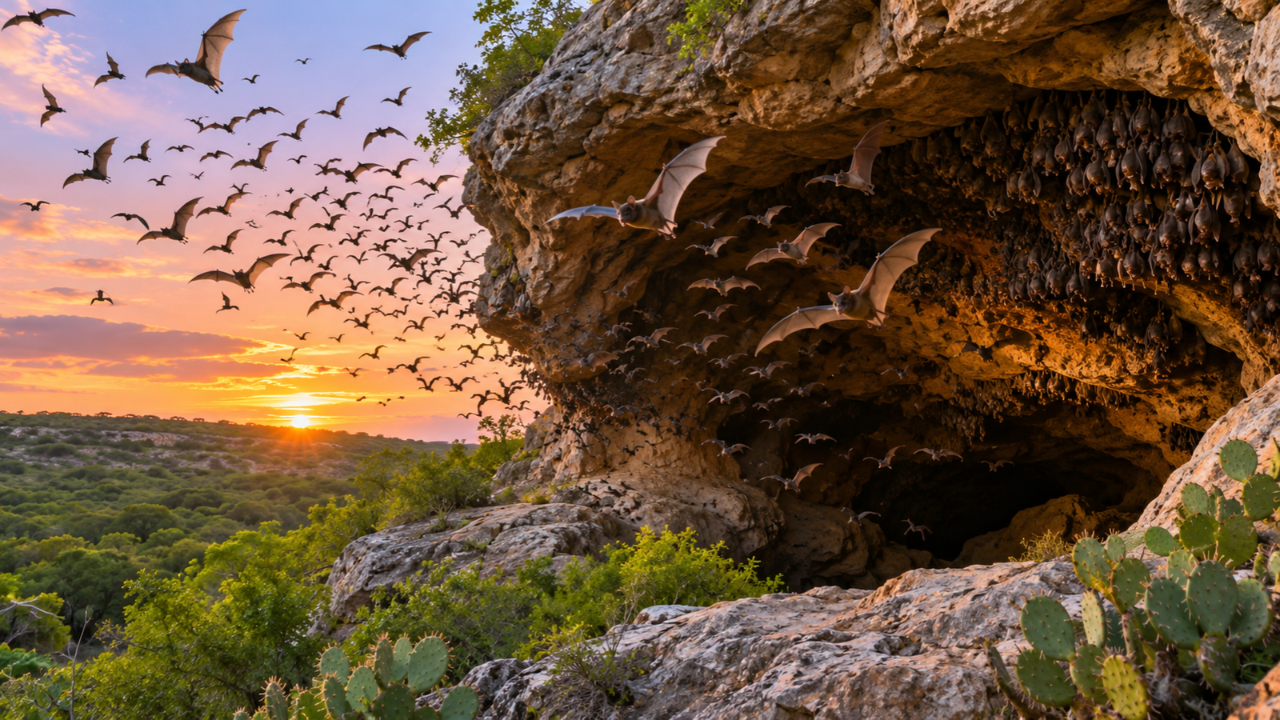
Everyone loves a heartwarming story about rich landowners signing over a pristine piece of Texas dirt to save millions of cute, fuzzy bats. It reads like a fairy tale. A wealthy family steps up, hands a historic cave to a conservation non-profit, and four million Mexican free-tailed mothers and pups live happily ever after.
Except they won't. Not if we keep treating conservation like a real estate transaction.
The mainstream press eats these press releases alive because they offer a clean, simple narrative with zero villains. Buying up land and putting a fence around a cave entrance is the lazy consensus of modern wildlife conservation. It lets donors slap their names on a plaque, gives non-profits a shiny fundraising brochure, and convinces the public that writing a check solves an ecological crisis. Meanwhile, the actual threats to those four million bats don't care who holds the deed to the surface acreage.
The Illusion of the Fortress
Look at the mechanics of a maternity roost like Bracken Cave or the historic caverns dotting the Edwards Plateau. Four million bats do not stay inside a dark hole all day. Every single evening at dusk, they pour out into the night sky and disperse across a foraging radius that stretches up to sixty miles in every direction. They fly thousands of feet into the air to hunt agricultural pests over cotton fields, corn rows, and sprawling suburbs.
Owning the cave protects the bedroom. It does nothing to protect the kitchen.
When a family donates a cave, the deed transfers the subterranean void and maybe a few hundred surrounding acres of scrub oak and limestone. That land represents less than one percent of the ecosystem those bats actually depend on to survive. You can surround that cave entrance with armed guards and gold-plated razor wire, and you still haven't stopped a single drop of neonicotinoid pesticide from wiping out their food supply thirty miles away. You haven't stopped a single wind turbine blade from shattering their spines during their autumn migration south into Mexico.
I have watched conservation groups spend decades and tens of millions of dollars locking up isolated parcels of habitat, only to watch the target species plummet anyway because nobody bothered to look at the broader industrial corridor. Protecting a single point on a map while ignoring the airshed and the agricultural matrix around it is like buying an expensive safe for your jewelry while leaving the front door of your house wide open.
Follow the Tax Write-Offs
Let's talk about the business side of these grand philanthropic gestures, because nobody in the wildlife press ever will. Land donations in Texas are rarely pure acts of selfless charity. They are sophisticated financial maneuvers wrapped in green ribbon.
Under Section 170(h) of the Internal Revenue Code, donating land or a qualified conservation easement to a land trust generates massive federal income tax deductions. For high-net-worth families sitting on appreciated ranchland outside booming corridors like Austin or San Antonio, handing over a rocky, unbuildable cave system—land that was a liability anyway because someone might fall in and sue—can wipe out millions in capital gains and income taxes.
There is nothing illegal about using the tax code. Smart families do it every day. The problem arises when conservation organizations and journalists confuse a tax-advantaged asset transfer with an actual ecological victory. When we applaud the donation as the finish line, we starve the unglamorous, expensive, politically toxic work of actual species management of the funding and attention it desperately needs.
What Happens When You Lock the Gate
Even on the ground, turning a working ranch cave into a strict nature preserve introduces a host of new problems that armchair environmentalists refuse to acknowledge.
For over a century, many of Texas's largest bat caves survived precisely because they were on private working ranches. Ranchers mined the bat guano for fertilizer, grazed cattle across the brush, and kept trespassers off the property with a shotgun and a locked gate. The ecosystem reached a rough, functional equilibrium.
When a non-profit takes over, the management philosophy shifts overnight. Suddenly, the goal is pristine preservation. Cattle are pulled off the land to let native grasses recover. Public education tours are scheduled to generate donor revenue.
Here is the catch. Removing grazing animals without replacing them with rigorous, expensive prescribed fire regimes turns Texas scrubland into a dense, impenetrable tinderbox of Ashe juniper. Wildfire risk spikes. Worse, bringing busloads of tourists and donors to the lip of a maternity cave—even with strict rules—introduces artificial light, noise, and human scent right at the critical moment when mothers are nursing pups that weigh less than half an ounce.
Bat Conservation International (BCI) and Texas Parks and Wildlife biologists know these risks well. They work tirelessly to balance public outreach with biological safety. Yet the pressure on non-profits to monetize their acquisitions through eco-tourism and donor junkets is relentless. A cave that used to see two ranch hands a month suddenly sees hundreds of curious visitors a week.
The Real Killers in the Dark
If you want to know what actually threatens four million Mexican free-tailed bats, stop looking at real estate deeds and start looking at three massive, interconnected failures in how we manage the skies.
1. The Wind Energy Meat Grinder
Texas leads the nation in wind power generation. Millions of bats migrating between Texas and central Mexico have to fly straight through a wall of spinning steel blades. Unlike birds, which frequently collide with turbines, bats suffer from both direct strikes and barotrauma—a phenomenon where the rapid drop in air pressure near moving turbine blades causes their delicate lungs to hemorrhage and burst internally. Research published in journals like BioScience and Biological Conservation has consistently estimated that wind turbines kill hundreds of thousands of bats across North America every single year. Donating a cave in the Hill Country does zero to stop a wind farm in South Texas from shredding those exact same bats six weeks later.
2. The Silent Insect Apocalypse
Mexican free-tailed bats are eating machines. A single colony of a million bats can consume roughly ten tons of insects in a single night, acting as a free, natural pest-control service worth billions of dollars to American agriculture. Yet modern industrial farming relies heavily on systemic pesticides that indiscriminately nuke insect populations across millions of acres. When the bugs vanish, the mothers cannot produce enough milk. Pups starve. They drop off the cave ceiling by the thousands onto the guano floor below, where flesh-eating dermestid beetles strip their bones clean in hours.
3. White-Nose Syndrome Creep
For years, biologists hoped the warmer climate of Texas would shield southern bat populations from Pseudogymnoascus destructans, the invasive fungus behind White-Nose Syndrome that wiped out millions of hibernating bats in the Northeast. That hope is dead. The fungus has already been detected in Texas counties, including on Mexican free-tailed bats. While free-tailed bats do not hibernate deeply like little brown bats, the presence of the pathogen in their roosts creates a massive vector risk for other vulnerable, cave-dwelling species across the Southwest. A deed transfer does not sterilize soil spores.
Dismantling the Common Myths
When stories like this hit the news cycle, the public immediately asks the wrong questions. Let's clear the smoke.
Should more wealthy families donate caves to save wildlife?
Only if the donation comes with a massive, permanent cash endowment to pay for active management, biological monitoring, and regional policy advocacy. Land without an operating budget is an albatross. Non-profits are drowning in "land-rich, cash-poor" properties they cannot afford to properly steward.
Do bats actually need human protection if they've survived for millions of years?
Yes, because they never evolved to deal with industrial-scale habitat fragmentation, chemical warfare on insects, or 400-foot-tall spinning blades in their flight paths. Bats reproduce painfully slowly—most species have just one pup per year. A single catastrophic mortality event takes decades for a population to recover from.
Does saving a bat cave help local farmers?
Only if the bats survive the trip to the farm. The economic value of bats to cotton and corn growers is staggering, documented extensively by researchers like Gary McCracken and Thomas Kunz. Protecting the roost while poisoning the foraging grounds is economic suicide for the agricultural sector.
The Uncomfortable Truth About My Stance
Let's be honest about the downside of pushing back against land donations. If we make it harder or less socially rewarding for wealthy landowners to donate property, some of them will simply sell to commercial developers. In rapidly urbanizing corridors like the Austin-San Antonio metroplex, a limestone cave left in private hands without protection can quickly become the centerpiece of a luxury subdivision, complete with bright security lights, feral cats, and clogged sinkholes.
Locking up the cave entrance is a necessary floor. It is not the ceiling.
How to Actually Save Four Million Bats
If conservation organizations, policymakers, and donors want to stop trading in feel-good press releases and start delivering measurable biological outcomes, the playbook needs a radical overhaul.
- Tie Land Donations to Corridor Easements: Stop celebrating isolated cave acquisitions. Conservation groups should prioritize paying working ranchers and farmers across the surrounding sixty-mile foraging radius to reduce pesticide use, maintain native brush corridors, and protect water sources.
- Mandate Turbine Feathering During Peak Migration: The single fastest way to save millions of bats is forcing wind energy operators to curtail turbine operations—known as "feathering" the blades—during low-wind nights in late summer and early autumn when bat migration peaks. Studies show this reduces bat fatalities by over 50 percent while costing wind operators less than 1 percent of their annual power output. It is a trivial cost for a massive ecological return.
- Keep the Public Out: Maternity caves are biological nurseries, not theme parks. Close them to casual tourism during the summer pup-rearing season. Use high-definition infrared cameras to stream the emergence online for donors and schoolkids instead of marching warm bodies up to the cave mouth.
- Fund the Boring Science: Shift donor dollars away from commemorative plaques and toward acoustic monitoring, radar tracking, and soil pathogen testing. You cannot manage a population you cannot accurately count or track across international borders.
Signing over a deed makes for a great photo op in the local paper. Real conservation happens at two in the morning in a dark cotton field fifty miles away, where nobody is handing out awards.