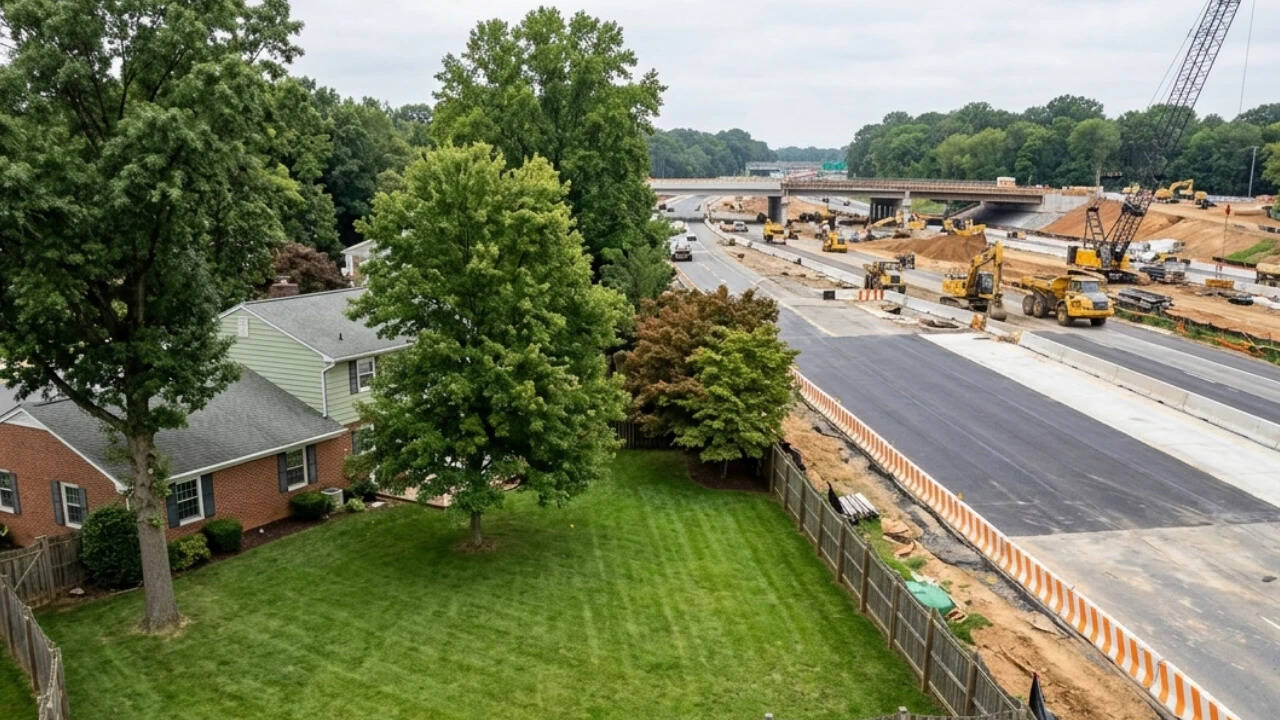
Property owners adjacent to major infrastructure projects routinely confuse economic loss with compensable legal injury. When a Virginia court dismisses a homeowner's claim regarding an adjacent highway expansion, the ruling rarely hinges on whether the property lost market value. Instead, it reflects a strict constitutional boundary separating direct physical appropriation from consequential neighborhood externalities. Understanding this boundary requires examining the mechanics of inverse condemnation, the legal definition of a compensable taking, and the structural asymmetry between public infrastructure utility and private residential equity.
The Constitutional Architecture of Eminent Domain in Virginia
The Fifth Amendment to the United States Constitution and Article I, Section 11 of the Virginia Constitution establish the baseline rule: private property shall not be taken or damaged for public use without just compensation. While Virginia's inclusion of the words "or damaged" places it among jurisdictions offering broader theoretical protection than the purely federal "taken" standard, judicial interpretation strictly constrains what constitutes compensable damage.
To prevail in an inverse condemnation action—where a property owner sues the government for uncompensated taking or damage—the plaintiff must prove an interference with a specific property right, not merely a reduction in the aesthetic or acoustic quality of the surrounding environment.
Direct Physical Invasion vs. Consequential Externalities
Legal systems divide infrastructure impacts into two operational categories:
- Direct Physical Takings: The state acquires title to a strip of land, establishes a permanent easement, or causes physical invasion (such as recurring flooding or structural vibration that cracks foundations). Compensation is mandatory, calculated as the fair market value of the taken parcel plus severance damages to the remainder.
- Consequential Damages (Damnum Absque Injuria): Loss without legal injury. When a highway expands within an existing right-of-way, or on land acquired from neighboring parcels, adjacent owners experience increased decibel levels, particulate emissions, glare from nighttime traffic, and obstructed sightlines. Unless these impacts rise to the level of a physical destruction of property rights—such as completely severing access to the public road network—courts classify them as general burdens shared by the public at large.
When a Virginia couple challenges a highway expansion that does not physically cross their property line, their claim collides directly with the damnum absque injuria doctrine. The law treats the proximity of a widened highway no differently than a neighbor constructing a lawful, albeit unsightly, commercial building on an adjacent lot.
The Three Pillars of Proximity Litigation Failure
Litigation over adjacent highway expansions almost always fails along three predictable structural fault lines. Property owners and their counsel frequently misallocate resources by focusing on valuation appraisals rather than threshold legal standing.
1. The Absence of a Property Right in the Status Quo
Homeowners purchase real estate under an implicit assumption of environmental stability, pricing quietude and scenic views into their acquisition cost. Legally, however, a property deed conveys a bundle of sticks—rights to exclude, possess, use, and transfer—none of which include a perpetual easement over light, air, view, or ambient noise levels across state-owned rights-of-way.
When the Virginia Department of Transportation (VDOT) widens a corridor, it exercises dominion over land it already owns or validly acquired. Because the adjacent homeowner never held a vested property interest in the buffer zone's prior state, altering that buffer extinguishes no legal right. Without the extinguishment of a recognized right, the constitutional trigger for compensation never fires.
2. The Special vs. General Injury Threshold
Under Virginia constitutional jurisprudence, compensable "damage" to property not physically taken requires proof that the injury is special and direct, rather than general and shared by the community.
- General Injury: Increased traffic volume, ambient highway roar, and regional air quality shifts affect every parcel along the corridor to varying degrees. The difference between a house 50 feet from the new shoulder and one 300 feet away is treated by courts as a difference in degree, not in kind.
- Special Injury: Access elimination illustrates the distinction. If a highway expansion erects a concrete barrier that entirely blocks a driveway, rendering the parcel landlocked, the injury is unique to that property and directly impairs the right of ingress and egress. Conversely, if the expansion merely converts a direct left turn into a circuitous half-mile U-turn, Virginia courts routinely classify the inconvenience as a non-compensable exercise of police power regulating traffic flow.
3. Sovereign Immunity and the Tort-Contract Divide
Property owners frequently attempt to bypass eminent domain limits by framing highway impacts as common-law nuisance or negligence. In Virginia, sovereign immunity shields the Commonwealth and its agencies from tort liability unless expressly waived by statute. The Virginia Tort Claims Act provides narrow waivers for specific negligent acts, not for the lawful, statutorily authorized design and construction of public highways.
Consequently, plaintiffs must route their claims through the self-executing constitutional guarantee of Article I, Section 11, which operates as an implied contract to pay for taken or damaged property. If the claim fails the strict constitutional test for a taking or special damage, sovereign immunity forecloses alternative tort remedies.
The Valuation Asymmetry in Infrastructure Expansion
The friction driving these lawsuits stems from a fundamental divergence between economic reality and legal rules of measurement. Appraisers and courts operate on different planes when assessing proximity impacts.
In open-market real estate transactions, buyers discount properties adjacent to multi-lane highways. High-decibel road noise, brake dust, and visual intrusion create measurable functional obsolescence, depressing resale prices by quantifiable percentages depending on distance, topography, and sound-barrier mitigation. To the homeowner, this equity erosion is concrete, immediate, and financially devastating.
In eminent domain valuation, however, market value diminution is merely a metric applied only after a compensable taking is established. If a state agency takes a one-foot strip of a homeowner's front yard to widen a road, Virginia law permits the owner to recover severance damages—which can include the loss in value to the remaining house caused by the closer highway. Yet if the exact same highway expansion stops one inch short of the property line, the compensation drops to zero.
This binary cliff creates profound horizontal inequity between neighbors:
- Parcel A (Partial Take): Loses two square feet of lawn to a slope easement. The owner unlocks the legal mechanism to claim tens of thousands of dollars in proximity and noise damages to the remainder of the residence.
- Parcel B (No Take): Sits at the exact same distance from the new travel lanes, suffers identical acoustic and visual degradation, but experiences zero physical boundary intrusion. The owner receives nothing.
Courts maintain this rigid boundary to prevent fiscal paralysis. If every property owner within earshot or sightline of a public infrastructure project could demand compensation for market-value fluctuations, the transaction costs and payout liabilities would render road, rail, and utility expansion financially impossible.
Operational Mechanics of Noise and Access Mitigation
Because direct financial recovery through litigation rarely succeeds without a physical take, the practical battleground shifts from the courtroom to the administrative and engineering phases of project development.
Federal and State Noise Abatement Frameworks
When highway projects receive federal funding through the Federal Highway Administration (FHWA), VDOT must execute a formal noise analysis under 23 CFR Part 772. This process operates entirely outside constitutional eminent domain, functioning instead as an administrative mitigation protocol.
- Noise Abatement Criteria (NAC): For residential areas (Activity Category B), the threshold for considering mitigation is typically an exterior noise level approaching or exceeding 67 decibels (dBA) during the loudest hour.
- Feasibility and Reasonableness: Even when modeled noise exceeds the NAC, VDOT only constructs sound walls if the barrier is both acoustically feasible (achieving at least a 5 dBA reduction for impacted receptors) and economically reasonable (falling below a strict cost-per-benefited-residence ceiling).
Homeowners who wait until construction begins to file inverse condemnation suits miss the only window where engineering concessions—such as earthen berms, shifted alignments, or sound walls—are practically achievable.
The Severance of Access Nuance
Litigation remains viable only when a project crosses the threshold from regulating traffic to destroying reasonable access. Virginia courts evaluate access claims by examining whether the property retains "reasonable and convenient" entry to the public road system.
If a commercial or residential parcel previously fronted a primary arterial road and the expansion replaces that frontage with a service road, no compensable taking occurs. The state owns the right to regulate traffic patterns under its police power. A claim gains traction only when the physical alteration leaves the owner with an access point incapable of supporting the property's highest and best use—such as narrowing an entrance so severely that standard residential or service vehicles cannot physically navigate the turn.
Strategic Allocation of Legal and Financial Capital
For property owners, real estate investors, and legal practitioners confronting adjacent infrastructure expansion, reacting to a completed project through inverse condemnation litigation is a low-probability, high-cost play. Capital and effort must be deployed upstream where leverage actually exists.
- Audit Title and Plat Boundaries Early: Immediately upon announcement of a corridor study, obtain the original subdivision plat, deed restrictions, and VDOT right-of-way plans. Determine whether the state already holds prescriptive easements or dedicated right-of-way width that absorbs the planned expansion without crossing your boundary.
- Target the Administrative Record During NEPA/Design Phases: Submit technical objections during the National Environmental Policy Act (NEPA) public comment period and design public hearings. Challenge traffic modeling, decibel receptor placements, and drainage calculations on the record. Once the Record of Decision is signed, design modifications become exponentially harder to extract.
- Isolate Physical Boundary Encroachments: Scrutinize construction plans for temporary construction easements, grading slopes, utility relocations, or altered stormwater runoff patterns. Any physical intrusion, however minor, crosses the constitutional threshold and converts a barred proximity claim into a viable partial-take severance claim.
- Execute Pre-Construction Exit or Hedge Strategies: Where plat audits confirm the expansion will occur entirely within existing state right-of-way and no physical intrusion will occur, recognize that legal recovery is functionally capped at zero. Owners facing unacceptable equity erosion should evaluate divesting the asset during the early planning phase—before heavy machinery mobilizes and market discounts fully price in the completed corridor—or negotiate collective neighborhood lobbying for sound wall inclusion rather than funding solo constitutional litigation.